Jebel Akhdar (the Green Mountain)
Jebel Akhdar, the "Green Mountain", is the inhabited high plateau of Oman's Hajar Mountains, at around 2,000 m, some 160 km and 2 hours by road from Muscat airport. People come for the cool air, the terraced villages of the Saiq Plateau, the rose season (late March to early May) and hiking. The road is open to 4x4 vehicles only, checked at a police post at the foot of the mountain.
Jebel Akhdar, Arabic for "Green Mountain", is the farmed plateau of the Hajar Mountains in the heart of Oman: at around 2,000 m, some 160 km and two hours' drive from Muscat airport, it has stone villages clinging to cliffs, terraces of pomegranate trees and roses, deep canyons and a handful of mountain hotels. It is 11 to 13 °C cooler than Nizwa, down on the plain, in every month of the year. Plan on two or three nights between October and April, or early May for the roses. Only four-wheel-drive vehicles are allowed up.
Getting up the mountain
The Birkat al Mouz checkpoint. The plateau road starts at Birkat al Mouz, an oasis at the foot of the massif about 120 km and 1 h 20 from the airport. A Royal Oman Police checkpoint controls the traffic: only four-wheel-drive vehicles are let through, and drivers must show their licence and the vehicle's registration papers. The rule was restated in 2022 by the Oman Observer, the English-language daily published by the Ministry of Information, and the Anantara, one of the plateau hotels, confirms it on its website in 2026. In 2022 the government also announced a future road from South Batinah open to all cars, with no opening date. Sabaro checks the rule before every departure.
The drive. Beyond the checkpoint, a paved mountain road climbs to the Saiq Plateau: allow 160 km and two hours from the airport without stops, or 2.5 hours according to the hotels. The hotels can arrange airport transfers and the checkpoint crossing for guests who prefer not to drive. Our Driving in Oman guide covers the road rules and the choice of vehicle.
Safety. Mountain roads are dangerous without a well-equipped 4x4, animals wander onto the road, and altitude sickness is possible in parts of Oman. Foreign ministries do not all give the same advice for Oman: yours is in the "Travel advice" table on this page, and our Oman travel situation guide compares them.
At the foot of the mountain: Birkat al Mouz
Birkat al Mouz deserves a stop on the way up. Bayt Ar-Ridaydah, a 17th-century fort built under Imam Sultan bin Saif (1649-1679), guards the mouth of Wadi Al Muaydin, 24 km from central Nizwa. It covers 6,761 m² over two floors, with a defensive wall and small corner towers, painted ceilings, carved gypsum and an inner well. Its position on the road to Jebel Akhdar gave it control of the caravan route.
The Falaj Al Khatmeen runs through its courtyard. A falaj (plural aflaj) is an irrigation channel that carries water from a spring or an underground source by gravity alone, sometimes over several kilometres. Al Khatmeen is one of five aflaj inscribed as a UNESCO World Heritage Site in 2006, standing for more than 3,000 systems still in use across the country; four of the five lie around the Jebel Akhdar massif. Water is still shared between families under old communal rules guided by the stars.
The Saiq Plateau and its villages
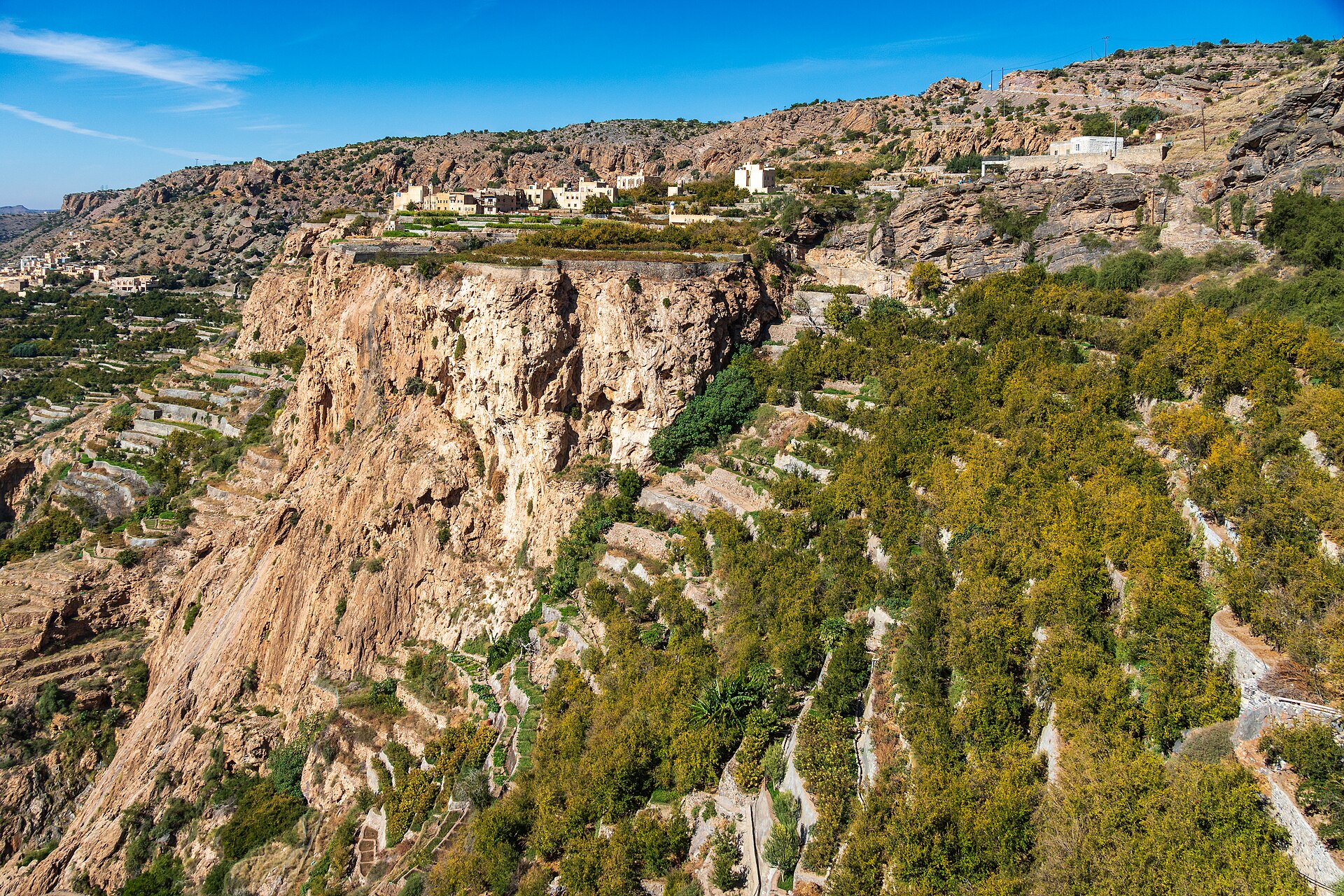
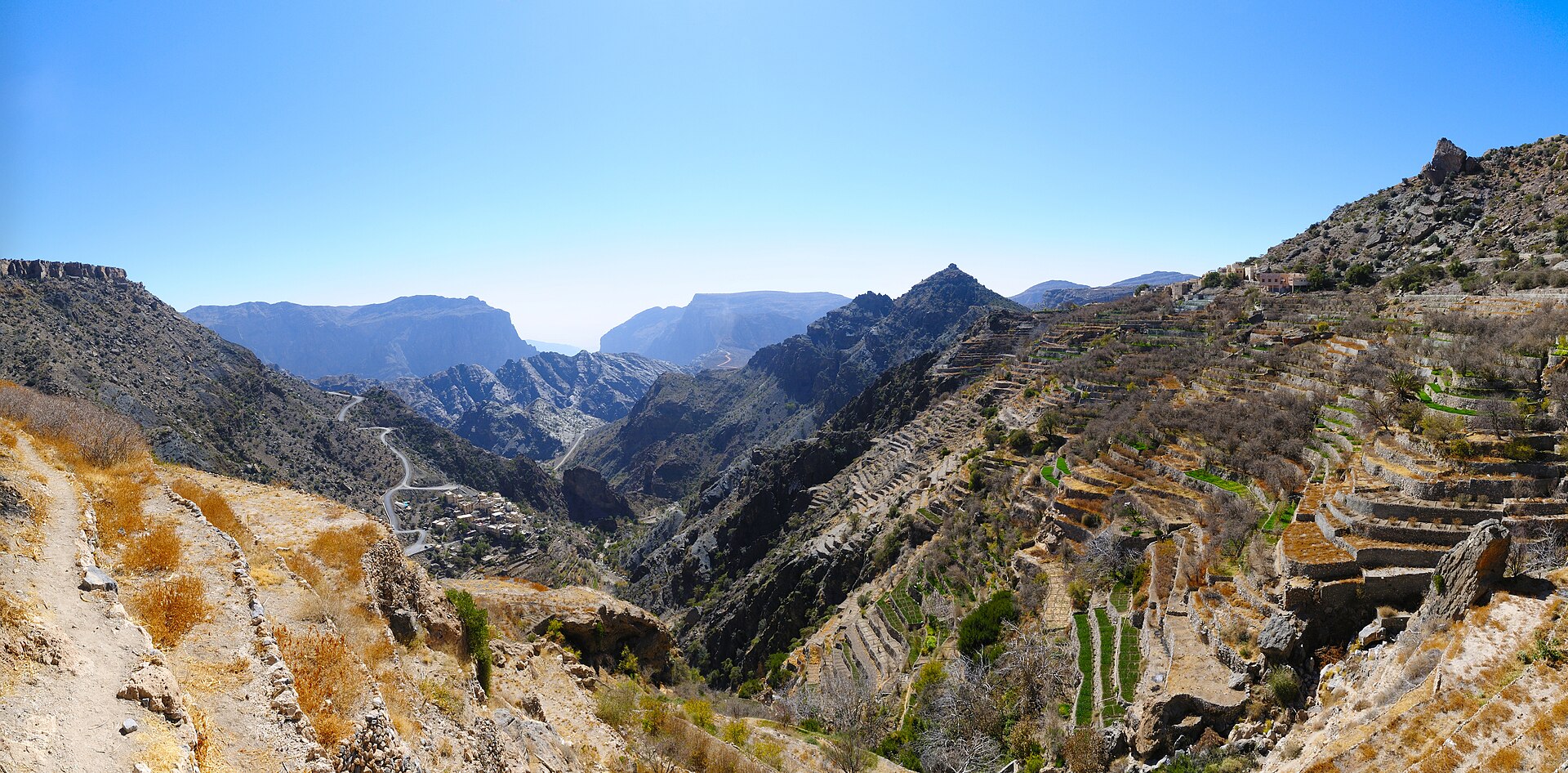
The Saiq Plateau, at around 2,000 m, is the inhabited, cultivated part of the mountain. Its villages are built of stone on the rim of the gorges, above terraces watered by aflaj.
Al Aqr, Al Ayn and Ash Shirayjah are the three best-known villages, linked by a cliffside path. Their terraces grow pomegranates, pears, grapes, garlic and onions, along with Damask roses. The Anantara runs this walk with an Omani guide who takes guests into mosques, majlis (reception rooms), lived-in and abandoned houses and a rose-water distillery. Al Aqr is the usual starting point for hikers, with views over Al Ayn, Ash Shirayjah and the neighbouring villages. Its residents are turning old houses into inns, cafés and museums; the Suspended Terraces Lodge opened there in September 2023, with eleven rooms in three traditional houses. Al Ayn, meaning "the spring", is built entirely in terraces around its springs.
Wadi Bani Habib is an abandoned mud-brick village on the cliffside. About twenty minutes on foot, then a descent down natural rock steps, bring you to the wadi floor, planted with walnut, apricot, almond, peach and pomegranate trees that farmers still come back to tend. More than fifty families once lived here; their houses are crumbling, but the small mosque, about 40 m², is still in use.
Fossils. The plateau's limestone holds marine fossils, corals, sponges and oysters, from a time when the mountain lay under the sea. The Oman Observer points to petrified tufa waterfalls west of Sayh Qatanah and, near the village of Ar Rus, a rock layer marking the great end-Permian extinction some 251 million years ago.
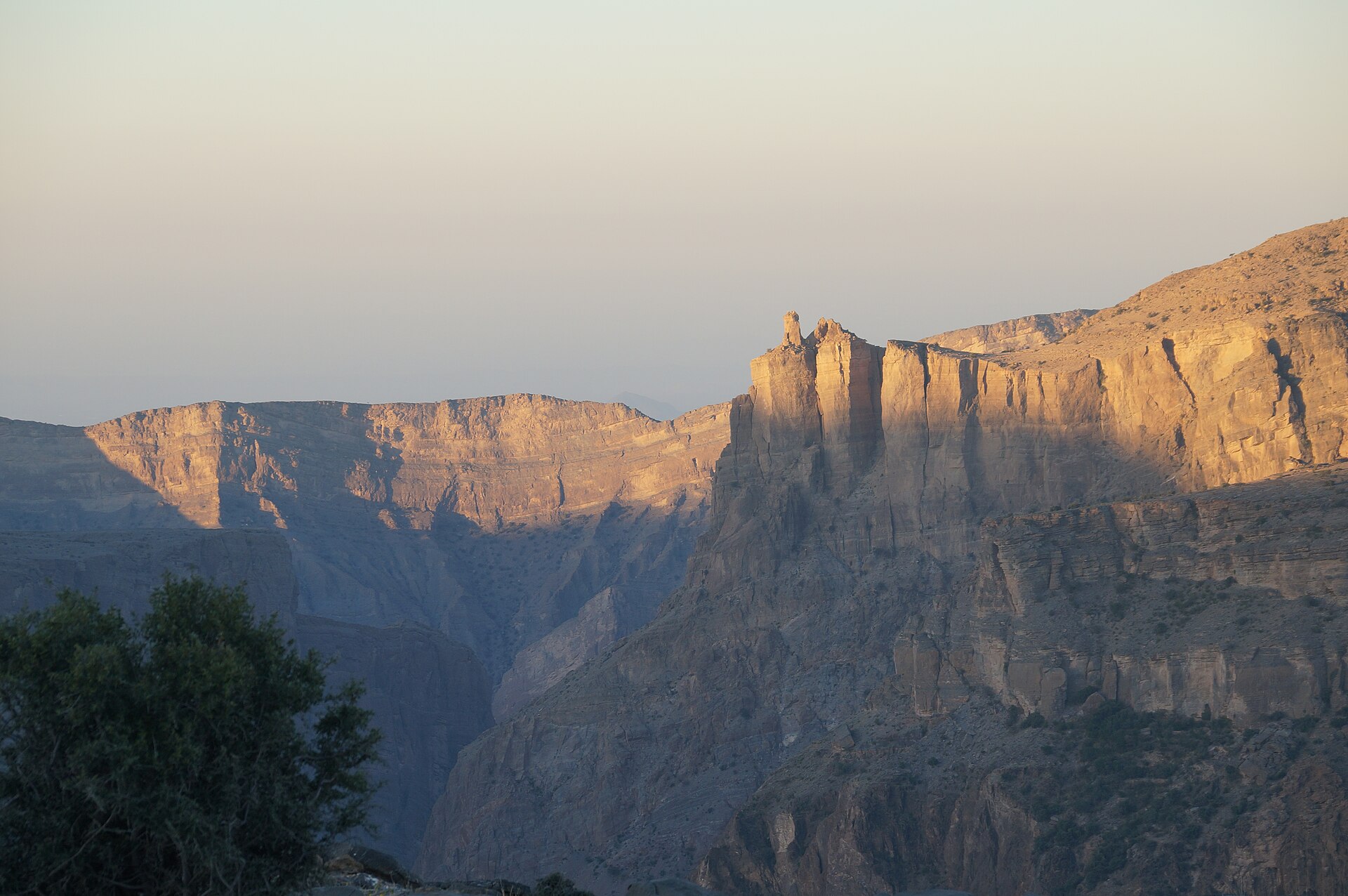
Diana's Point is a wood-and-glass viewing platform over the canyon, named after the Princess of Wales, who came to admire the view in the 1980s. It now lies within the Anantara resort.
The mountain's seasons
Roses. Damask roses have been grown on the plateau since the 17th century. From late March to early May, peaking in April, the terraces turn pink; farmers pick the flowers at dawn, when the scent is strongest, then distil them for hours in clay ovens and earthenware pots. The result is the brown rose water that flavours Omani coffee and sweets. Our Rose season page gives the expected dates for 2027.
Pomegranates. The plateau has some 27,000 pomegranate trees, according to Oman's Ministry of Agriculture, including 5,500 in Saiq and 5,000 in Ash Shirayjah. The harvest starts in mid-August, and the fruit is sold to visitors on the mountain and as far as the Nizwa souq.
Temperatures. The Saiq weather station records average highs of 15 °C in January, 20 °C in March, 23 °C in October and 30 °C at the height of summer. Winter evenings and nights are cold, so bring a proper jumper and a jacket. In summer, when the plain tops 40 °C, the plateau draws visitors from Oman and the other Gulf states.
Hiking and climbing
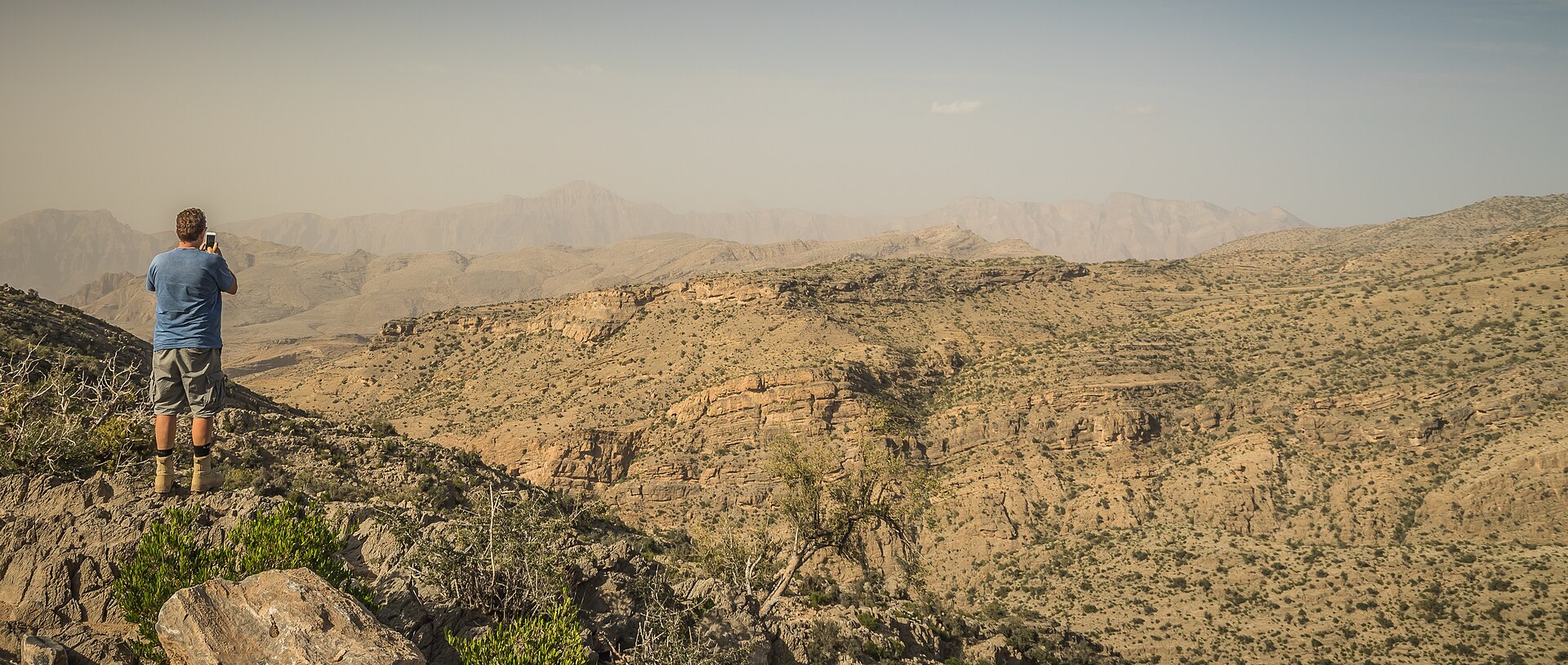
Hiking is the main draw. The three-village walk, from Al Aqr to Ash Shirayjah, takes about three hours as a loop, with steep sections along the drop. Stick to waymarked trails, and carry water even in winter. Our Hiking in the Hajar Mountains guide covers the routes across the range.
The Jebel Akhdar via ferrata, a climbing route fitted with cables and rungs, takes two hours and costs from about €100 per person. A three-hour outing combines via ferrata and a hike to Sharaijah village for about €115 per group of up to three. A full-day trip from Muscat costs about €117 per person, but the drive takes at least four hours there and back, so one or two nights on the mountain are a better plan.
Where to stay on Jebel Akhdar
All three hotels in the Sabaro selection are on the Saiq Plateau.
Anantara Al Jabal Al Akhdar Resort: 82 canyon-view rooms and 33 private-pool villas, a heated pool, a spa with hammam, and clubs for children and teenagers. Diana's Point is on its grounds. Check-in 14:00, check-out 12:00. Expect from about €450 a night for two with breakfast, possible local taxes extra.
Alila Jabal Akhdar: 86 suites and villas at 2,000 m, outdoor and indoor pools, Spa Alila, a children's club and a 3 km Butterfly Trail for families. The hotel offers via ferrata, hikes, stargazing and cooking classes. Price on request.
Sahab Resort & Spa: a small 27-room hotel on the canyon edge, with an infinity pool over the valley, the URU Spa, village walks, rock climbing and cliff-edge yoga. Fossils can be seen on the property. Price on request.
Our Mountains, Spa and wellness and Honeymoon pages list these hotels alongside Sabaro's other addresses.
Combining Jebel Akhdar with other regions
The plateau is about an hour's drive from Nizwa, with its fort and Friday market. Jebel Shams is reached via Nizwa and Al Hamra: our Jebel Shams page covers the canyon and the Balcony Walk. A first trip might combine two nights in Muscat, two on the plateau and one in Nizwa; our Oman page gives the overview.
What to see
- Saiq plateau — around 2,000 m; the inhabited heart of the massif, with terraced villages, orchards and rose gardens NOAA, station météorologique de Saiq (41254)
- Rose gardens and rose water — Damask rose grown since the 17th century; picked at dawn from late March to early May, distilled in clay ovens and earthenware pots Oman Observer, saison des roses (avril 2026)
- Bayt Ar-Ridaydah (Birkat al Mouz) — 17th-century fort (Imam Sultan bin Saif, 1649-1679) on the road to Jebel Akhdar, west of Birkat al Mouz; 6,761 m², painted ceilings, crossed by Falaj Al Khatmeen Experience Oman (ministère du Patrimoine et du Tourisme)
- Falaj Al Khatmeen (World Heritage) — one of five aflaj (irrigation channels) inscribed by UNESCO in 2006, representing more than 3,000 systems still in use; four of the five lie around the Jebel Akhdar massif Unesco, systèmes d'irrigation aflaj d'Oman
- Terraced villages of Al Aqr, Al Ayn and Ash Shirayjah — stone houses clinging to the cliff, falaj-irrigated terraces (pomegranates, pears, grapes, roses); Al Aqr is restoring its old houses as inns and cafés Anantara Al Jabal Al Akhdar, promenade des trois villages
- Wadi Bani Habib — abandoned old mud village on the cliffside above walnut, pomegranate and apricot orchards, reached down natural rock steps Oman Observer, le vieux village de Wadi Bani Habib
- Diana's Point — canyon-edge viewpoint named after the Princess of Wales, who came in the 1980s; now within the Anantara resort Anantara Al Jabal Al Akhdar (site officiel)
- Pomegranate orchards — some 27,000 pomegranate trees on the mountain terraces, according to the Ministry of Agriculture; harvest from mid-August Oman Observer, saison des grenades
When to go
Climate in Saiq (Jebel Akhdar)
| Jan | Feb | Mar | Apr | May | Jun | Jul | Aug | Sep | Oct | Nov | Dec | |
|---|---|---|---|---|---|---|---|---|---|---|---|---|
| Max. (°C) | 14.9 | 17.0 | 20.0 | 23.8 | 27.7 | 30.4 | 30.3 | 29.3 | 27.4 | 23.4 | 18.7 | 16.1 |
Source: Meteostat, normales 1991-2020 de la station 41254 (calculées par Meteostat à partir des relevés) — 1991-2020, accessed 20 October 2026
Getting there
- About 120 km and 1 h 20 from Muscat airport to the Birkat al Mouz checkpoint, then a mountain road to Saiq: 160 km and 2 h in all, without stops OSRM, itinéraire calculé sur les données OpenStreetMap depuis l'aéroport de Mascate (durée sans arrêt)
- Royal Oman Police checkpoint at the foot of the road: 4x4s only, with licence and registration papers; hotels can arrange transfers and the checkpoint crossing Anantara Al Jabal Al Akhdar (site officiel, 2026) ; Oman Observer (2022)
By air
| Airport | By road | Direct flights |
|---|---|---|
| Muscat (MCT) | 168 km, 2h13 |
Hotels chosen in the region
| Hotel | Category | Suits | Guest rating | Indicative price |
|---|---|---|---|---|
| Alila Jabal Akhdar | Mountain resort of suites and villas, 5 stars, part of Hyatt (Alila brand) | Mountains, Spa and wellness, Family, Food and dining, Character hotels | 4,8/5 (Tripadvisor (affiché par Google Hôtels)) | Price on request |
| Anantara Al Jabal Al Akhdar Resort | Mountain canyon-edge resort, 5 stars, rooms and private-pool villas | Mountains, Honeymoon, Spa and wellness, Family, Food and dining | 9,4/10 (Booking.com) | from 450 € per night |
| Sahab Resort & Spa | Boutique mountain hotel on the canyon edge | Mountains, Spa and wellness, Family | 4,1/5 (Tripadvisor (affiché par Google Hôtels)) | Price on request |
Chosen activities
- Jebel Akhdar via ferrata — 2 hours · from 101 € per person
Public price collected on: Civitatis — accessed 20 October 2026
- Jebel Akhdar via ferrata and hike (Sharaijah village) — 3 hours
Public price collected on: Musement (prix par groupe, 3 participants au plus) — accessed 20 October 2026
- Full-day Jebel Akhdar trip from Muscat — 8 hours · from 117 € per person
Public price collected on: Musement — accessed 20 October 2026
Upcoming events
- 25 March 2027 – 5 May 2027 Jebel Akhdar rose season (estimated date)
Read next
Travel advice
| Country | Official advice | Source |
|---|---|---|
| United Kingdom | Desert and mountain roads dangerous without a well-equipped 4x4; animals on the road; travel in convoy if possible, with water and a phone. | GOV.UK (Site last updated 22 July 2026) |
| United Kingdom | Altitude sickness possible in parts of Oman; follow marked trails. | GOV.UK (Site last updated 22 July 2026) |
| France | The whole country is under heightened vigilance. Since the Iranian strikes on Omani territory, France calls for the utmost vigilance; during an alert, follow the authorities, take shelter, keep away from military sites and do not approach debris from intercepted projectiles. Travel advised against unless for compelling reasons to the Salalah, Duqm and Musandam areas and to the Yemen border zone. In Dhofar away from the coastal strip, heightened vigilance and leave your itinerary with relatives. Photographing public buildings, military or police vehicles is forbidden; avoid wadis when rain is possible because of flash floods. Registration on Fil d'Ariane recommended to receive alerts; French embassy in Muscat: +968 24 68 18 00, to be contacted before any travel to the Yemen border. | Ministère de l'Europe et des Affaires étrangères (France Diplomatie), Conseils aux voyageurs (Site last updated 15 September 2026) |
| Belgium | Oman is relatively stable and calm, in a particularly volatile region: increased vigilance is extremely important after the regional strikes since 28/02/2026 and the new attacks that followed the 17/06/2026 agreement, which Iran and the United States no longer consider binding; sudden airspace closures are possible, avoid military areas and strategic infrastructure. Immediate Yemen border zone: all travel strongly advised against. Musandam province: non-essential travel advised against (entrance to the Strait of Hormuz). Areas near military installations, energy sites and large port and industrial complexes, notably in Duqm, Sohar and Salalah: non-essential travel advised against. Registration on Travellers Online recommended; consular services are provided by the Belgian embassy in Riyadh, with an honorary consulate in Muscat. Comprehensive travel insurance, including legal assistance, medical care and repatriation, is considered absolutely essential. | SPF Affaires étrangères, Commerce extérieur et Coopération au Développement (Belgique), Conseils aux voyageurs (Site last updated 12 August 2026) |
| Switzerland | No advice against travel to Oman as a whole: the Middle East remains tense despite the 17/06/2026 memorandum; expect airspace closures and avoid the vicinity of potential targets (diplomatic, military and security sites). Tourist and non-urgent travel to Musandam province advised against. Yemen border: tense, with checkpoints and minefields; check with local authorities and stay on busy roads. Photographing people in uniform, military installations or people without consent is an offence; wadis can turn into torrents in heavy rain. | Département fédéral des affaires étrangères (DFAE, Suisse), Conseils pour les voyages (Site last updated 17 July 2026) |
| Germany | No formal travel warning for Oman: the regional situation remains volatile, with strikes after the June 2026 US–Iran declaration of intent; risk of wider fighting and airspace closures, elevated abstract terrorist threat; keep well away from US and military sites. Travel advised against to the Musandam exclave on the Strait of Hormuz and to the immediate Yemen border area. Do not photograph police, military or border posts or their personnel; leave wadis as soon as possible during weather warnings. Registration on the ELEFAND crisis preparedness list and the "Sicher Reisen" app; keep phones and power banks charged. | Auswärtiges Amt (ministère fédéral des affaires étrangères, Allemagne), Reise- und Sicherheitshinweise (Site last updated 4 September 2026) |
| Luxembourg | No Oman-specific page. Regional Middle East notice: since 28/02/2026 the ministry strongly advises against travel to the Middle East, including the Gulf states, and refers to the Belgian, German and French advice for country detail. | Ministère des Affaires étrangères et européennes, de la Défense, de la Coopération et du Commerce extérieur (Luxembourg), Avis de voyage (Site last updated 28 February 2026) |
| Ireland | Level 2 of 4, High Degree of Caution. Travel alert on the Middle East and Gulf: EU Aviation Safety Agency advisory covering parts of the airspace over the Gulf of Oman until 16/11/2026; risk of attacks on military or strategic sites and debris from intercepts. Do not travel to the Yemen border area. Yacht and leisure-craft travel on the high seas advised against except when essential in the Gulf of Aden, Arabian Sea and part of the Indian Ocean (piracy). | Department of Foreign Affairs and Trade (DFA, Irlande), Travel advice (Site last updated 30 September 2026) |
| Sweden | Oman is not on the Swedish foreign ministry's list of countries it advises against travelling to. The responsible embassy asks Swedes, given limited but continuing attacks on Oman, to exercise particular caution, avoid affected areas and follow local authorities; Muscat airport remains open. | Utrikesdepartementet (UD, ministère des affaires étrangères, Suède) et ambassade de Suède à Riyad (Sweden Abroad) (Site last updated 1 October 2026) |
| Poland | Level 3, "Avoid travel" (risk much higher than in Poland), because of the large-scale military operation in the Middle East; airspace closed or restricted across the region and a preliminary US–Iran deal that does not rule out renewed fighting. | Ministerstwo Spraw Zagranicznych (ministère des affaires étrangères, Pologne), service Odyseusz (Site last updated 17 July 2026) |
| Czechia | Because of the escalating conflict with Iran, the Czech ministry recommends travelling to Oman only when strictly necessary; transit remains possible following airline and airport information; on site, increased caution. Increased caution recommended near the Yemen border (general country page). Photographing military and government sites is forbidden. | Ministerstvo zahraničních věcí (ministère des affaires étrangères, Tchéquie), Upozornění na cesty (Site last updated 24 June 2026) |
| Denmark | Not checked by Sabaro: see Udenrigsministeriet (um.dk) | |
| Norway | Not checked by Sabaro: see Regjeringen | |
| Austria | Not checked by Sabaro: see BMEIA | |
| Netherlands | Not checked by Sabaro: see Nederland Wereldwijd | |
| Italy | Not checked by Sabaro: see Viaggiare Sicuri | |
| Spain | Not checked by Sabaro: see exteriores.gob.es | |
| Portugal | Not checked by Sabaro: see Portal das Comunidades | |
| Finland | Not checked by Sabaro: see Ulkoministeriö (um.fi) | |
Rules change: always check the official website before you travel.
Frequently asked questions
Do you need a 4x4 to drive up Jebel Akhdar?
Yes. A Royal Oman Police checkpoint at Birkat al Mouz only lets four-wheel-drive vehicles through, and drivers must show their licence and registration papers. The hotels arrange transfers for guests who prefer not to drive.
How long is the drive from Muscat?
About 160 km and two hours without stops from the airport to the Saiq Plateau, or 2.5 hours according to the hotels. The checkpoint is about 1 h 20 from the airport.
When can you see the roses on Jebel Akhdar?
From late March to early May, peaking in April. The flowers are picked at dawn and distilled into rose water in the plateau villages.
Is it cold on Jebel Akhdar?
Average highs in Saiq range from 15 °C in January to 30 °C in summer, 11 to 13 °C below Nizwa. Winter evenings and nights are cold, so pack warm clothes.
Where should I stay on Jebel Akhdar?
Sabaro has selected three hotels on the Saiq Plateau: the Anantara Al Jabal Al Akhdar, the Alila Jabal Akhdar and the Sahab Resort & Spa.
A travel advisor replies by email. Free, no commitment.