Nizwa, Bahla and Jabreen
Nizwa, Oman's former capital, lies about 150 km and 1 h 40 by road from Muscat airport, at the foot of the Hajar Mountains. Visitors come for its round 17th-century fort, the souq and, on Friday mornings, the livestock market; nearby are Bahla Fort, a UNESCO World Heritage Site since 1987, and Jabreen Castle, 20 km away. The best time is November to March, as summer highs top 40 °C.
Nizwa is the historic city of inland Oman: the main town of Ad Dakhiliyah Governorate, at the foot of the Hajar Mountains, it was the country's capital for centuries, according to Oman's Foreign Ministry. It is about 150 km and 1 h 40 from Muscat airport on a paved road. The draw is three strongholds: Nizwa's round fort, Bahla Fort, Oman's first UNESCO World Heritage Site, and Jabreen Castle, a 17th-century palace with painted ceilings. On Friday mornings, the livestock market brings herders and onlookers to the edge of the souq.
Nizwa at a glance
- Distances. Nizwa is 150 km (1 h 40) from Muscat airport, Bahla 180 km (2 h); Jabreen is 20 km from Nizwa and 8 km from Bahla. An ordinary car is fine; a 4x4 is only needed to drive up Jebel Akhdar or Jebel Shams.
- Time needed. One day covers Nizwa's fort and souq, a second Bahla and Jabreen. Spending Thursday night in Nizwa puts you at the Friday market by 7 am.
- Season. From November to March, highs range from 26 to 33 °C. From May to September they exceed 40 °C.
Nizwa Fort
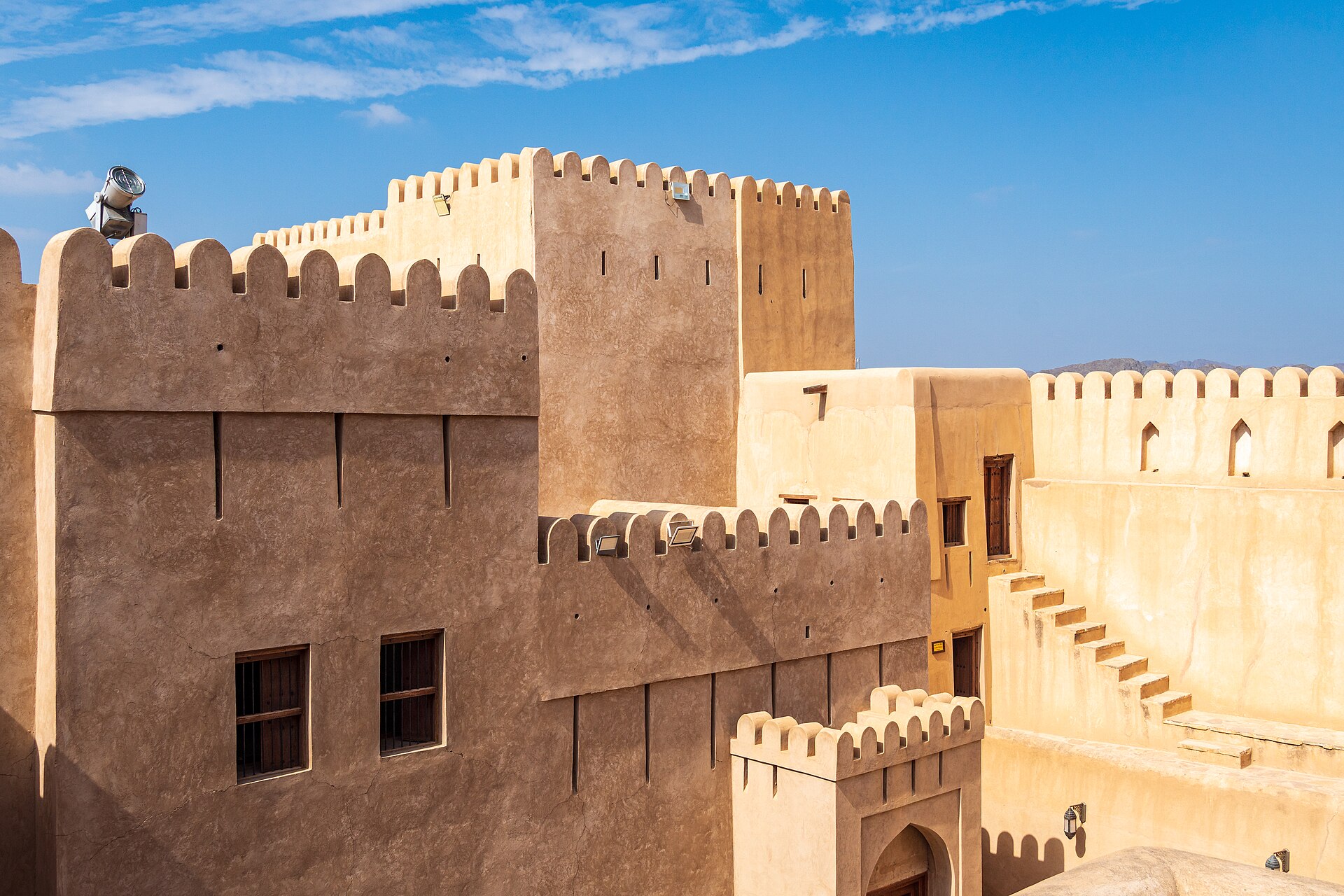
Nizwa Fort is a round tower 34 m high and 45 m across, built in the mid-17th century under Imam Sultan bin Saif Al Yaarubi (1649-1679). The Ministry of Heritage and Tourism describes it as the largest fort of its kind in the Arabian Peninsula. Its walls are stone and sarooj, the traditional Omani mortar, and its cannon ports cover the full circle. The base is packed with stone to a height of 15 m, which made it all but impregnable.
You climb to the top by a narrow zigzag staircase broken by seven fortified doors, with openings for striking at attackers. The fort was also the seat of local government and home to the imam and his family, and it held prisons.
The souq and the old quarter
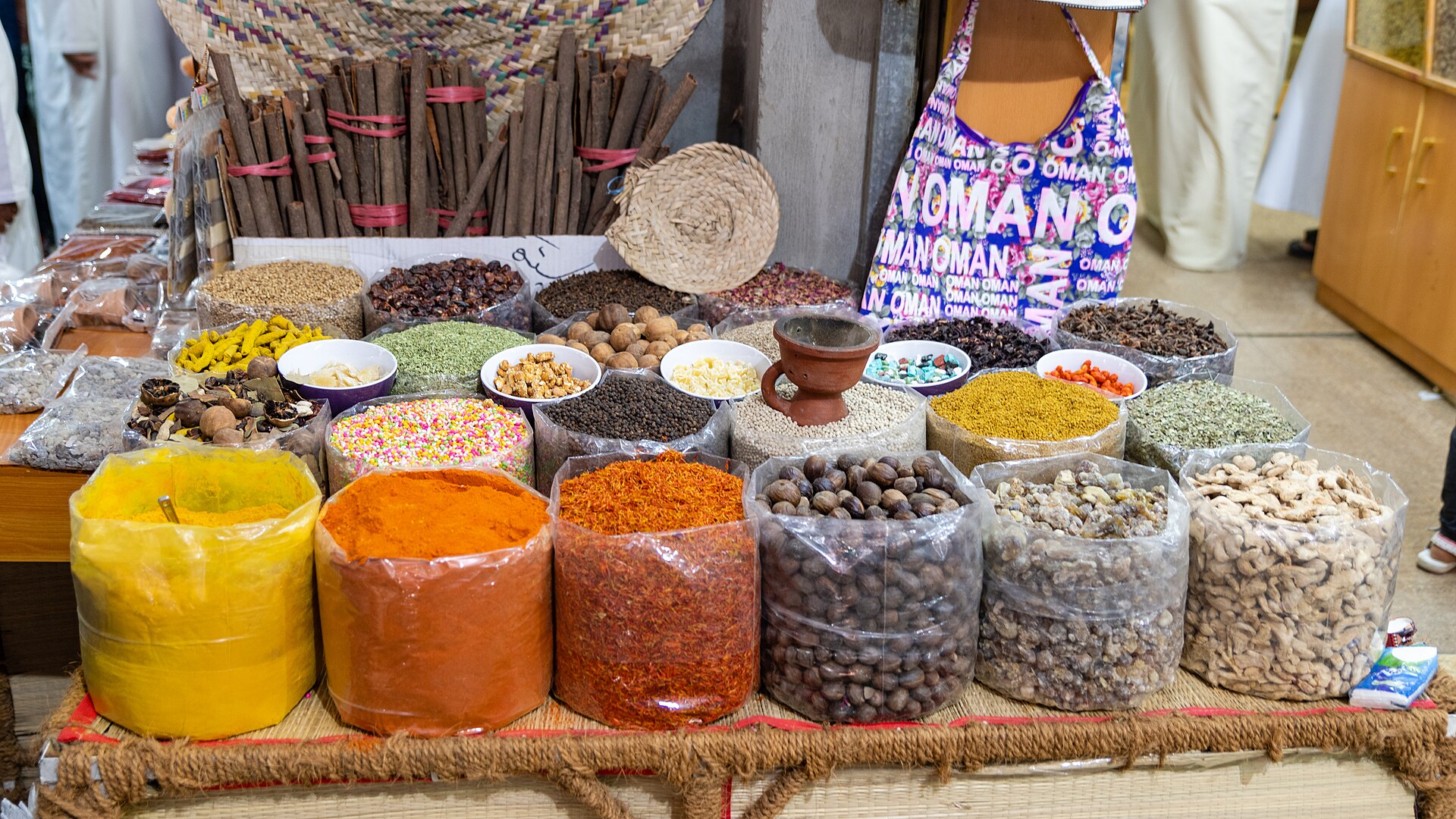
Nizwa souq backs onto the fort. It is organised by trade: pottery, dates, spices, silver jewellery and handicrafts.
Next door, Harat Al Aqr, the old quarter, keeps its stone houses and narrow lanes. A 40-minute vintage buggy tour of the area costs from about €7 per person.
Friday morning: the livestock market
Every Friday, herders from the surrounding villages, and from as far as Jebel Shams and Ibri, bring goats, sheep and sometimes cows to the livestock market, held in a small round pavilion next to the souq. They arrive before dawn; at around 7 am local time the auction, known as al munadah, gets under way. Sellers lead their animals in a circle around the pavilion, buyers shout their bids, and deals are closed on the spot. It is noisy and lively.
In the days before Eid al-Fitr and Eid al-Adha, the two great Muslim festivals, the market grows into the habta, a fair that also sells clothes, halwa and household goods. Around thirty auctioneers work there, and a goat sells for OMR 60 to 300 (Omani rials), according to the Oman Observer. Our Eid al-Fitr 2027 and Eid al-Adha 2027 pages give the expected dates.
Arrive before the bidding starts. Ask before photographing anyone: European foreign ministries stress this for the whole country.
Bahla, UNESCO's fortified oasis
Bahla Fort became Oman's first UNESCO World Heritage Site in 1987. It overlooks an oasis that the Banu Nabhan, the dominant tribe of the region, made their capital from the 12th to the end of the 15th century. Its oldest parts predate Islam.
The fort covers 9,822 m² on an irregular plan that follows the rock. It has three parts: the qasbah, its defensive core; Bayt al-Jabal, which watches over the surroundings; and Bayt al-Hadith, now home to the site museum. Its walls and towers are mud brick on stone foundations.
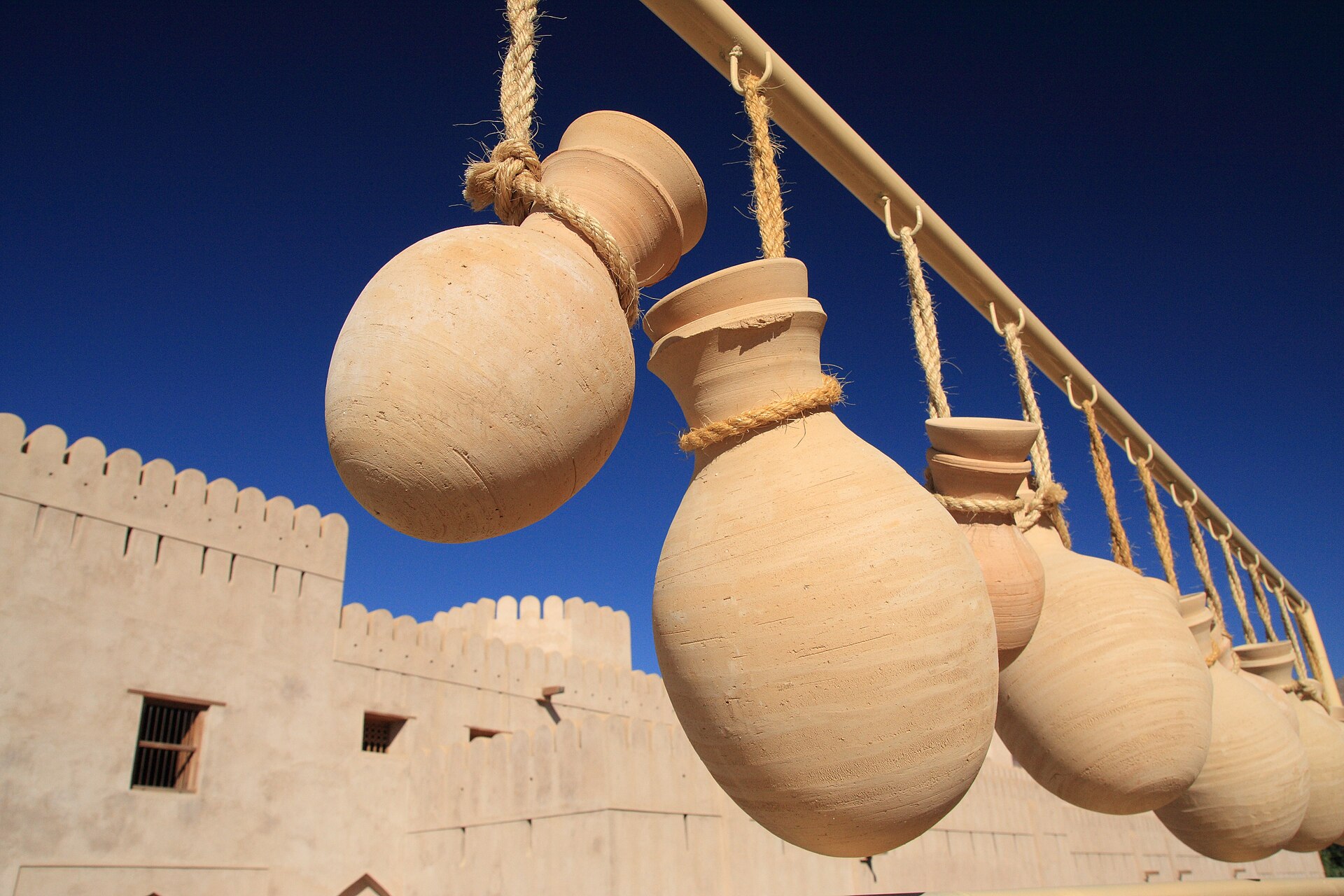
Around it, a wall more than 12 km long, with a sentry walk, watchtowers and gates, encloses mud-brick quarters, mosques, Quran schools, the old souq and the palm grove, still watered by aflaj, the traditional irrigation channels. The Friday Mosque has a finely carved mihrab (prayer niche). Bahla is also known for its pottery, the craft that made its name.
The fort was in ruins when it was inscribed. It was put on the List of World Heritage in Danger in 1988, restored with earthen materials from 1995 onwards, and taken off that list in 2004.
Jabreen Castle
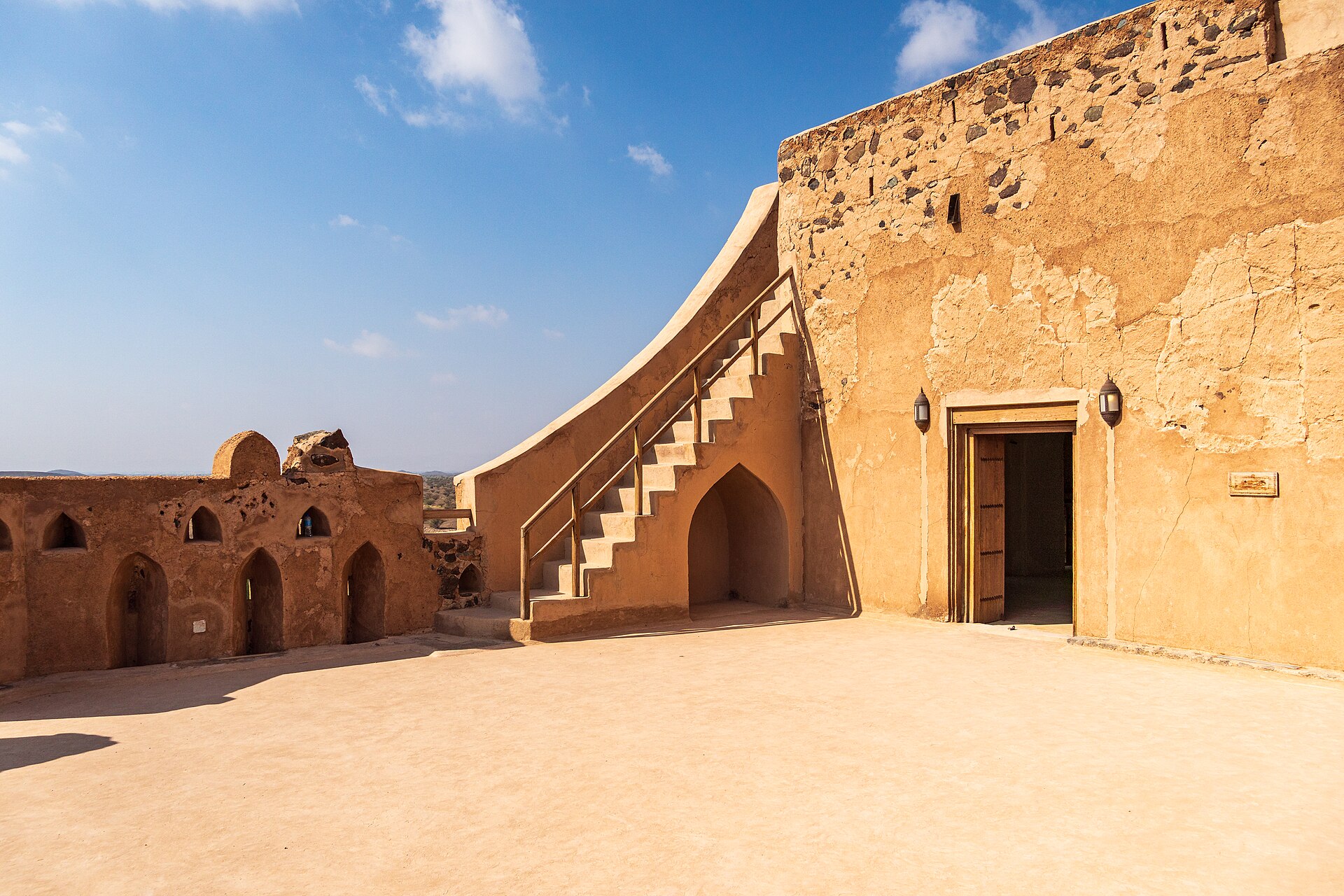
Eight kilometres from Bahla, Jabreen Castle was built in 1675 by Imam Bil'arab bin Sultan Al Yaarubi. Both fort and palace, it served as a seat of learning and government: meeting halls, a courtroom, living quarters, a kitchen, date and gunpowder stores, and separate prisons for men and women. The plan is rectangular, with two entrances and two towers; the main gate is decorated with floral motifs and conical studs.
People come for the painted ceilings and carved interiors, and for two rooms in particular: the Sun and Moon Room, used for important consultations, and the Imam's Protection Room, where soldiers hid to guard him. Openings allowed defenders to pour boiling oil and date syrup on attackers. The castle is open daily, and a buffet lunch or dinner can be booked in advance. It offers panoramic views of the Hajar Mountains.
Around Nizwa
- Birkat al Mouz, 24 km away, is where the Jebel Akhdar road begins; its fort, Bayt Ar-Ridaydah, is crossed by a UNESCO-listed falaj. See our Jebel Akhdar page.
- The Oman Across Ages Museum in Manah tells Oman's story from prehistory to the present, with interactive displays suited to children. The galleries are open Saturday to Thursday, 9 am to 5 pm local time.
- Al Hoota Cave, in Al Hamra wilayat (district), can be visited on a guided tour from about €21 per person; our Jebel Shams page covers that valley.
From Muscat, a 9.5-hour group day trip takes in Nizwa, Birkat al Mouz and Jabreen from about €84 per person. It leaves little time on site: a night in Nizwa adds the Friday market and the evening light on the fort.
What is the weather like in Nizwa?
The Nizwa weather station records average highs of 26 °C in January, 33 °C in March, 37 °C in October and 43 °C in June. November to March is the time to go; from April to October, sightseeing is best done early in the morning. The Jebel Akhdar plateau, an hour's drive away, is 11 to 13 °C cooler. Your country's travel advice for Oman appears at the top of this page, and our Oman travel situation guide compares them.
Where to stay in Nizwa
Antique Inn is the character address chosen by Sabaro in central Nizwa, a few minutes' walk from the fort and the souq. It is a 300-year-old property made up of several restored mud-brick houses, with a small pool, a garden and a rooftop terrace where breakfast comes with a view of the fort; in the evening a buffet dinner stands in for a restaurant. Low doorways and narrow stairs make it difficult for guests with limited mobility. Expect from about €100 a night for two with breakfast, possible local taxes extra.
For more comfort, the Jebel Akhdar hotels are an hour's drive away. Our Boutique hotels and Museums and culture pages list other addresses.
What to see
- Nizwa Fort — round tower 34 m high and 45 m across, built in the mid-17th century under Imam Sultan bin Saif (1649-1679); zigzag staircase and seven fortified doors; souq next door Experience Oman (ministère du Patrimoine et du Tourisme)
- Nizwa souq and Friday livestock market — souq for crafts, dates, spices and silver; on Fridays, goats, sheep and cattle are auctioned (al munadah) in a small round pavilion from 7 am (local time) Oman Observer, les marchés aux chèvres
- Harat Al Aqr — Nizwa's old quarter near the fort, stone houses and narrow lanes Experience Oman, gouvernorat d'Ad Dakhiliyah
- Bahla Fort (World Heritage 1987) — Oman's first UNESCO site; mud-brick fort of the Banu Nabhan (12th-15th century), 9,822 m², oasis enclosed by more than 12 km of walls, renowned pottery Experience Oman (ministère du Patrimoine et du Tourisme)
- Jabreen Castle — 1675 palace-fort (Imam Bil'arab bin Sultan), painted ceilings, Sun and Moon room; open daily; 20 km from Nizwa, 8 km from Bahla Experience Oman (ministère du Patrimoine et du Tourisme)
- Oman Across Ages Museum (Manah) — Oman's history from prehistory to today, interactive, family-friendly; galleries Saturday-Thursday 9 am-5 pm (local time) Experience Oman (ministère du Patrimoine et du Tourisme)
- Bayt Ar-Ridaydah (Birkat al Mouz) — 17th-century fort at the mouth of Wadi Al Muaydin, west of Birkat al Mouz, 24 km from central Nizwa; crossed by Falaj Al Khatmeen Experience Oman (ministère du Patrimoine et du Tourisme)
- Al Hoota Cave (Al Hamra) — show cave in Al Hamra wilayat (district); foreign visitors OMR 7.350 (adult), OMR 3.675 (6-16) in 2024 showcaves.com
When to go
Climate in Nizwa
| Jan | Feb | Mar | Apr | May | Jun | Jul | Aug | Sep | Oct | Nov | Dec | |
|---|---|---|---|---|---|---|---|---|---|---|---|---|
| Max. (°C) | 26.0 | 28.7 | 32.8 | 37.0 | 41.1 | 43.3 | 42.8 | 41.8 | 39.8 | 36.5 | 31.4 | 27.7 |
Source: Meteostat, normales 1991-2020 de la station 41255 (calculées par Meteostat à partir des relevés) — 1991-2020, accessed 20 October 2026
Getting there
- About 150 km and 1 h 40 from Muscat airport to Nizwa, without stops; Bahla 180 km (2 h); paved road OSRM, itinéraire calculé sur les données OpenStreetMap depuis l'aéroport de Mascate (durée sans arrêt)
By air
| Airport | By road | Direct flights |
|---|---|---|
| Muscat (MCT) | 157 km, 1h53 | |
| Sohar (OHS) | 341 km, 4h00 |
Hotels chosen in the region
| Hotel | Category | Suits | Guest rating | Indicative price |
|---|---|---|---|---|
| Antique Inn | Characterful guesthouse in restored mud-brick houses | Boutique and historic hotels, Museums and culture, Family, Shopping | 8,3/10 (Booking.com) | from 101 € per night |
Chosen activities
- Nizwa, Birkat al Mouz and Jabreen full-day tour from Muscat — 9 h 30 · from 84 € per person
Public price collected on: Civitatis — accessed 20 October 2026
- Vintage buggy tour in Al Aqur (Nizwa) — 40 minutes · from 7 € per person
Public price collected on: Civitatis — accessed 20 October 2026
- Al Hoota Cave guided tour — 1 hour · from 21 € per person
Public price collected on: Civitatis — accessed 20 October 2026
Read next
- Travelling in Oman during Ramadan 2027: dates and etiquette
- Turtle watching at Ras al Jinz: tours, times and seasons
- Muscat, Jebel Akhdar and Nizwa in 7 days
- Oman's wadis: swimming, hiking and flash floods
- Driving in Oman: car hire, 4WD, mountain roads and the rules
- Oman and the regional situation: facts, official advice and precautions
- Hiking in the Hajar mountains: Jebel Shams, Jebel Akhdar and the Balcony Walk
- Jebel Akhdar (the Green Mountain)
Travel advice
| Country | Official advice | Source |
|---|---|---|
| United Kingdom | Desert and mountain roads dangerous without a well-equipped 4x4; animals on the road; travel in convoy if possible, with water and a phone. | GOV.UK (Site last updated 22 July 2026) |
| France | Not checked by Sabaro: see France Diplomatie | |
| Belgium | Not checked by Sabaro: see diplomatie.belgium.be | |
| Switzerland | Not checked by Sabaro: see DFAE (eda.admin.ch) | |
| Luxembourg | Not checked by Sabaro: see mae.gouvernement.lu | |
| Ireland | Not checked by Sabaro: see ireland.ie (DFA) | |
| Germany | Not checked by Sabaro: see Auswärtiges Amt | |
| Sweden | Not checked by Sabaro: see Regeringen (UD) | |
| Denmark | Not checked by Sabaro: see Udenrigsministeriet (um.dk) | |
| Norway | Not checked by Sabaro: see Regjeringen | |
| Poland | Not checked by Sabaro: see Odyseusz (MSZ) | |
| Czechia | Not checked by Sabaro: see MZV ČR | |
| Austria | Not checked by Sabaro: see BMEIA | |
| Netherlands | Not checked by Sabaro: see Nederland Wereldwijd | |
| Italy | Not checked by Sabaro: see Viaggiare Sicuri | |
| Spain | Not checked by Sabaro: see exteriores.gob.es | |
| Portugal | Not checked by Sabaro: see Portal das Comunidades | |
| Finland | Not checked by Sabaro: see Ulkoministeriö (um.fi) | |
Rules change: always check the official website before you travel.
Frequently asked questions
When is the Nizwa goat market?
Every Friday morning, next to the souq. Herders arrive before dawn and the auction starts at around 7 am local time. Before Eid, the market expands into a fair, the habta.
Can you visit Nizwa as a day trip from Muscat?
Yes: 1 h 40 each way for the fort and the souq. To add Bahla and Jabreen and catch the Friday market, a night in Nizwa is better.
Why is Bahla Fort a UNESCO site?
It is an outstanding example of a late medieval fortified oasis: a mud-brick fort, a wall more than 12 km long, mud-brick quarters, a mosque with a carved mihrab and an old souq. It was inscribed in 1987, the first site in Oman.
Do you need a 4x4 for Nizwa, Bahla and Jabreen?
No. The roads are paved. A 4x4 is only needed to drive up Jebel Akhdar or towards the top of Jebel Shams.
Where should I stay in Nizwa?
At the Antique Inn, restored mud-brick houses in the town centre, a few minutes from the fort. For a high-comfort hotel, Jebel Akhdar is an hour's drive away.
A travel advisor replies by email. Free, no commitment.