Morocco's imperial cities in 10 days
10 days · Couples, history and architecture lovers · March to May, October and November
A ten-day rail journey from Rabat to Marrakech via Meknes, Volubilis and Fez, for couples who love history and architecture. It takes in five UNESCO World Heritage sites, with three nights in a riad in the Fez medina and four at La Mamounia.
from 2,150 € per person
Price collected on 11 October 2026. Based on 2 adults, listed hotels and activities; international flights, trains and transfers not included. Indicative price, taxes included, to be confirmed with your request.
Itinerary
- Days 1–3 Rabat · 2 nights
- Days 3–6 Fez, via Meknes and Volubilis · 3 nights — Riad Fès
- Days 6–10 Marrakech · 4 nights — La Mamounia
Activities included in the indicative price
Two thousand years in five stops
This trip moves through Moroccan history city by city, in the order of the railway rather than the centuries. A few landmarks help. Volubilis, capital of Mauretania founded in the 3rd century BC, became an outpost of Rome, then briefly the capital of Idris I, founder of the Idrisid dynasty. The Idrisids founded Fez between 789 and 808. The Almoravids founded Marrakech in 1070–72. The Almohads began the Hassan Mosque in Rabat in 1184. The Marinids added Fes Jdid in 1276. Moulay Ismail, founder of the Alaouite dynasty, ruled from Meknes from 1672 to 1727. Finally, between 1912 and the 1930s, the French built the new town of Rabat that is the capital today.
Trains link the cities, so you need no car: only Volubilis calls for a driver. The pace runs from calm to dense to comfortable: two days in an airy Atlantic capital, three in the Fez medina, four in Marrakech at a palace hotel set in gardens, where sightseeing and rest can alternate.
Day by day
Day 1: arriving in Rabat
Rabat has its own airport, Rabat-Salé, and Casablanca is 87.5 km away, about 1 h 03 by road. For a first evening, explore the Kasbah of the Udayas on foot. This itinerary does not set a hotel in Rabat: the page lists those in Sabaro's selection.
Day 2: Rabat, a capital with two faces
The site, inscribed in 2012 on the World Heritage List of UNESCO (the United Nations Educational, Scientific and Cultural Organization), covers 348.59 hectares and brings together two cities. One is Almohad: the Hassan Tower, minaret of the mosque begun in 1184, and the ramparts and gates of the same period, the only remains of a planned imperial capital. The other is the protectorate's new town, with its administrative buildings, residential districts, the Jardin d'Essais, both botanical and pleasure garden, and the neo-traditional Habous quarter of Diour Jamaâ. The Mohammed V Mausoleum is visited with the Hassan Tower. End the day at the Chellah necropolis.
Rabat is the calmest of the four imperial cities: a gentle warm-up before Fez.
Day 3: Meknes and Volubilis, on the way to Fez
This is the busiest day. Classic trains leave from Rabat Ville station; Rabat Agdal is served by the Al Boraq high-speed line. The ride to Meknes takes about 2 h 06, with hourly departures.
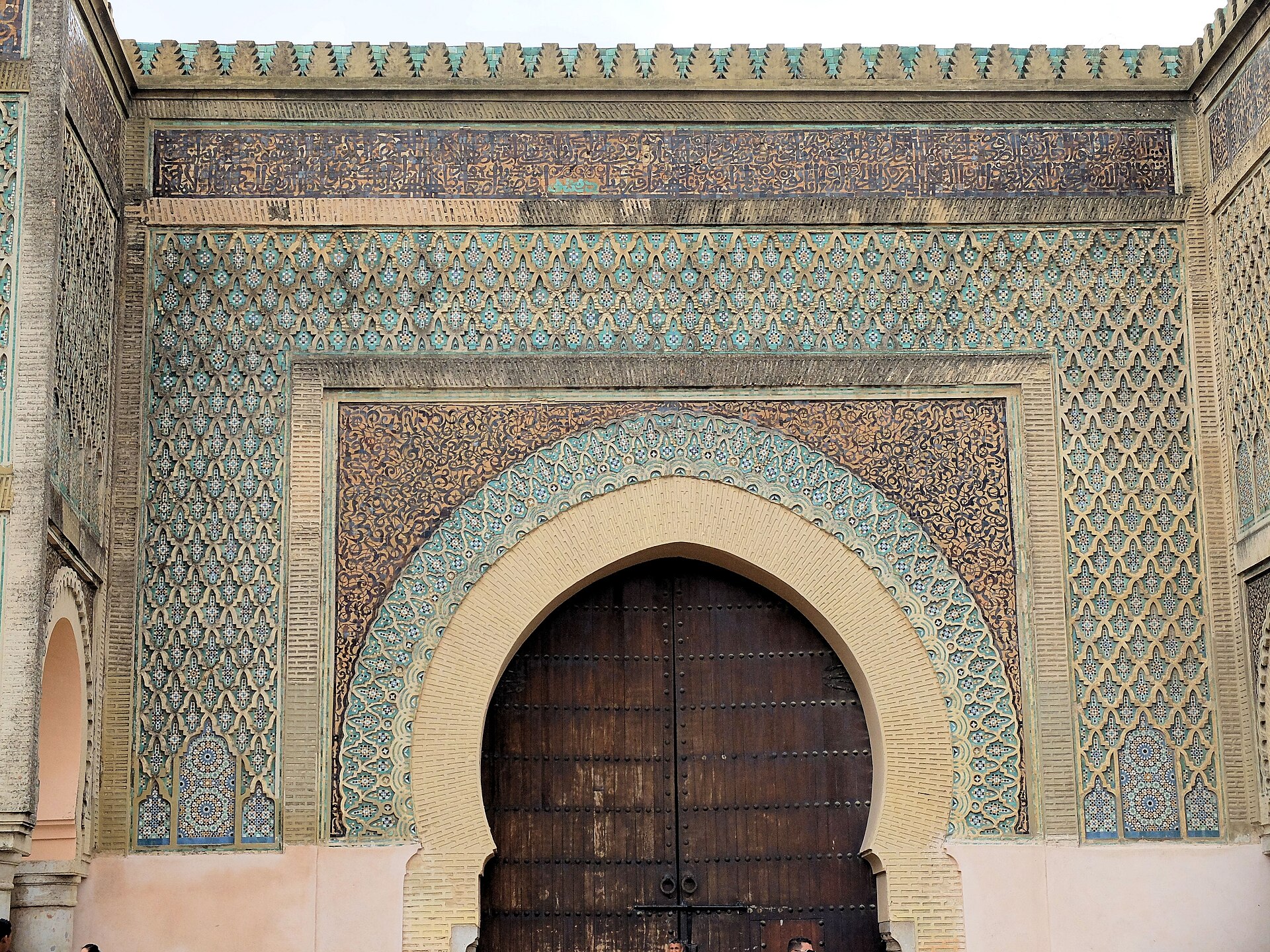
Meknes is a Hispano-Moorish city behind high walls pierced by nine monumental gates, with twenty-five mosques, ten hammams, palaces and vast granaries. El Hedime square faces Bab Mansour; the Heri es-Souani granaries and the Mausoleum of Moulay Ismail complete the visit.
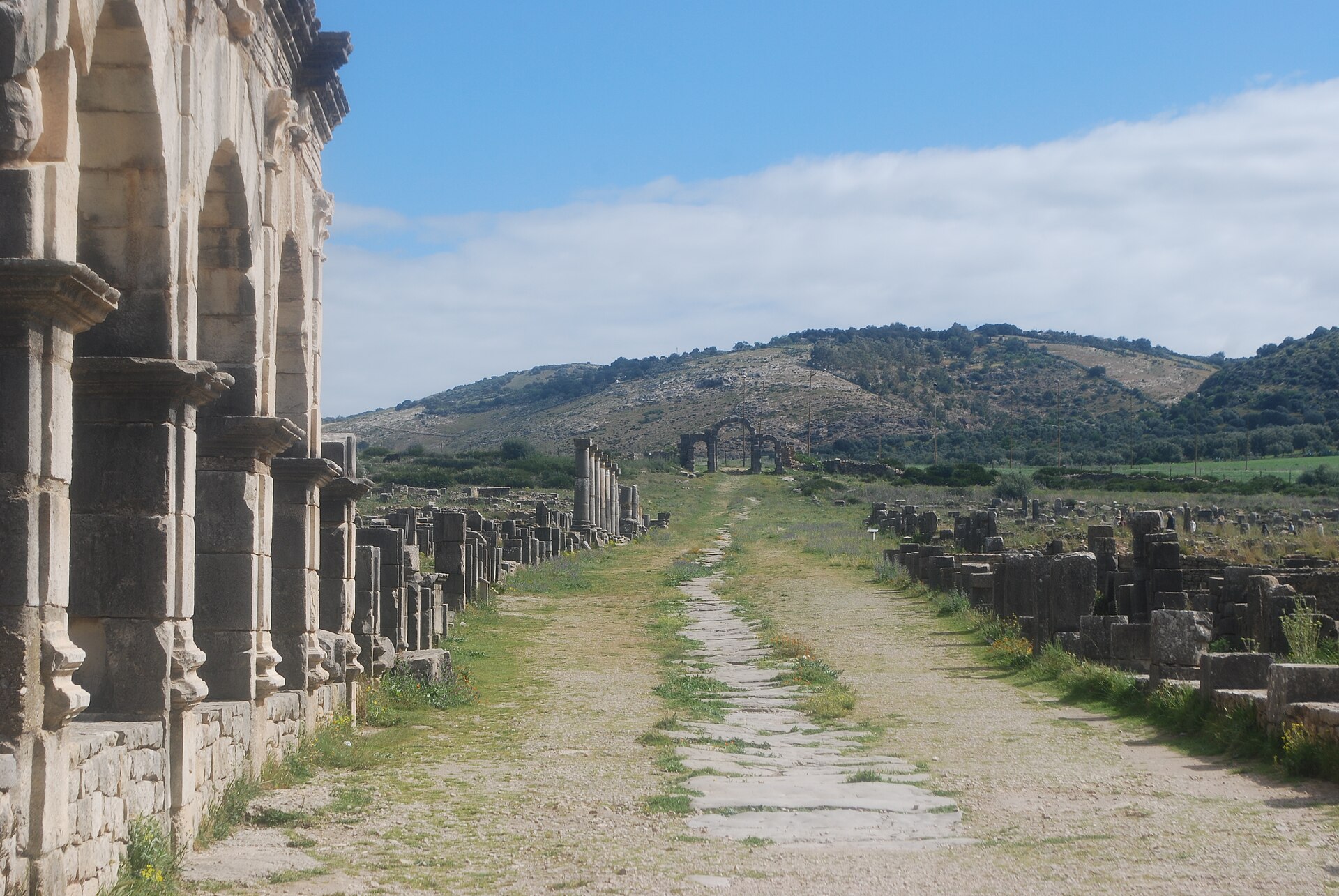
Volubilis lies 28 km from Meknes, about 30 minutes by road. The site covers 42 hectares at the foot of Jebel Zerhoun. You walk past the forum, the capitol, the Arch of Caracalla, dated 217, and the mosaics of the House of Orpheus. There is little shade: bring a hat and water, even in spring. Next door, Moulay Idriss Zerhoun holds the tomb of Idris I, a place of pilgrimage.
Practical tip. With luggage, a driver for the day is simplest: Rabat, Meknes, Volubilis, then Fez in the evening. Rabat to Meknes is 144 km, about 1 h 33 by road. If you prefer the train to Meknes, book a driver from Meknes station to Volubilis and on to Fez, bags included.
In the evening, Fez. Riad Fès is in Fes el-Bali, a 5-minute walk from Batha square, where a guarded car park takes vehicles.
Days 4 and 5: Fez on foot
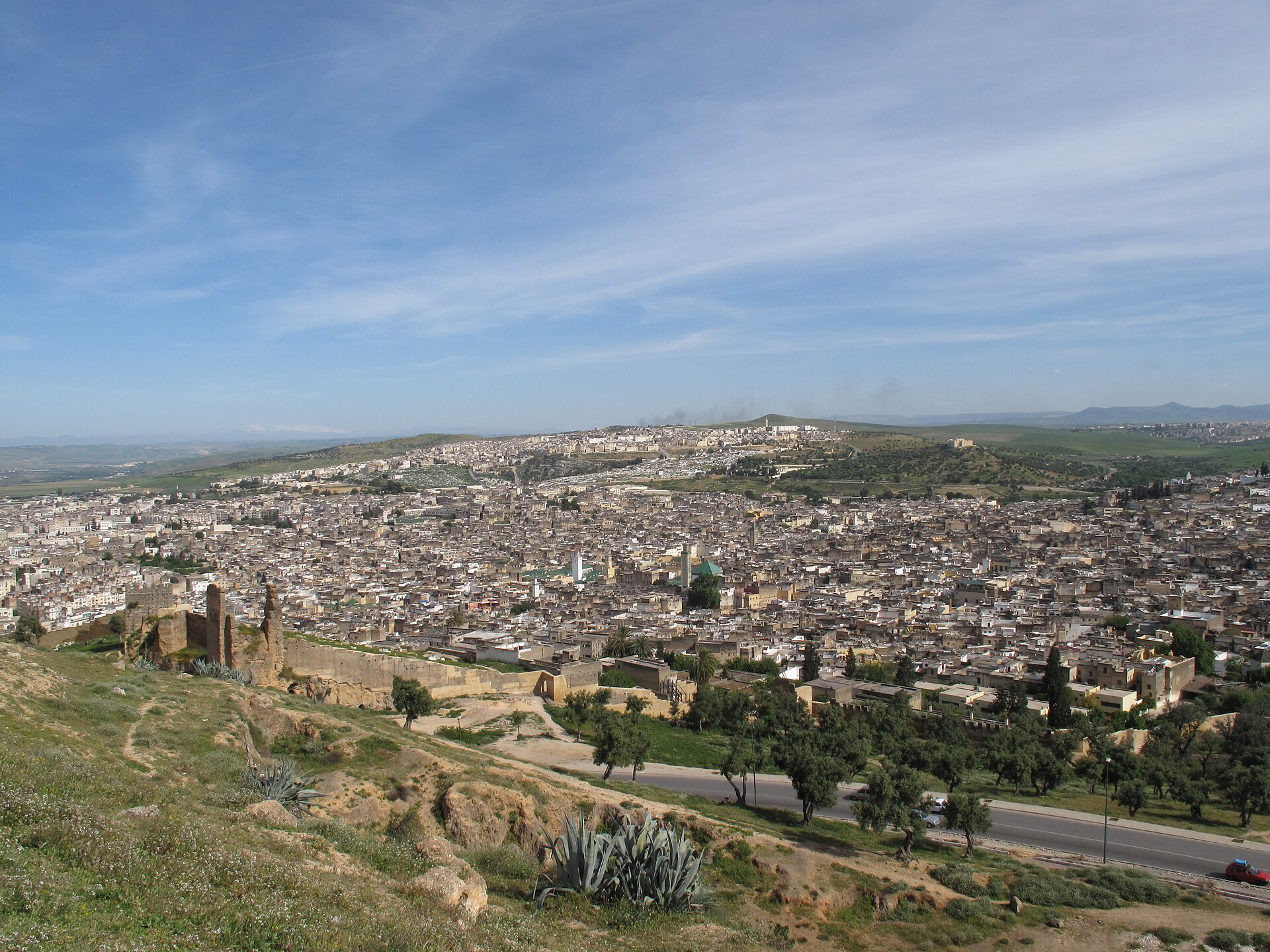
Fes el-Bali, inscribed in 1981, covers 280 hectares. Its street pattern and main monuments date from the Marinids, in the 13th and 14th centuries: madrasas, fondouks (former caravanserais), palaces, mosques and fountains. Fez remains the country's cultural and spiritual capital, although the political capital moved to Rabat in 1912.
Spend the first morning with a guide: the tour listed in this itinerary lasts 3 hours. It enters through Bab Boujloud, takes in the Bou Inania and Attarine madrasas, passes the Quaraouiyine Mosque, which non-Muslims see from outside, and stops above the Chouara tanneries. In the afternoon, the Nejjarine Museum of wooden arts is a quiet break.
On the second day, leave the old city: Fes Jdid, the Marinid town of 1276, with the gates of the Royal Palace and the Jnan Sbil garden, then the Merinid Tombs late in the day.
Riad Fès occupies a palace the hotel describes as dating from the 14th century, restored, and once owned by a family of local notables. Its 30 rooms and suites surround a 14 m pool, and its panoramic terrace looks over the medina and the mountains. Heading back to the riad at midday splits the sightseeing in two and makes the medina easier to enjoy.
Sabaro recommends three days in Fez: one or two days are not enough to take it in.
Day 6: Fez to Marrakech, the long ride
The direct train runs from Fez to Marrakech in about 6 h 30, with hourly departures. The line runs via Meknes, Rabat and Casablanca. In first class, Al Atlas coaches have six-seat air-conditioned compartments, against eight in second; first class can sell out. Tickets are sold on oncf-voyages.ma, the website of ONCF (the national railway office), up to 3 months ahead.
If six hours on a train feels long, the Fez–Marrakech flight takes about 1 h, five days a week. Marrakesh-Menara airport is 6 km from La Mamounia, a 10-minute drive.
Days 7 to 9: Marrakech, medina and gardens
The Marrakech medina, inscribed in 1985, spreads over about 700 hectares of historic housing. The Koutoubia Mosque, the ramparts, the monumental gates and the gardens date from the city's first centuries; the Badi Palace, the Ben Youssef Madrasa and the Saadian Tombs came later. Jemaa el-Fna square is on UNESCO's list of intangible cultural heritage.
One way to spread the three full days:
- Day 7: the guided medina tour listed in this itinerary (4 hours) in the morning, with the Koutoubia, the Ben Youssef Madrasa and the souks; the afternoon in the hotel gardens; Jemaa el-Fna in the evening.
- Day 8: the Saadian Tombs and El Badi Palace, then Bahia Palace.
- Day 9: Jardin Majorelle and the Yves Saint Laurent Museum, whose tickets are sold online only, then the Menara basin.
La Mamounia stands at the gates of the medina, in gardens planted with roses, orange, olive and palm trees. It has welcomed guests since 1923 and holds 3 Michelin Keys. Its 2,500 m² spa is a good place to land after a morning in the souks. In the evening, smart dress is expected in the restaurants and bars; shorts are not allowed after 6 pm local time.
Day 10: departure
Transfer to Marrakesh-Menara airport, 3 hours from Paris and 3h10 from Lyon by direct flight3h25 from Brussels by direct flighta few hours' flight from Europe's main cities, direct or with one stop.
Variations
- An extra day in Fez to see Meknes and Volubilis without luggage: travel straight from Rabat to Fez by train or by car (207 km, about 2 h 16), then go on a day trip. Fez and Meknes are about 64 km apart.
- Chefchaouen, in the Rif, is 194 km from Fez, about 3 h 24 by road. It fits between Rabat and Fez if you take a night from another stop.
- The High Atlas from Marrakech: Imlil or the Ourika valley work as day trips; Ouarzazate is 194 km away, about 3 h 45, over the Tizi n'Tichka pass.
- Essaouira, about 184 km from Marrakech, to finish by the ocean.
When to go
March to May, October and November. According to the World Meteorological Organization (WMO) 1991–2020 normals, the average high in Fez reaches 35.1 °C in July and August, against 22.0 °C in April and 26.1 °C in October. Rabat, on the coast, stays milder: 27.8 °C in August.
Read next
Frequently asked questions
How do I get from Fez to Marrakech?
By direct ONCF train, the national railway, with hourly departures, in about 6 h 30; by air, about 1 h, five days a week; or by car, about 5 h 15 for 520 km.
How much is the entry to Volubilis?
70 dirhams for adults and 30 dirhams for children under 12. Arrive by mid-afternoon at the latest.
Do I need a car?
No. Trains link Rabat, Meknes, Fez and Marrakech, with at least one departure an hour on each leg. Only Volubilis needs a taxi or driver from Meknes.
Should I book trains in advance?
For first class, yes: it can sell out on Al Atlas trains. Booking opens 3 months ahead on oncf-voyages.ma; some foreign cards are declined there, and online agencies such as 12go.com also sell tickets.
Can I go inside the mosques?
Non-Muslims see the Quaraouiyine Mosque in Fez from outside. The Bou Inania, Attarine and Ben Youssef madrasas, former Koranic schools, are open to visitors.
A travel advisor replies by email. Free, no commitment.