Marrakesh and Essaouira in 7 days
7 days · Couples · Spring, autumn
A week for couples between two UNESCO World Heritage medinas: four nights at El Fenn, a riad in the Marrakesh medina, with a souk tour and a cooking workshop at La Maison Arabe, then two nights at Heure Bleue Palais, set against the ramparts of Essaouira, about 2 h 30 away by road.
from 2,090 € per person
Price collected on 11 October 2026. Based on 2 adults, listed hotels, transfer and activities; flights not included. Indicative price, taxes included, to be confirmed with your request.
Itinerary
- Days 1–5 Marrakesh · 4 nights — El Fenn
- Days 5–7 Essaouira · 2 nights — Heure Bleue Palais
Activities included in the indicative price
- Private transfer Marrakesh → Essaouira (price per vehicle, up to 3 people) · 115 € per vehicle
Public price collected on: GetYourGuide — accessed 11 October 2026
- Guided tour of the Marrakesh souks · 18 € per person
Public price collected on: GetYourGuide — accessed 11 October 2026
- Cooking workshop at La Maison Arabe · 30 € per person
Public price collected on: GetYourGuide — accessed 11 October 2026
Two medinas, two climates
Marrakesh and Essaouira each have a medina on the World Heritage List of UNESCO (the United Nations Educational, Scientific and Cultural Organization), the first since 1985, the second since 2001. They are nothing alike. Marrakesh, founded in the 11th century at the foot of the Atlas, is a city of earth, souks and gardens, hot and dense. Essaouira, an 18th-century fortified port laid out by a French architect in the style of Vauban, is a city of stone, straight streets and wind.
The change of climate is half the trip. According to the 1991–2020 normals of the World Meteorological Organization (WMO):
| Average high | Marrakesh | Essaouira |
|---|---|---|
| January | 19.1 °C | 18.4 °C |
| April | 25.7 °C | 19.5 °C |
| July | 37.7 °C | 21.9 °C |
| October | 28.5 °C | 22.2 °C |
In spring and autumn you move from a mild city to a cool, windy one. In Essaouira the wind reaches at least 10 m/s, about 19 knots, on 186 days a year on average. Pack a jumper for the evenings, even when Marrakesh is warm.
Four days in Marrakesh
The riad
El Fenn occupies thirteen linked houses near Bab el Ksour, a five-minute walk from Jemaa el-Fna square and facing the Koutoubia minaret. Its 41 rooms and suites are finished in tadelakt (polished lime plaster) and zellige (glazed terracotta mosaic), with works from a contemporary art collection hung throughout the house. The 1,300 m² roof terrace is also open to the public, from noon to 11 pm, local time; residents have their own pools, including a 13 m one on the roof, and the Colonnade Café for afternoon tea.
Marrakesh-Menara airport is 15 minutes away. Cars stop at Bab el Ksour, a few metres from the entrance.
Four days, without a tight schedule
Four nights leave three full days, enough to see Marrakesh without rushing. The best rhythm follows the heat: sightseeing early in the morning and late in the afternoon, the riad in the middle of the day.
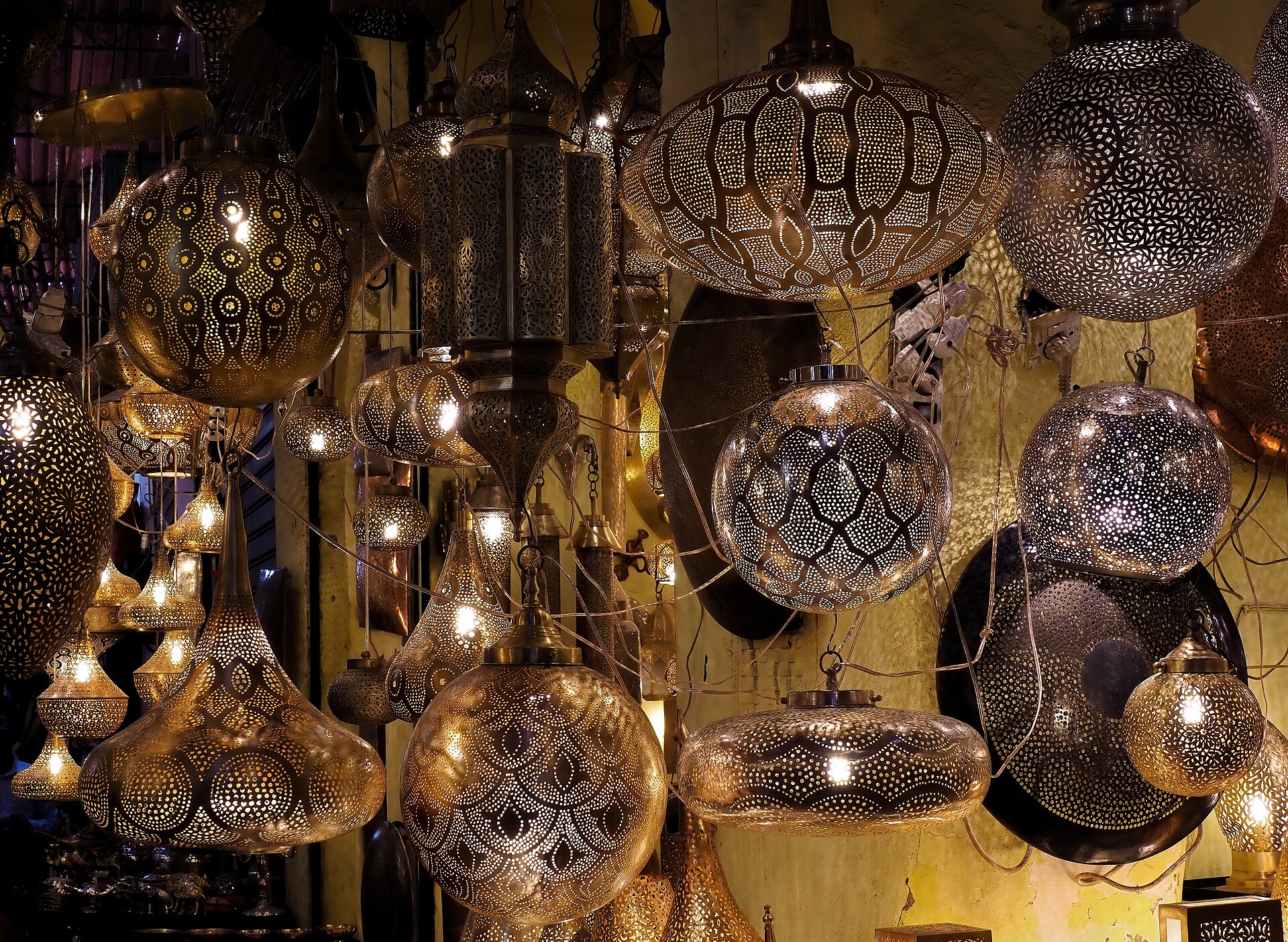
- The souks, with a guide. The tour listed in this itinerary lasts 3 hours. It gives you your bearings in a 700-hectare medina, which you then explore on your own. Sabaro advises doing it on the first day.
- The cooking workshop at La Maison Arabe. The half-day workshop, about 3 hours, teaches a starter and a main course, a tagine, with a dessert demonstration. It takes place at one of the house's two cooking schools: at the hotel or at its Country Club, where an organic garden supplies the herbs. Each cooking station has its own video screen. A one-hour express version exists for those short of time.
- Palaces and gardens. The Bahia Palace and the Ben Youssef Madrasa one morning; the Majorelle Garden another, at opening time, 8 am local time. Tickets for the garden and the Yves Saint Laurent Museum are sold online only, on the official site; the museum is closed on Wednesdays.
- Jemaa el-Fna, in the evening. The square is on UNESCO's intangible cultural heritage list for what happens there until late at night: storytellers, musicians, Gnawa dancers, stalls of traditional food. Watch it first from El Fenn's roof at sunset, then go down for dinner.
El Fenn's spa opens daily from 10 am to 6 pm, local time. Its tadelakt-lined hammam rounds off a morning in the souks.
The road to the ocean
Essaouira is about 184 km from Marrakesh, about 2 h 30 by road without stops. The private transfer listed in this itinerary is sold per vehicle, for up to three people. The country around Essaouira is argan land, where goats climb the trees.
You arrive on foot: cars stop at the gates of the medina. Heure Bleue Palais has its private car park at Bab Marrakech, at the entrance to the old town, and the hotel guides guests by phone on arrival.
Two days in Essaouira
The palace
Heure Bleue Palais is a late-19th-century palace, built on a former fondouk (a merchants' inn arranged around a courtyard) and set against the rampart near Bab Marrakech. Its 33 rooms and suites open onto a flowering patio. The hotel is a member of Relais & Châteaux, an association of independent hotels and restaurants, and has received a Michelin Key, the Michelin Guide's hotel distinction. On the roof, the heated pool and SAMA, an open-air restaurant facing the sea, are the place for the afternoon; the P'tit Spa has a hammam with black marble walls.
The town in two days
Two days are enough for the medina, the port and the beach. Sabaro advises following the wind, which picks up during the day: beach in the morning, medina in the afternoon, sheltered by the walls.
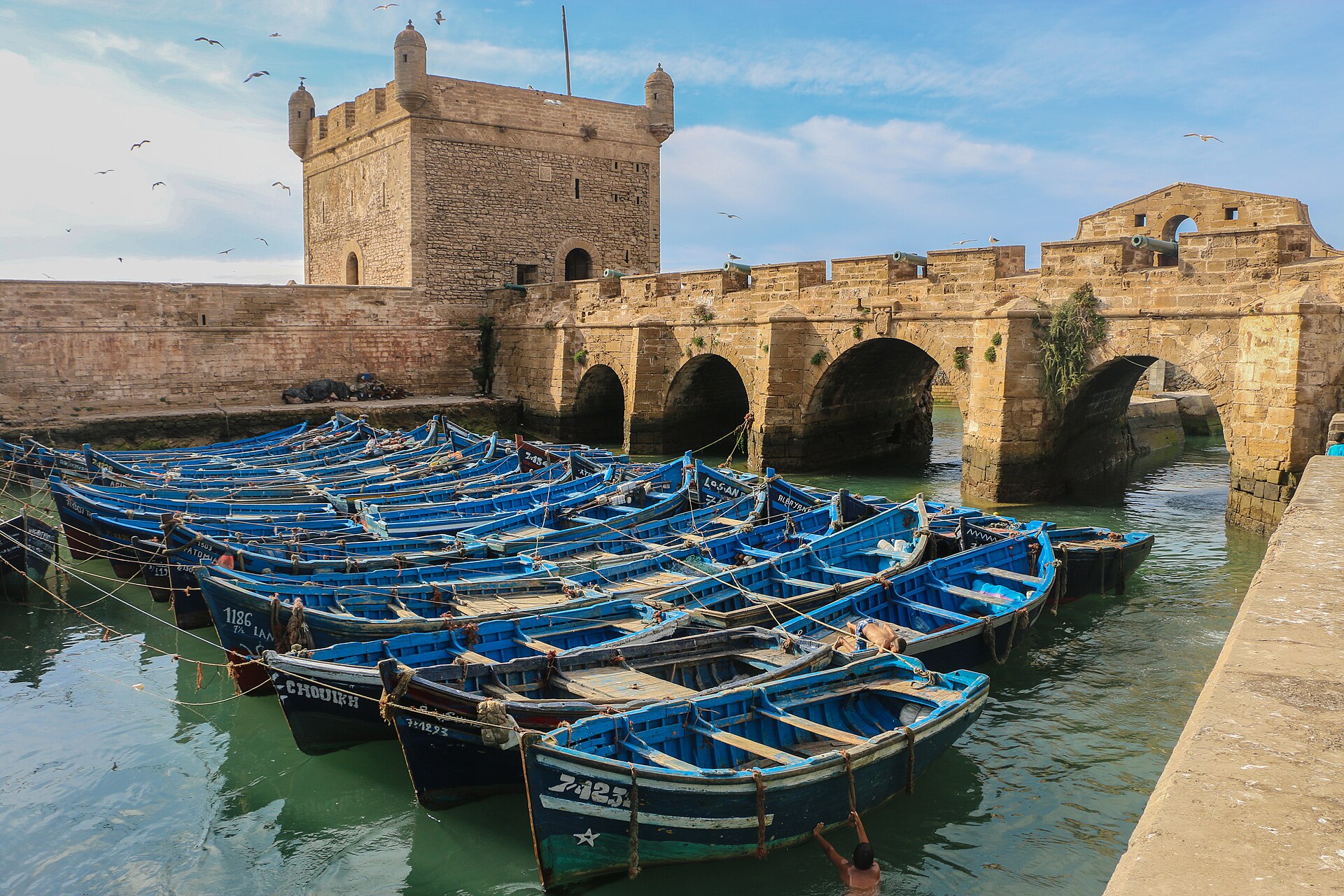
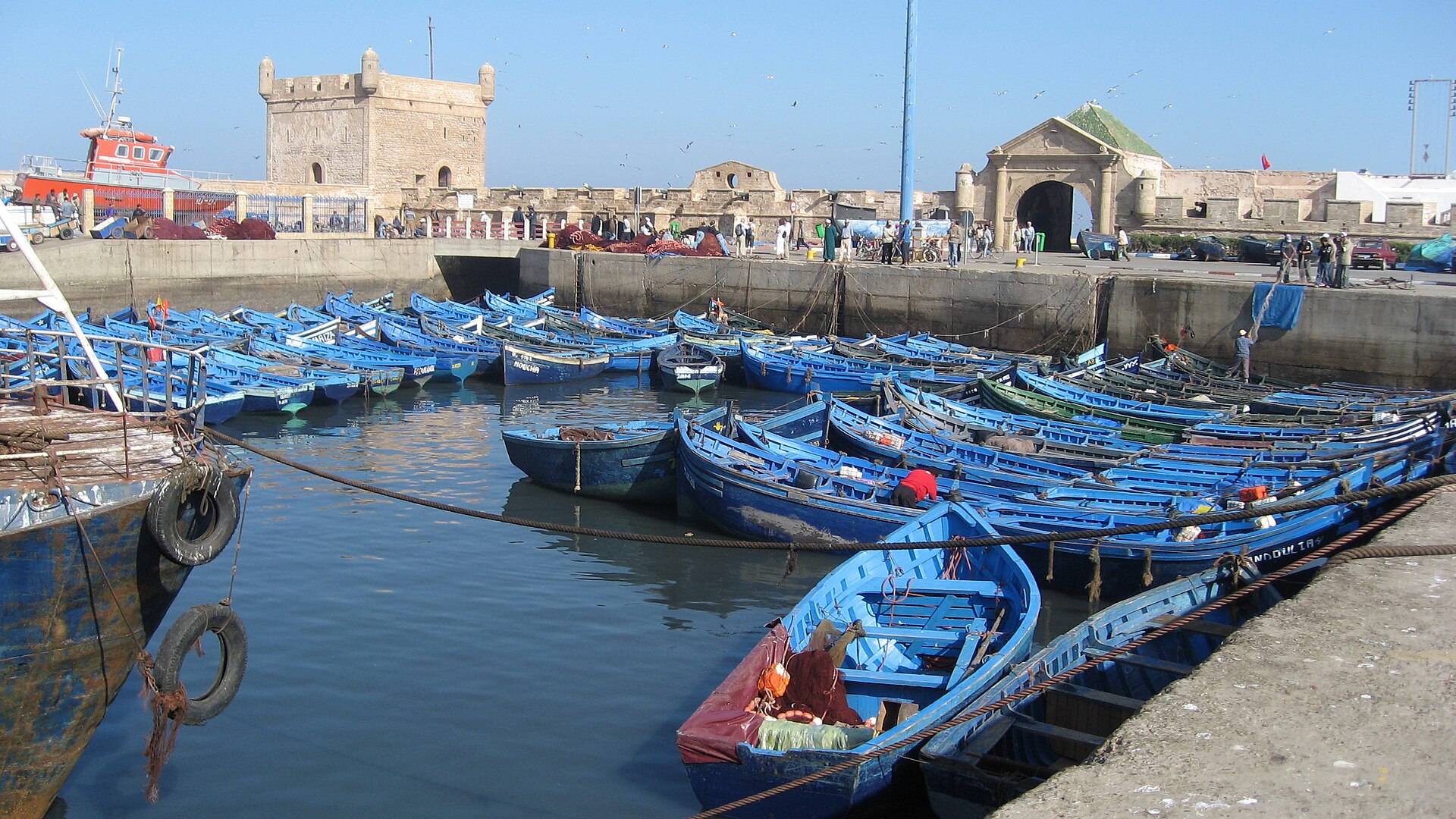
- On the first day, the ramparts and the Skala de la Kasbah, a bastion facing the open sea, with views of the Mogador islands; then the fishing port and the Sea Gate, where you lunch on fish caught overnight.
- On the second day, the Mellah, the former Jewish quarter, with Bayt Dakira, "the house of memory", which brings together the Slat Attia synagogue and a space devoted to Moroccan Judaism; then the beach. The water ranges from 16 to 19 °C depending on the month.
The Mogador islands are a nature reserve where landing requires official permission; they shelter a colony of Eleonora's falcons, a migratory raptor, and are watched from the ramparts.
Heure Bleue also gives a class in Moroccan and Souiri cooking, the cuisine of Essaouira: two dishes, prepared from 3 pm local time, then eaten for dinner, about 2 h 30 in all. It is booked 24 hours ahead and costs 1,000 dirhams per person, dinner included. It makes a sea-facing counterpart to the Marrakesh workshop.
Going home
Marrakesh airport is about 2 h 45 from the hotel, Agadir about 3 h. Essaouira-Mogador airport, 16 km south-east of town, is the closest; the hotel arranges private transfers on request.
Variations
- Reverse the order. Start in Essaouira if your flight lands in Essaouira or Agadir, and finish in Marrakesh, closer to its airport.
- A third night in Essaouira for a day on the water: kitesurfers, windsurfers and surfers find schools on the beach of the bay. Take the night from Marrakesh.
- In summer. Essaouira becomes the refuge: in July the average high there is 21.9 °C while Marrakesh reaches 37.7 °C. The trip works better with two nights in Marrakesh and four in Essaouira.
- For the Gnaoua festival. The Gnaoua and World Music Festival takes place in Essaouira from 24 to 26 June 2027. The town is full: Sabaro advises booking several months ahead.
Read next
Frequently asked questions
How long is the drive from Marrakesh to Essaouira?
About 2 h 30 for about 184 km, without stops. The private transfer is booked per vehicle, for up to three people.
Which season should I choose?
Spring and autumn. In summer, Marrakesh is very hot and Essaouira becomes the refuge; in winter, evenings are cool in both towns, and a riad is built around an open patio: a room with a fireplace changes winter evenings at El Fenn.
Can you swim in Essaouira?
Yes, but the water stays cool, 16 to 19 °C, and the wind blows often. The beach is best in the morning, before the wind picks up.
What is the difference between the two cooking classes?
At La Maison Arabe in Marrakesh, a 3-hour workshop on a starter, a tagine and a dessert demonstration. At Heure Bleue in Essaouira, a class on two dishes of Souiri cooking, turned towards the sea, followed by dinner.
What is the time difference with Morocco?
Morocco has been on GMT all year round since 20 September 2026: 1 hour behind Paris in winter and 2 hours behind in summer1 hour behind Brussels in winter and 2 hours behind in summer1 hour behind Geneva in winter and 2 hours behind in summer1 hour behind Luxembourg in winter and 2 hours behind in summerthe same time as London in winter and 1 hour behind in summerthe same time as Dublin in winter and 1 hour behind in summer1 hour behind Frankfurt in winter and 2 hours behind in summer1 hour behind Vienna in winter and 2 hours behind in summer1 hour behind Amsterdam in winter and 2 hours behind in summer1 hour behind Rome in winter and 2 hours behind in summer1 hour behind Madrid in winter and 2 hours behind in summerthe same time as Lisbon in winter and 1 hour behind in summer1 hour behind Warsaw in winter and 2 hours behind in summer1 hour behind Prague in winter and 2 hours behind in summer1 hour behind Stockholm in winter and 2 hours behind in summer1 hour behind Copenhagen in winter and 2 hours behind in summer1 hour behind Oslo in winter and 2 hours behind in summer2 hours behind Helsinki in winter and 3 hours behind in summer.
A travel advisor replies by email. Free, no commitment.