Abu Simbel Sun Festival
Abu Simbel
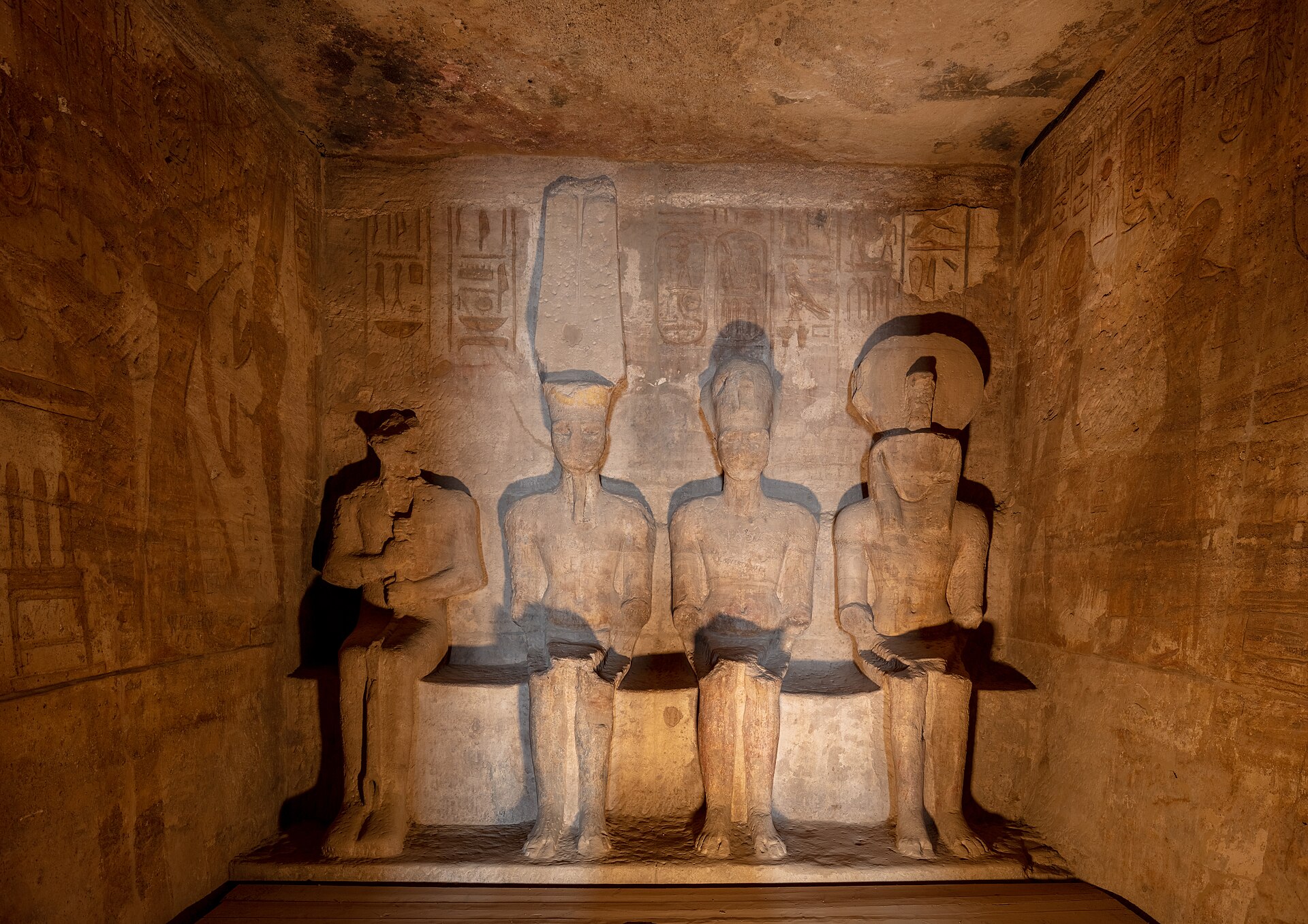
On 22 February and 22 October, around 6:20 am local time, the rising sun travels the length of Abu Simbel's Great Temple and lights up, for about twenty minutes, the statues of Amun-Ra, Ra-Horakhty and Ramesses II at the back of the sanctuary.
Dates
- 22 February 2027
Source: Egypt Independent — accessed 11 October 2026
A ray of light deep inside the mountain
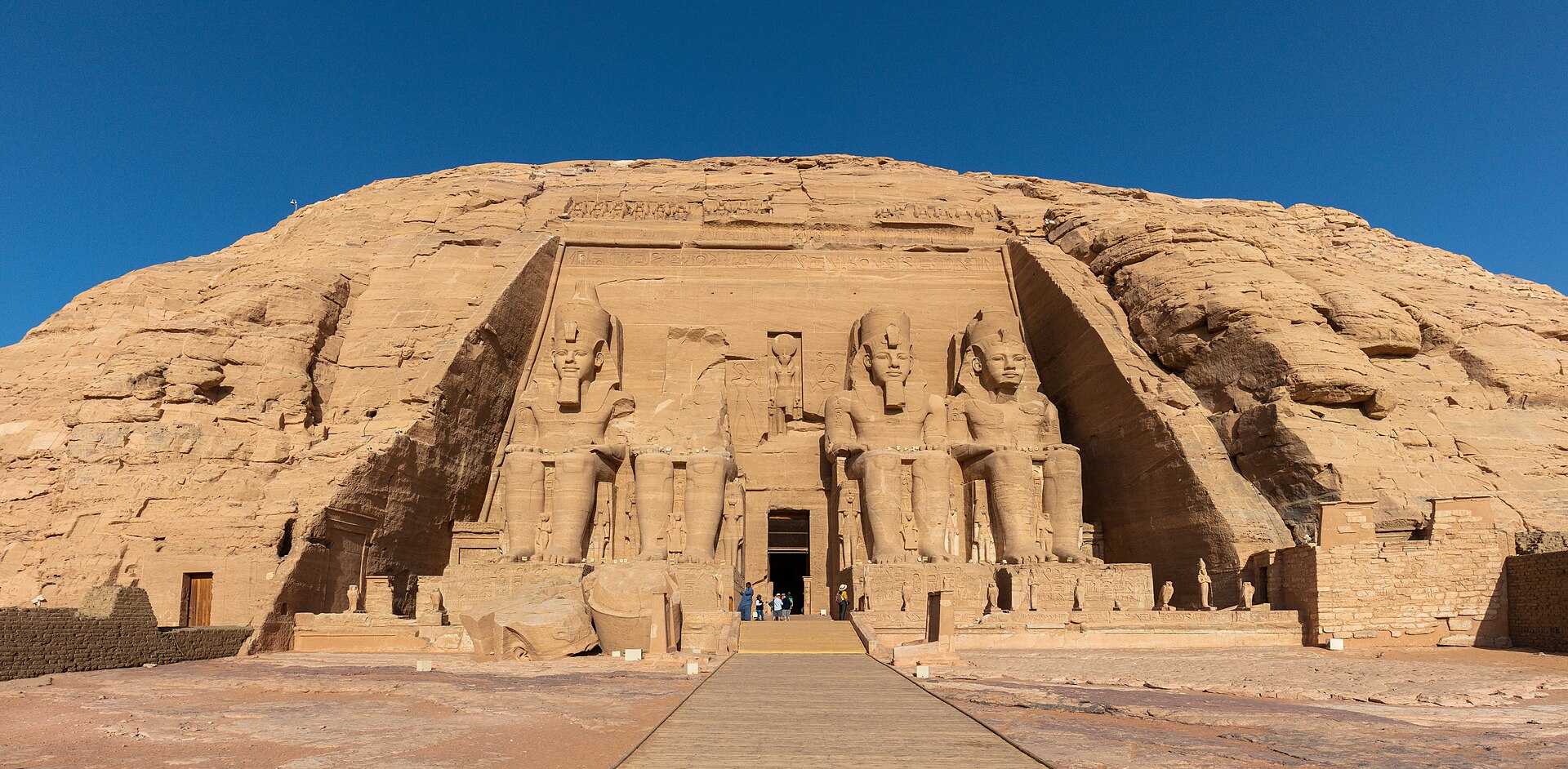
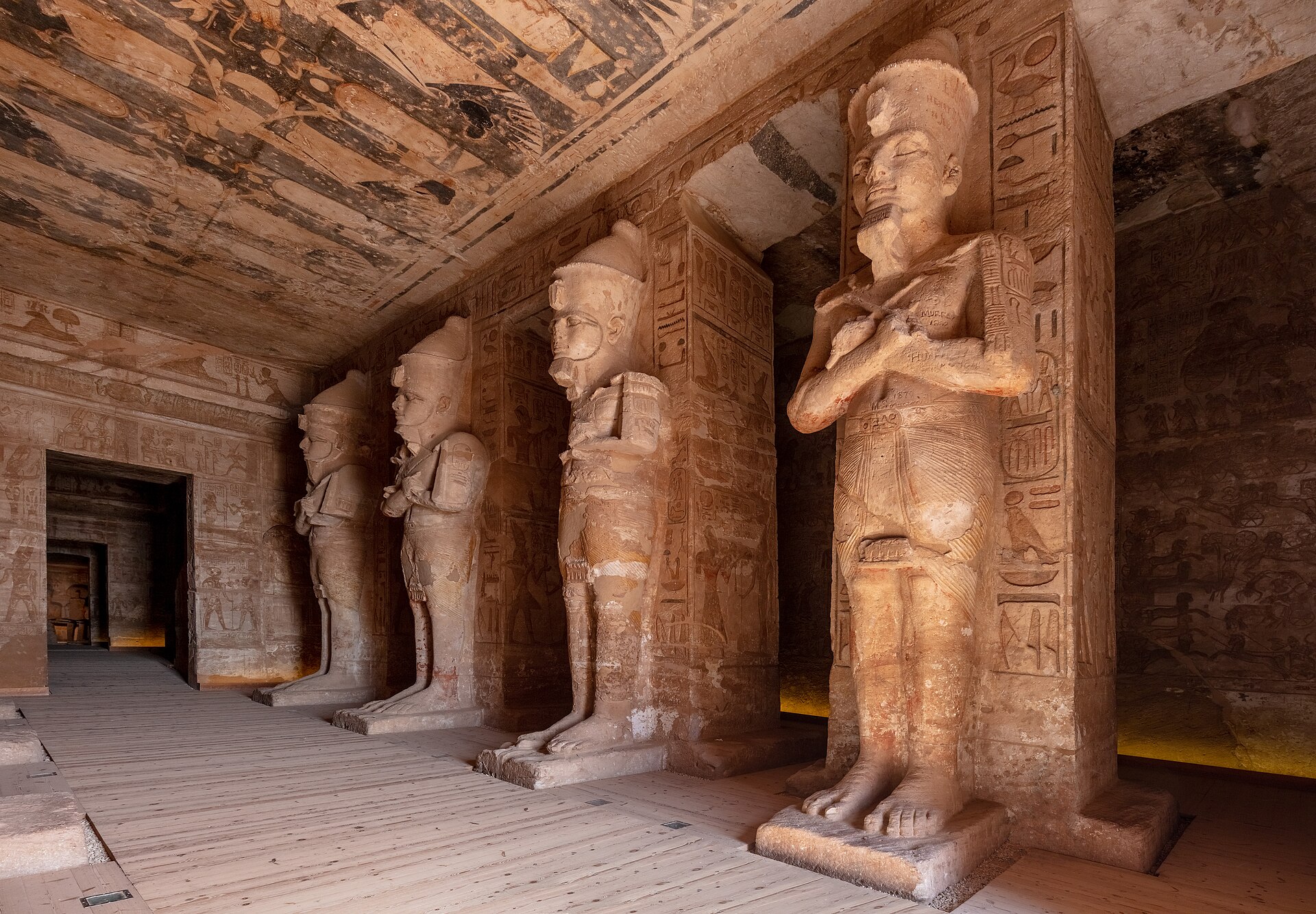
Abu Simbel's Great Temple is cut into the cliff, facing the sunrise. Behind the façade and its four colossi of Ramesses II, a sequence of halls runs into the rock as far as the sanctuary, where four seated statues sit against the back wall: Ptah, Amun-Ra, the deified Ramesses II and Ra-Horakhty, the morning sun.
Twice a year, the temple's axis lines up with the sunrise. The first ray passes the doorway, travels the full length of the halls and lights up three of the four statues. Ptah, god of darkness, stays in shadow. The phenomenon begins around 6:20 am local time and lasts about twenty minutes: on 22 February 2022 it began at 6:23 am.
Tradition links the two dates to the pharaoh's life: 22 February to his birthday, 22 October to his coronation.
A relocated temple, one day later
The temple, carved around 1264 BC, no longer stands where it was built. Threatened by the waters of Lake Nasser, it was cut into blocks and rebuilt higher up in 1968, during the international campaign to save the temples of Nubia led by UNESCO (the United Nations Educational, Scientific and Cultural Organization). The building's orientation was preserved. According to most sources, the phenomenon used to fall on 21 February and 21 October; the move shifted it by one day.
The day itself
The event draws thousands of visitors: about 3,000 tourists in October 2018, about 6,000 in February 2022. For the occasion, the site is fitted with electronic gates, X-ray scanners and surveillance cameras, and folk troupes from several regions of Egypt perform on the temple forecourt and in town.
According to the Ministry of Tourism and Antiquities website, on these two days the ticket rises to EGP 1,200 for a foreign adult (EGP 1,272 on the official online ticket office), instead of EGP 750, and EGP 600 for a student. The site normally opens at 6 am local time.
The queue forms well before dawn. Sabaro recommends allowing the whole morning on site: the sunrise first, then a visit to both temples, that of Ramesses II and that of Queen Nefertari, once the crowd thins out.
Being there before dawn
This is the real challenge. Abu Simbel is about 280 km south of Aswan, near the Sudanese border. Standard excursions leave Aswan around 4 am and arrive around 8 am local time: after the phenomenon.
There are two ways to be in front of the temple in time:
- Sleep on board a Lake Nasser boat. Lake cruises call at the foot of the temples and spend the night there on board; Sabaro's Lake Nasser trip idea describes how it works. Choose a departure whose Abu Simbel stop falls on the eve of the 22nd.
- Sleep in the small town of Abu Simbel, next to the site. Accommodation is limited and is booked far in advance for these dates.
Before and after, Aswan remains the base: the Old Cataract, facing Elephantine Island, Benben by Dhara, on an island facing Philae, or the Sonesta Nouba, on the east bank. The Sudanese border area, including the road south of Abu Simbel, is among the areas advised against: Abu Simbel is the end of the line.
February or October
The two dates feel quite different.
- 22 February falls in the heart of the high season. In Aswan, winter mornings are cool, around 10 °C in January: a jacket helps while you wait. In 2027 the date falls during Ramadan, expected to start around 8 February, with visiting hours sometimes adjusted.
- 22 October opens the season, with days that are still hot, around 36 °C average maximum in Aswan. Dawn is pleasant; the rest of the day is best spent in the shade or by the water.
Either way, the trip combines with Aswan, Philae and a Nile cruise to Luxor.
Frequently asked questions
When is the Abu Simbel Sun Festival?
On 22 February and 22 October every year, at sunrise, around 6:20 am local time. The phenomenon lasts about twenty minutes.
How much is the ticket on those days?
EGP 1,200 for a foreign adult and EGP 600 for a student, according to the Ministry of Tourism and Antiquities, instead of EGP 750 and EGP 375 on other days.
Can you see it on a day trip from Aswan?
Standard excursions arrive around 8 am, after the phenomenon. Sabaro recommends sleeping on site the night before, on a Lake Nasser boat or in the town of Abu Simbel.
Which statues are lit up?
Amun-Ra, Ramesses II and Ra-Horakhty. The fourth statue in the sanctuary, Ptah, god of darkness, stays in shadow.