The Western Desert, from the White Desert to Siwa, 9 days
9 days · Travellers comfortable with long drives, desert lovers · November to March
Nine days in Egypt's Western Desert: a night in Bahariya, a night in camp in the White Desert, stops in Giza and Alexandria, then three nights at Adrère Amellal in Siwa Oasis, reached along the Mediterranean coast. A road trip, about 25 hours of driving in all, for two desert landscapes rarely seen together.
Itinerary
- Days 1–2 Cairo · 1 nights — Four Seasons Hotel Cairo at Nile Plaza
- Days 2–3 Bahariya Oasis · 1 nights
- Days 3–4 Black and White Deserts, night in camp · 1 nights
- Days 4–5 Giza · 1 nights — Marriott Mena House
- Days 5–6 Alexandria · 1 nights — Four Seasons Hotel Alexandria at San Stefano
- Days 6–9 Siwa Oasis, via El Alamein and Marsa Matruh · 3 nights — Adrère Amellal
Activities included in the indicative price
- Private trip to the White Desert and Bahariya, with a night in camp (from Cairo; cheapest option) · 313 € per person
Public price collected on: Civitatis — accessed 14 October 2026
- Guided tour of Alexandria with lunch (Qaitbay, catacombs, Bibliotheca Alexandrina) · 62 € per person
Public price collected on: Civitatis — accessed 14 October 2026
A detour that shapes the trip
On the map, Bahariya and Siwa look like neighbours: a direct road crosses the desert between them. It is closed by the army. The trip therefore runs along the coast, between the Nile Delta and Marsa Matruh, then takes the Marsa Matruh–Siwa road. Foreign ministries do not all give the same advice for these regions. Here is your country's:
| Country | Official advice | Source |
|---|---|---|
| France | Increased vigilance (yellow) in Cairo, Alexandria, the Nile Valley, the Red Sea coast and the South Sinai coast (secured hotels advised); North Sinai and the Israeli border in red, North Sinai closed to foreigners; Libyan and Sudanese borders in red, western desert in orange; no driving at night outside towns, buses included; registration with Ariane advised; French embassy in Cairo: +20 2 35 67 32 00. | diplomatie.gouv.fr (Site last updated 21 September 2026) |
| Belgium | Except North Sinai, the Western Desert and the border zone with Libya and Sudan (advised against, no consular assistance possible), it is generally safe to travel in Egypt, taking into account the points of attention and the regional situation. After the events in Israel and the Palestinian Territory, demonstrations may flare up again, including without warning; the army and police may intervene violently. In case of unrest, limit travel outside hotel complexes; avoid demonstrations and gatherings and take no photos or videos; participants may be held in custody for long periods. Egyptian airspace remains open. Register on Travellers Online. | SPF Affaires étrangères (Belgique), Égypte, dernière mise à jour (Site last updated 2 October 2026) |
| United Kingdom | All travel advised against in North Sinai, along the Israeli border and within 20 km of the Libyan border; all but essential travel advised against in the Western Desert, except Luxor, Aswan, Abu Simbel, Fayoum, the Bahariya, Farafra, Dakhla, Kharga and Siwa oases and the roads linking them (the Bahariya–Siwa road remains advised against), and in the north of South Sinai beyond the St Catherine–Nuweiba road, coasts excepted. | GOV.UK (accessed 14 October 2026) |
| Netherlands | Red (do not travel): North Sinai north of the Suez–Taba line, the border areas with Libya and Sudan, the Halaib Triangle and Bir Tawil. Orange (essential travel only, no holidays): western Egypt except the town of Siwa, reachable by the secured Highway 19; central Sinai north of the St Catherine–Nuweiba road, with permission from the local authorities; north-west Sinai; the area around the Halaib Triangle. Yellow for the rest of the country, including the Suez Canal. Risk of terrorist attacks throughout the country; Hurghada–Luxor road open in daytime only, with prior permission from the tourist police for tour operators; demonstrations banned. Dutch embassy reachable 24/7 through the contact centre: +31 247 247 247. | Nederland Wereldwijd (Site last updated 19 June 2026) |
| Switzerland | Not checked by Sabaro: see DFAE (eda.admin.ch) | |
| Luxembourg | Not checked by Sabaro: see mae.gouvernement.lu | |
| Ireland | Not checked by Sabaro: see ireland.ie (DFA) | |
| Germany | Not checked by Sabaro: see Auswärtiges Amt | |
| Sweden | Not checked by Sabaro: see Regeringen (UD) | |
| Denmark | Not checked by Sabaro: see Udenrigsministeriet (um.dk) | |
| Norway | Not checked by Sabaro: see Regjeringen | |
| Poland | Not checked by Sabaro: see Odyseusz (MSZ) | |
| Czechia | Not checked by Sabaro: see MZV ČR | |
| Austria | Not checked by Sabaro: see BMEIA | |
| Italy | Not checked by Sabaro: see Viaggiare Sicuri | |
| Spain | Not checked by Sabaro: see exteriores.gob.es | |
| Portugal | Not checked by Sabaro: see Portal das Comunidades | |
| Finland | Not checked by Sabaro: see Ulkoministeriö (um.fi) | |
Hence the shape of this trip, a loop in two parts. First an out-and-back south-west of Cairo, for Bahariya and the White Desert. Then a second departure northwards, through Alexandria and along the Mediterranean, before heading back down to Siwa. Giza and Alexandria, in between, serve both as sightseeing stops and as breaks between two long drives.
This trip is for people who enjoy the road: about 25 hours of driving over nine days, not counting the 4x4 (four-wheel-drive) outings. In return, it brings together two very different deserts, the chalk rocks of the White Desert and the dunes of the Great Sand Sea around Siwa, with two historic cities on the way.
Days 1 to 4: Bahariya and the White Desert
Day 1, Cairo. Arrival and a night at the Four Seasons Nile Plaza, on the Nile corniche in Garden City.
Day 2, the Bahariya road. About 370 km and 4 hours south-west. Bahariya is the closest of the Western Desert oases to Cairo: a fertile strip of about 90 km by 40 around the town of Bawiti, with date palms, olive trees and hot springs. The afternoon is spent in the oasis: the date gardens, the salt lake, the view from Gabal al-Ingleez, the "English Mountain", then a soak in one of the springs that rise at 40 °C or more north-east of Bawiti, such as Bir Ramla, 2 km away. The small Bawiti museum shows some of the finds from the Valley of the Golden Mummies, a Graeco-Roman necropolis that is still being excavated. This night in the oasis is what sets the trip apart from the usual two-day formula, which only passes through Bahariya.
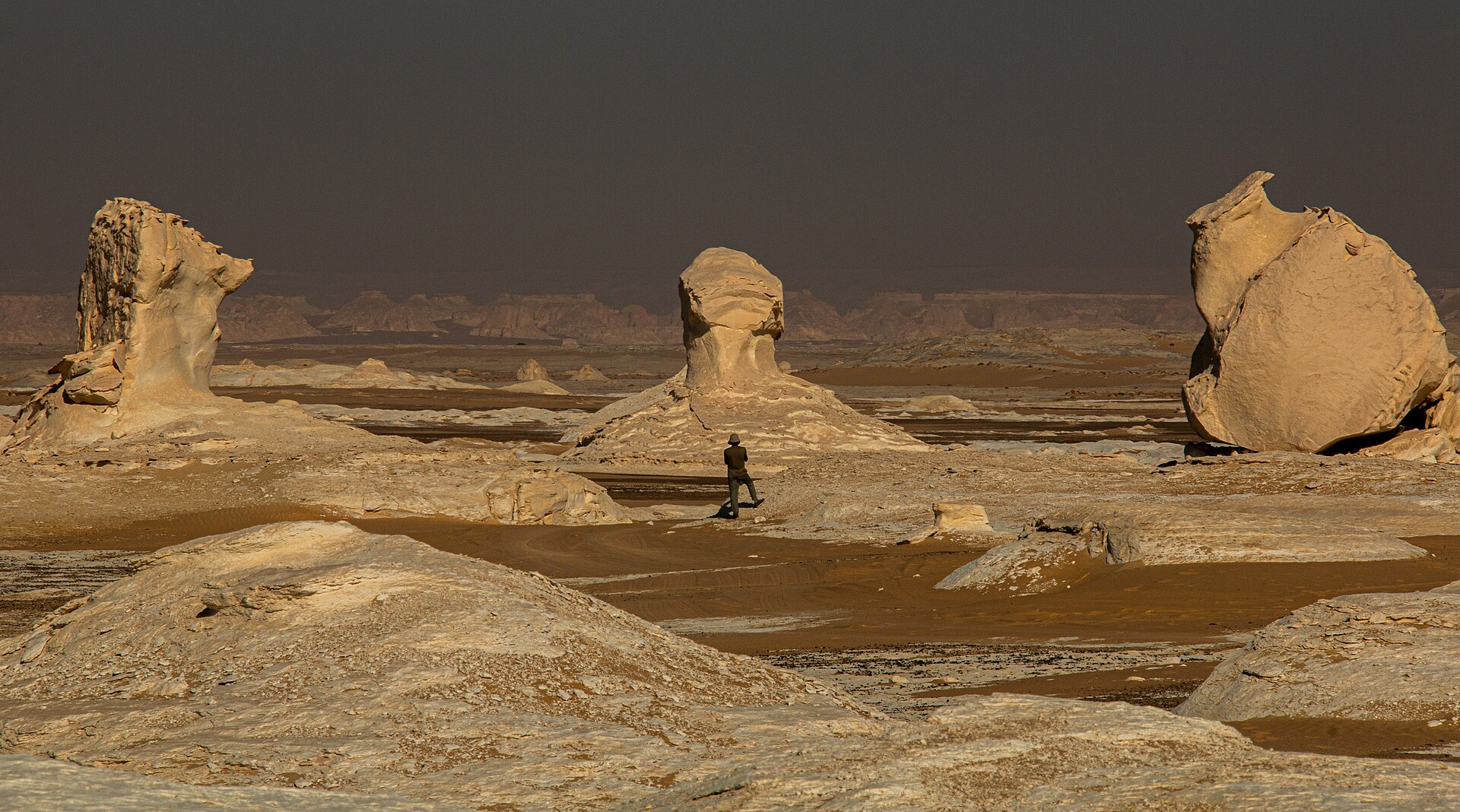
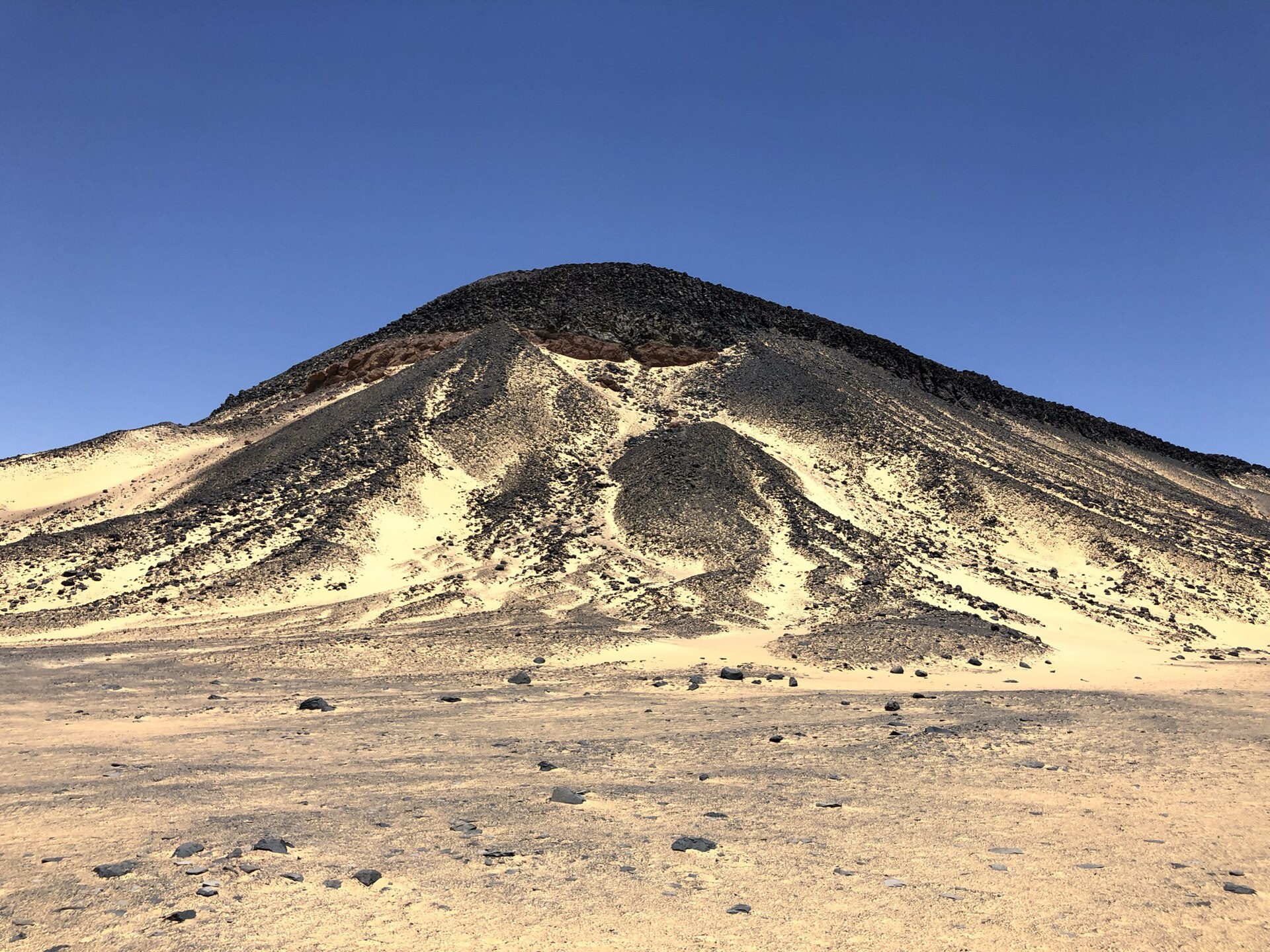
Day 3, from the Black Desert to the White Desert. You leave by 4x4 heading south. Within a hundred kilometres, three landscapes follow one another: the Black Desert, hills capped with basalt on ochre sand, with Gebel el-Marsus as its clearest outline; the village of El-Hez and the Agabat area; Crystal Mountain, a natural arch lined with crystals, to be looked at and left untouched. Then the formations of the White Desert, chalk and limestone rocks carved by the wind into mushrooms and towers, reached in time for sunset. Dinner and a night in camp, under canvas.
The White Desert is a protected area. Your operator keeps to the tracks, sets up camp at one of the fifteen designated bivouac sites, brings its own fuel and takes all rubbish away; nothing is carved on the rocks, and stones and fossils stay where they are. In winter the nights are cold, around 10 °C in Bahariya and lower in the desert: a warm layer and a hat belong in the bag.
Day 4, back to Giza. Sunrise on the rocks, the 4x4 back to Bahariya, then the Cairo road: organised trips bring their guests back by mid-afternoon. The night is at the Marriott Mena House, 760 m from the Pyramid of Khufu; at the end of the day, the 139 Pavilion terrace, facing the plateau, is enough to see the pyramids.
Day 5: Giza in the morning, Alexandria in the afternoon
This is the busiest day of the trip. The Giza plateau opens at 07:00 local time: a visit at opening, ahead of the heat and the groups, leaves time to set off for Alexandria in the late morning. The road is about 220 km, a little over 2 hours.
The guided tour of Alexandria listed in this idea lasts 7 hours, with a fish lunch by the Mediterranean: Qaitbay Fort, built in the 15th century on the ruins of the ancient lighthouse, the Roman catacombs of Kom el-Shuqafa and the Bibliotheca Alexandrina. The library is closed on Fridays and Saturdays; on those days the tour goes to the Abu al-Abbas al-Mursi mosque and the corniche instead. The fort stays open until 20:00 local time, so it can be kept for the end of the day, above the sea.
The night is at the Four Seasons on the corniche at San Stefano. From November to April its private beach is closed; the heated indoor pool on the 5th floor stays open.
Day 6: the coast road
Alexandria to Siwa is 584 km, about 7 h 45 of driving without stops. This is the stage that calls for the most discipline.
- Leave at dawn. Night driving outside towns is strongly advised against, and winter days are short: you need to reach Siwa before dark.
- El Alamein, a short stop. West of Alexandria, the Commonwealth war cemetery holds 7,240 Second World War graves, and a military museum tells the story of the two battles of 1942. An hour there fits the day; any longer would mean finishing the drive after dark.
- Marsa Matruh, the last landmark. About 290 km from Alexandria, the town marks the end of the coast. About 300 km remain to the south-west, roughly 4 hours, across desert with no petrol station and a café halfway.
- Checkpoints. There are police checkpoints on the road: keep your passport to hand.
The transfer is booked with a driver who knows the route and speaks Arabic.
Days 6 to 9: three nights in Siwa
Siwa is the most remote of the five Western Desert oases: a depression about 80 km by 20, at or slightly below sea level, some fifty kilometres from the Libyan border. Its people are Amazigh (Berber) and speak Siwi, a Berber language, as well as Arabic.
Adrère Amellal sets the pace. This 40-room ecolodge, built of kershef, a mix of salt, clay and straw, has no electricity: candles in the evening, fireplaces in winter, no sockets in the rooms. Full board includes drinks, alcohol included, and two excursions a day, the town in the morning and the desert in the afternoon. Three nights give two full days.
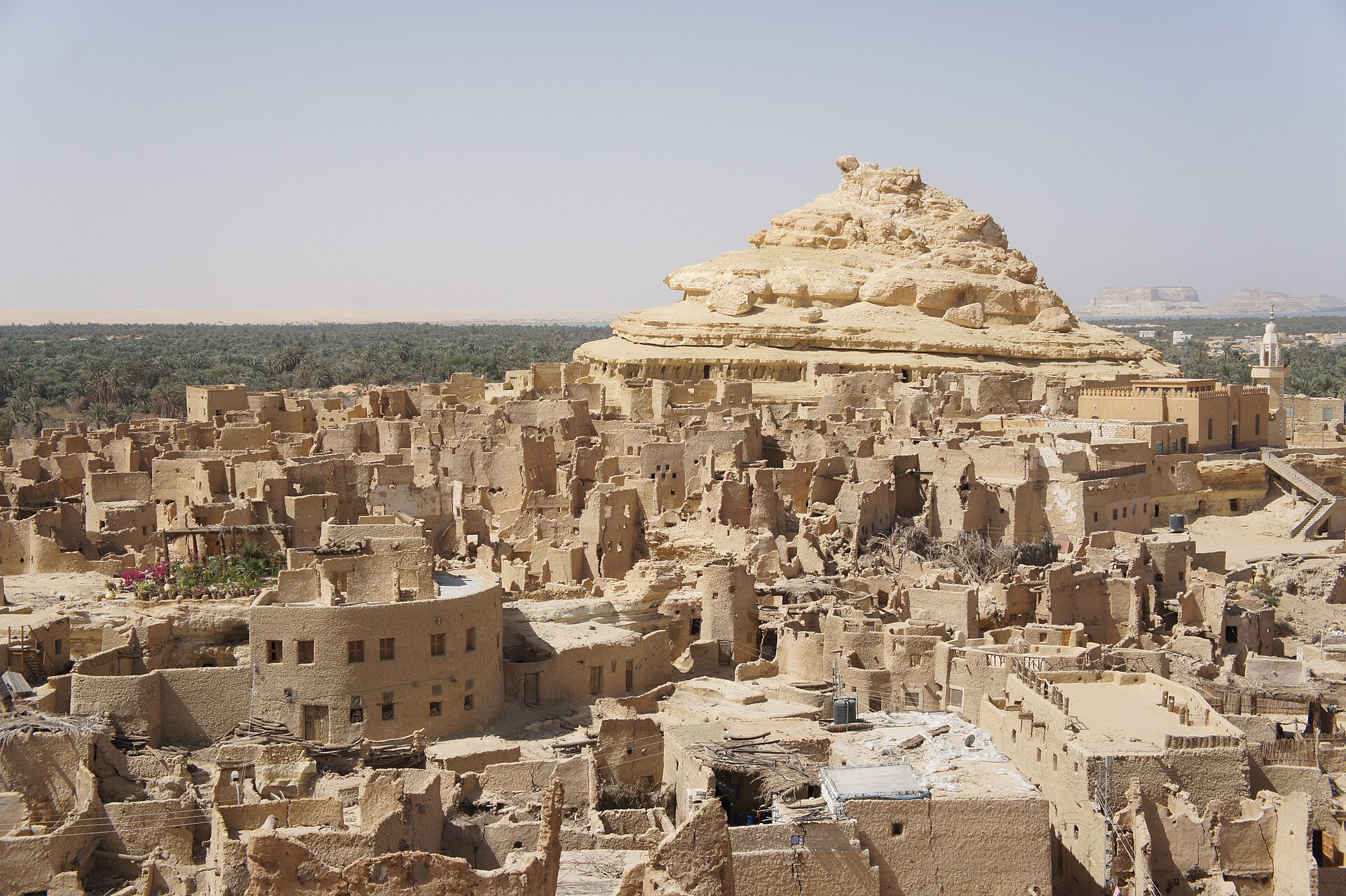
A day for the town and antiquity. Shali fortress, the old walled town about eight centuries old, restored and reopened at the end of 2020; the Temple of the Oracle of Amun at Aghurmi, where Alexander the Great came to consult the oracle in 331 BC; Gebel al-Mawta, a hill honeycombed with Ptolemaic and Roman tombs, including the tomb of Si-Amun and its painted reliefs. Photography is not allowed in the main tombs.
A day for water and sand. Cleopatra's Bath, a pool fed by a warm spring; the salt lakes, where you float without effort; then a 4x4 trip into the first dunes of the Great Sand Sea, as far as Bir Wahed, a sulphurous hot spring 12 km south-west of town, next to a cold-water lake. These outings require a permit, which the local guide obtains with a copy of your passport. In the evening, Fatnas Island, now joined to the shore, is the usual viewpoint for sunset.
The rest of the time is spent at the ecolodge: the spring-fed pool in the palm grove, the twenty-minute climb to the top of the "white mountain" that gives it its name, and a dinner that moves to a different spot each evening depending on the wind.
Siwa is a conservative community. Alcohol is not drunk in public, clothing that covers shoulders and legs is expected, and the fare for a donkey-cart ride is agreed before setting off.
Day 9, the return. Siwa to Cairo is about 800 km, 7 to 10 hours on the road depending on stops; leaving at first light gets you in before dark. This day leaves no room for an international flight: Sabaro recommends an extra night in Cairo and a flight the next day. The oasis also has an airport with a link to Cairo; Sabaro checks at booking whether there is a flight on your dates, which makes this last day much lighter.
Permits, guides and safety
The White Desert and Bahariya are visited with an approved operator. Tourists entering the Bahariya Oasis, Farafra, White Desert and Black Desert areas must apply for permits in advance and use an official guide; the operator handles this. Phone reception is limited and medical facilities are poor.
A locally recognised agency or guide is strongly recommended, with means of communication, plenty of water and suitable clothing; keep strictly to the secured roads to the oases. Do not leave roads and marked tracks, because of the risk of landmines in desert areas, and do not travel at night outside towns and tourist sites, by car or by bus. South of Siwa, a zone closed to civilians and vehicles has been in place since 2014: trips west and south of the oasis are made with a local guide who knows its limits.
When to go
November to March. In Siwa, according to the station's 1991–2020 normals, the average maximum temperature ranges from 20 °C in January to 25.6 °C in November and March, with nights of 7 to 12 °C; from June to August it reaches 38 to 39 °C. Bahariya follows the same pattern, with mild days and cold nights in winter. Christmas and Easter are the busiest times in the White Desert; in Siwa it is best to avoid Ramadan, when part of the oasis closes.
Variations
- Two nights in the desert. Three-day trips from Cairo can include two nights in camp instead of the night in Bahariya: more time in the White Desert, less in the oasis.
- Breaking up the coast road. A night in Marsa Matruh splits the Alexandria–Siwa stage in two and leaves time for El Alamein. It adds a day; the town's beaches and most of its shops come alive mainly from June to September.
Read next
Frequently asked questions
Can you drive directly from Bahariya to Siwa?
The direct road is closed by the army. The trip therefore goes through Cairo, Alexandria and along the coast to Siwa.
Do you need a permit for the White Desert?
Yes. The permit is applied for in advance and the visit is made with an official guide; the tour operator takes care of it. Trips into the Great Sand Sea at Siwa also need a permit, obtained by the local guide.
Can you charge a phone at Adrère Amellal?
The rooms have no sockets: the ecolodge has no electricity. Bring a charged power bank and a head torch; the last chance to recharge is in Alexandria.
When should you go?
From November to March, when days are mild in Siwa and Bahariya. Nights are cold, especially in the White Desert. From June to August the average maximum approaches 39 °C in Siwa.
A travel advisor replies by email. Free, no commitment.