Getting around Tunisia: car, train, plane, TGM and ferries
In Tunisia, a car, with a driver or hired, is the most flexible way to travel between regions, on a good road network with a motorway from Tunis to the Libyan border; driving at night is strongly discouraged. In Tunis, the TGM train serves Carthage, Sidi Bou Said and La Marsa; in the Sahel, the Sahel Metro starts at Monastir airport. For the south-west, flying is recommended, with Tunis - Tozeur flights.
Checked on 20 October 2026
A car is the most flexible way to get around Tunisia: the road network is good, and the A1 motorway now runs from Tunis to the Libyan border via Sousse, Sfax and Gabès. Trains are slow but punctual, domestic flights bring Tozeur and Djerba within reach of Tunis, and two urban networks are useful to visitors: the TGM in Tunis and the Sahel Metro between Monastir, Sousse and Mahdia. One rule applies everywhere: stay off the roads outside towns after dark.
Distances from Tunis
Driving times from Tunis-Carthage Airport, calculated with no stops or traffic; allow more in practice.
| Destination | Distance | Time |
|---|---|---|
| Carthage, Sidi Bou Said, La Marsa | 15-16 km | about 15 min |
| Hammamet | 75 km | about 1 h |
| Dougga | 113 km | about 1 h 45 |
| Sousse | 160 km | about 2 h 10 |
| Tabarka | 171 km | about 2 h 45 |
| Kairouan | 174 km | about 2 h 30 |
| El Jem | 218 km | about 2 h 45 |
| Mahdia | 224 km | about 3 h |
| Tozeur | 429 km | about 6 h 35 |
| Djerba (Houmt Souk) | 525 km | about 7 h |
Four other international airports are useful to travellers: Enfidha-Hammamet and Monastir for the Sahel, Djerba-Zarzis and Tozeur-Nefta for the south. Flying into the right one often saves hours on the road: Sousse is 15 km from Monastir airport, Houmt Souk 9 km from Djerba's.
Driving in Tunisia
Licences and car hire
Depending on the country that issued your licence, your national licence is enough for a tourist stay, or you also need a 1968 international driving permit, obtained in that country before you travel. The formalities for your country:
Entry requirements
| Nationality | Visa | Travel document | Source |
|---|---|---|---|
| French | No visa for stays of up to three months; beyond that, visa and residence card from the Ministry of the Interior; overstaying requires exit authorisation and a fine proportional to the overstay | Passport compulsory for all stays, valid for at least 3 months on the date of entry (rule in force since 1 January 2025). The ID card, formerly accepted on package tours, no longer is | France Diplomatie, Conseils aux voyageurs, Entrée / séjour (Site last updated 15 September 2026) |
| Details: French child travelling with one parent: no authorisation required on leaving Tunisia; family record book useful if surnames differ. Child who is also a Tunisian national: Tunisian passport and exit authorisation signed by the Tunisian parent before a Tunisian authority. French-Tunisian dual nationals: treated as Tunisian and asked for a Tunisian passport. Always carry ID or a copy of the passport photo page | |||
| Belgian | See the official page | Valid passport | Travel documents (Site last updated 17 January 2025) |
| Swiss | See the official page | The FDFA advises always carrying a photocopy of the passport or ID card, including the entry-stamp page — See the official page | DFAE (Département fédéral des affaires étrangères, Suisse), Conseils pour les voyages – Tunisie, « Adresses utiles » et « Criminalité » (Site last updated 3 November 2025) |
| British | Up to 90 days without a visa (except Crown Dependency passports, which may need a visa on arrival); get the passport stamped; overstay fine payable on departure; contact details, return or onward ticket and accommodation booking may be requested | Passport valid for the whole stay and in good condition (a damaged passport may cause problems on exit) | GOV.UK (FCDO), Tunisia, Entry requirements (Site last updated 24 July 2026) |
| Details: Always carry ID or a copy of the passport photo page. Driving: a 1968 international driving permit, obtained in the UK before you travel, in addition to your UK licence; a green card (international certificate of insurance) for the vehicle | |||
| German | No visa for tourist, private or business stays of up to 120 days; keep the 'non-resident visitor card' issued at some airports; beyond 120 days, TND 20 per five-day period, payable on departure | Passport or child passport valid for at least 6 months on entry; ID card not accepted; temporary passport accepted with a return ticket and sufficient funds. Without a package-tour booking, border police may ask for proof of funds | Auswärtiges Amt, Tunesien: Reise- und Sicherheitshinweise, « Einreise und Zoll » (Site last updated 6 October 2026) |
| Details: Child passport accepted. The parental authorisation formerly required for Tunisian or dual-national minors not accompanied by the Tunisian parent is officially no longer needed, but is sometimes still requested on exit. German-Tunisian dual nationals: treated as Tunisian and asked for a Tunisian passport. No vaccination required for travellers arriving from Germany. Driving: a German national licence is recognised for a tourist stay | |||
| Dutch | No visa for stays of up to 90 days with a Dutch passport; beyond that, visa from the Tunisian embassy in The Hague. On arrival, proof of a hotel booking is required, possibly also a return ticket and proof of sufficient funds; otherwise entry may be refused | Passport valid for the whole stay | Nederland Wereldwijd (ministère néerlandais des Affaires étrangères), Reisadvies Tunesië (Site last updated 17 September 2026) |
| Details: Each child needs their own passport; an adult travelling alone with one or more children under 18 should carry the documents required for travelling with a minor. Dutch driving licences are valid in Tunisia. Always carry your passport or a copy | |||
| Luxembourgish | Not checked by Sabaro: see mae.gouvernement.lu | ||
| Irish | Not checked by Sabaro: see ireland.ie (DFA) | ||
| Swedish | Not checked by Sabaro: see Regeringen (UD) | ||
| Danish | Not checked by Sabaro: see Udenrigsministeriet (um.dk) | ||
| Norwegian | Not checked by Sabaro: see Regjeringen | ||
| Polish | Not checked by Sabaro: see Odyseusz (MSZ) | ||
| Czech | Not checked by Sabaro: see MZV ČR | ||
| Austrian | Not checked by Sabaro: see BMEIA | ||
| Italian | Not checked by Sabaro: see Viaggiare Sicuri | ||
| Spanish | Not checked by Sabaro: see exteriores.gob.es | ||
| Portuguese | Not checked by Sabaro: see Portal das Comunidades | ||
| Finnish | Not checked by Sabaro: see Ulkoministeriö (um.fi) | ||
Rules change: always check the official website before you travel.
Tourists entering with their own vehicle receive a three-month circulation permit; they are insured if their green card, the international certificate of insurance, covers Tunisia.
To hire a car you need your passport and licence. Avoid leaving your passport as a deposit.
Rules of the road
- Speed limits: 110 km/h on motorways, 90 km/h elsewhere, 70 km/h on the island of Djerba.
- Alcohol: 0.3 g per litre of blood at most, and zero for new drivers and tourism professionals.
- Tolls: the motorway is tolled and paid in cash.
- Checkpoints: police and military checkpoints are frequent. Approach them slowly, do not cross without permission and show ID and licence when asked.
- Accidents: a joint accident report is drawn up; after a fatal accident the driver is taken into police custody.
What to expect
Driving demands constant attention: unmarked speed bumps in many villages, potholes after heavy rain, sand on the road in the south, right of way often ignored at junctions and roundabouts, and pedestrians walking in the road. Before a long drive in a remote area, ask about petrol stations.
Driving at night is strongly discouraged: unlit roads, vehicles without lights, livestock on the road. For the same reason, it is better to fly or use the motorway to reach the tourist areas of the south-west.
A car with a driver avoids these constraints. The custom is to tip the driver, like a guide, about 50 dinars a day (about €15).
Tunis, Carthage and Sidi Bou Said
The TGM
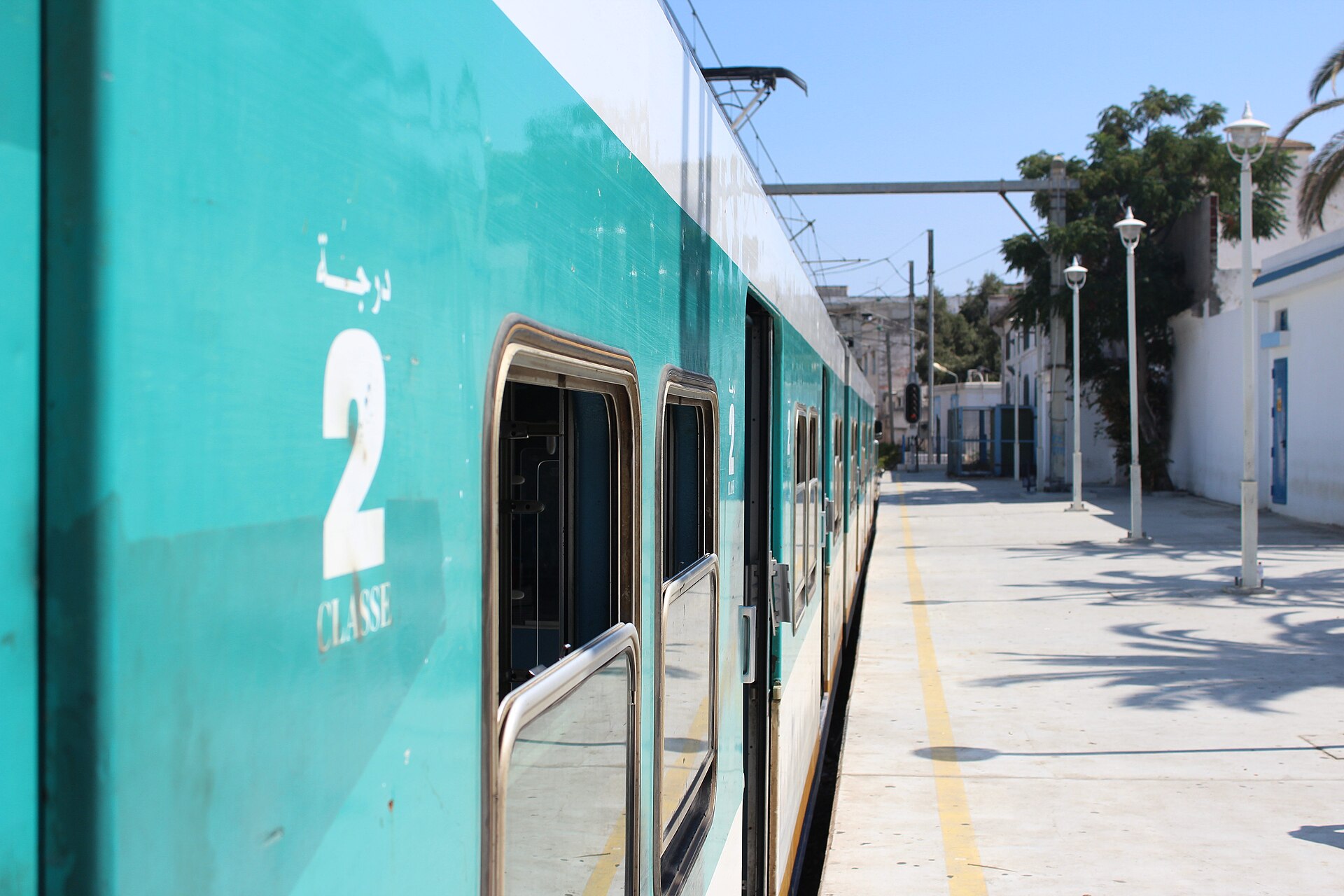
The TGM (Tunis - Goulette - Marsa train) runs from Tunis Marine station to La Marsa via La Goulette, Carthage and Sidi Bou Said: 19 km in about 45 minutes. Works have reduced the line to a single track between Le Bac station and Tunis Marine: since direct service resumed at the end of February 2026, there has been one train every 45 minutes on the 2026-2027 winter timetable.
- Tickets: 0.500 to 0.800 dinar in second class, 0.900 to 1.250 dinar in first (under €0.40), sold at the counter for cash only.
- Carthage: Carthage Hannibal station is about 250 m from the Antonine Baths.
- Sidi Bou Said: the station sits below the village, a 10 to 15 minute walk uphill.
- Watch out: the station called "L'Aéroport" does not serve Tunis-Carthage Airport.
The Carthage and Sidi Bou Said page covers the sites along the line.
Light rail and taxis
Tunis also has a tram network known as the "métro léger" (light metro), run like the TGM by Transtu, the Tunis transport company. In town and the suburbs, metered taxis are the most common way to get about, according to the tourist board. A taxi is free when its light is red and taken when it is green. If the meter is not running, ask for it or agree the fare before setting off; the custom is to round up.
Tunis-Carthage Airport is 8 km from the medina, about ten minutes by car, and about a quarter of an hour from Carthage and Sidi Bou Said. The Tunis page covers the city.
The Sahel Metro
The Sahel Metro is an electric regional train run by SNCFT, Tunisia's national railway. Its line links Sousse Bab Jedid to Mahdia through 31 stations, one of them next to the Monastir airport terminal. There are 46 services a day from 5 am to 10 pm (local time), a train every 40 minutes on average. Tickets are paid in cash. It is the easiest way to reach Sousse, Monastir or Mahdia from the airport.
Main-line trains
The SNCFT network covers about 2,000 km. It links Tunis with Bizerte in the north and with the east coast as far as Sfax and Gabès; trains are rather slow, but cheap and punctual. Some reference times from the winter timetable, 1 September 2026 to 30 June 2027 (local time):
- Tunis - El Jem - Sfax: the main southern line stops at El Jem, for the amphitheatre.
- Tunis - Gabès: departures at 1:05 pm (arriving 7:36 pm) and 9:15 pm (arriving 4:25 am).
- Tunis - Gafsa - Metlaoui - Tozeur: leaves Tunis at 7:25 am, arrives in Tozeur at 6:30 pm; the return leaves Tozeur at 6 am.
A different timetable applies during Ramadan: see the guide Ramadan and public holidays 2027. The Lézard Rouge, the old tourist train through the Selja gorges, has not run since 2017; its return has been announced several times without a published timetable.
Louages and coaches
The louage, a shared taxi with 5 or 6 seats, is the Tunisians' favourite way to travel between towns. Every town has a louage station, and vehicles leave when full. Cars with blue stripes serve nearby places, those with red stripes long distances. Coaches also link towns, for example Sousse and Kairouan, 56 km apart, which have no passenger train between them.
Domestic flights
- Tunis - Tozeur: the Tunisair Express route was restored on 27 April 2025, with about four flights a week according to Tozeur airport in February 2026. By road, Tozeur is 6 h 35 from Tunis; by train, 11 hours.
- Tunis - Djerba: Tunisair Express also flies between Tunis and Djerba.
Djerba is 2h50 from Paris and 2h20 from Lyon by direct flighta few hours' flight from Europe's main cities, direct or with one stop, and Tozeur 2h55 from Paris by direct flighta few hours' flight from Europe's main cities, direct or with one stop: flying into these two airports often saves going through Tunis. See Tozeur and Nefta and Djerba.
Djerba: ferry, causeway and taxis
Djerba is linked to the mainland in two ways: the Ajim - Djorf ferry, a short crossing running continuously, on the Gabès and Matmata side, and the El Kantara causeway to Zarzis, which is being widened. On the island the speed limit is 70 km/h. A regional bus links Houmt Souk with the airport for 1 dinar (about €0.30), five times a day; taxis are metered, with a 50% surcharge from 9 pm to 5 am (local time), according to the civil aviation and airports authority.
Kerkennah: the ferry from Sfax
Sonotrak ferries link Sfax to Sidi Youssef, in the Kerkennah archipelago, in about an hour. The timetable in force since 1 September 2026 has 10 departures a day from Sfax, from 4:15 am to 10 pm (local time). Vehicles can be booked online on the company's website.
The desert south of Douz
South of Douz, a travel permit is needed to venture into the desert; the agencies that run bivouacs and camel treks obtain it for their clients. Several European foreign ministries recommend the desert only in organised groups with a guide, and several advise against the whole area south of the line Algerian border - Tozeur - Douz - Ksar Ghilane - Tataouine - Zarzis. The guide Safety in Tunisia gives your country's advice; see also the guide A night in the desert.
Read next
Frequently asked questions
Can I drive in Tunisia with my national licence?
It depends on the country that issued it: for some nationalities, the national licence is recognised for a tourist stay; others must add a 1968 international driving permit. Your country's foreign ministry gives the rule.
Is it dangerous to drive in Tunisia?
The roads are good, but driving demands constant attention: right of way often ignored, pedestrians in the road, unmarked speed bumps. Driving outside towns at night is strongly discouraged.
How do I get from Tunis to Sidi Bou Said?
By TGM from Tunis Marine, in under 45 minutes, for 1.250 dinar at most; or by taxi, about a quarter of an hour from the airport. Sidi Bou Said station is a 10 to 15 minute walk from the village.
How do I get from Monastir airport to Sousse?
By the Sahel Metro, which has a station next to the terminal, or by taxi: Sousse is 15 km away, about a quarter of an hour's drive.
Are there domestic flights in Tunisia?
Yes: Tunisair Express flies from Tunis to Tozeur, about four times a week, and to Djerba. For the south-west, flying is recommended.
How do I get to the Kerkennah Islands?
By Sonotrak ferry from Sfax: an hour's crossing, 10 departures a day from 4:15 am to 10 pm (local time).
Official sources
- France Diplomatie, Tunisie (accessed 20 October 2026)
- GOV.UK, Tunisia travel advice (accessed 20 October 2026)
A travel advisor replies by email. Free, no commitment.