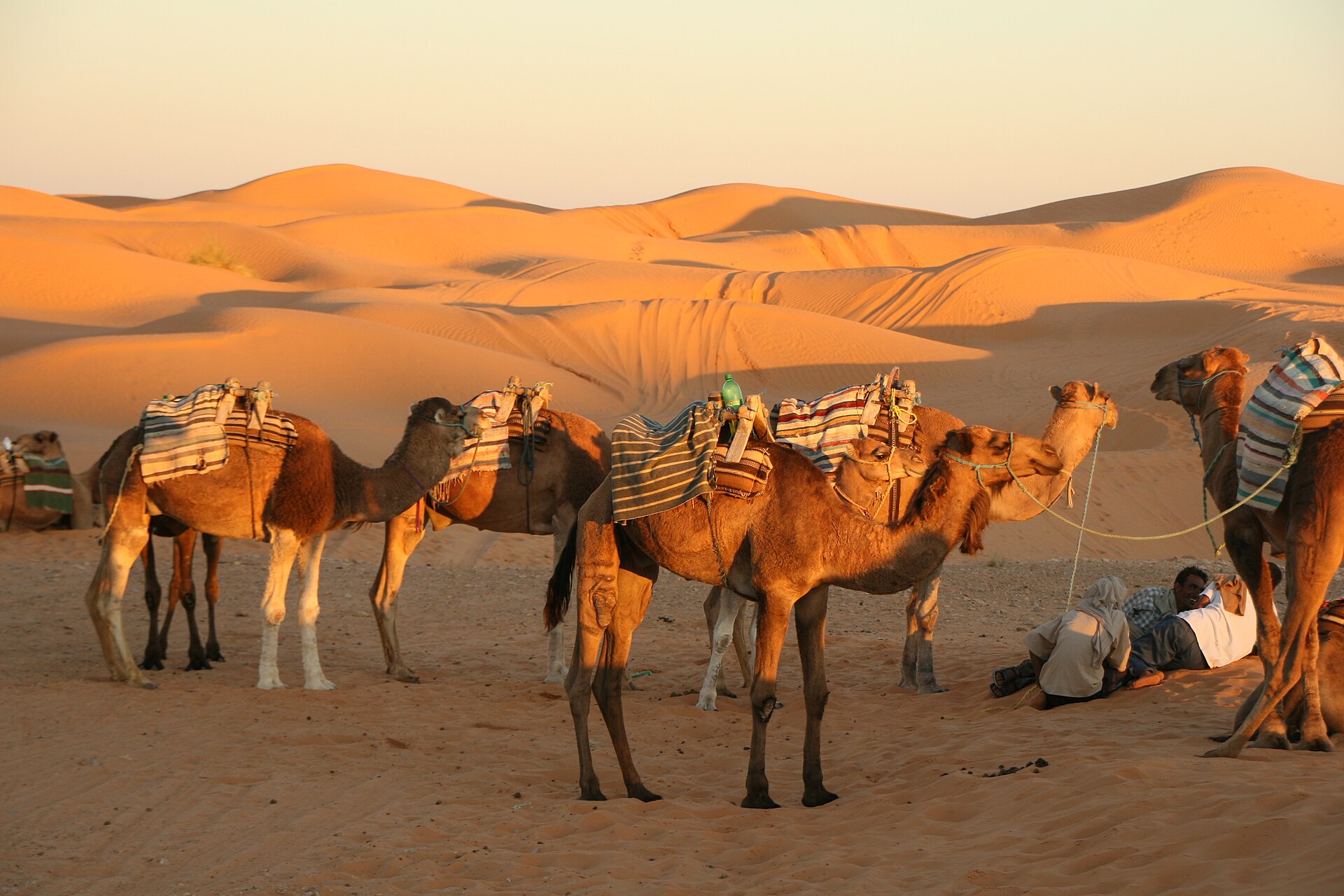
A night at the edge of the Tunisian Sahara: Douz, Tozeur and the ksour
A desert night in Tunisia means staying at the gateway to the Sahara, in Douz or around Tozeur and Nefta, in hotels built on the edge of the dunes and Chott el Djerid. The Grand Erg Oriental begins south of Douz: several European foreign ministries advise against that part of the desert, including Ksar Ghilane. The season runs from October to April.
Checked on 20 October 2026
Tunisia's Sahara begins at Douz, south of Chott el Djerid, and there are dunes too around Tozeur and Nefta further west. These are the two bases for a night in the desert. South of Douz lies the Grand Erg Oriental, a sea of sand stretching to Algeria and Libya: this is where the camps of Zaafrane, Tembaine and Ksar Ghilane are, and it is also the part of the country that several European foreign ministries advise against. This guide covers what you can do in Douz and Tozeur, where to stay, and where the areas advised against begin.
Where the areas advised against begin
None of the European foreign ministries Sabaro follows advises against travel to Tunisia as a whole, but the Saharan south is where their advice differs most.
Several ministries advise against everything south of a line running from the Algerian border through Tozeur, Douz, Ksar Ghilane and Tataouine to Zarzis, and against the desert except in an organised group with a local guide. Travel in border and desert areas is also strongly advised against. Further south, beyond a line from Bir Rjim Maatoug to Borj Bourguiba, lies a military zone requiring authorisation since 2013.
Your country's advice:
| Country | Official advice | Source |
|---|---|---|
| France | The country is under heightened vigilance and a state of emergency in force since 24 November 2015. Keep away from demonstrations and from places where security forces are posted, avoid night travel off the main roads, and fly or use the motorway to reach the south-west. A passport has been compulsory since 1 January 2025. Advised against (red): the far-south Saharan area near Libya and Algeria (military zone created in August 2013, entry by prior permit), the town of Ben Guerdane, and Mounts Orbata, Selloum, Semmama, Chaambi and Mghila. Advised against unless essential (orange): the desert south and east of the Bir Rjim Maatoug – Borj Bourguiba – Ben Guerdane line; the areas between Mounts Chaambi, Semmama and Mghila, south of Mount Selloum and around Mount Orbata; in Jendouba and Le Kef governorates, a 5 km strip along the Algerian border except roads to official crossings. Check with the authorities before visiting rural areas between Kasserine, Sbeitla, Sidi Bouzid and Gafsa off the Gafsa-Kasserine and Gafsa-Sidi Bouzid roads. Table de Jugurtha (Le Kef): on organised tours with a guide. Its map, dated 4 February 2026, also shows an orange strip along the whole Algerian border. | Ministère de l'Europe et des Affaires étrangères (France Diplomatie), Conseils aux voyageurs, Sécurité (Site last updated 15 September 2026) |
| Belgium | With due vigilance, travellers may visit Tunisia except the border areas with Algeria and Libya. Outside the coastal zone, use certified tour operators and agencies in close contact with the Tunisian security services. Heat (over 40 °C) and forest fires in summer. Strongly advised against: the Algerian border area west of the Jendouba – Le Kef – Kasserine – Feriana – Tameghza (Tamerza) axis, and the mountain areas of Kasserine and Le Kef governorates; the Libyan border area south of the Rjim Maatoug – Bir Ellouza – Bir Aouine – Borj Bourguiba – Remada – Ben Guerdane axis (military zone). Travel in the far south requires a permit from Tataouine governorate. | SPF Affaires étrangères, Commerce extérieur et Coopération au Développement (Belgique), Conseils aux voyageurs (Site last updated 2 October 2026) |
| Switzerland | Travel to Tunisia is considered generally safe. The political, social and economic situation is tense (demonstrations, strikes, possible curfews); the 2015 state of emergency remains in force and the risk of terrorist attacks persists nationwide. Reach your destination before nightfall. Advised against: the Algerian border area west of the Tabarka – Tozeur road, including the whole of Kasserine governorate (kidnapping risk in the Chaambi, Selloum and Mghila mountains); the Libyan border region. Tourist and non-urgent travel advised against south of the line Algerian border – Tozeur – Douz – Tataouine – Zarzis. The towns of Tabarka, Tozeur, Douz, Tataouine and Zarzis may be visited with the stated precautions; desert trips only in a group with a reliable local guide. | Département fédéral des affaires étrangères (DFAE, Suisse), Conseils pour les voyages (Site last updated 3 November 2025) |
| United Kingdom | Terrorists are likely to try to carry out attacks in Tunisia; higher risk around religious and tourist sites, festivals, government buildings and places where foreigners gather. State of emergency since 2015, frequent checkpoints. Demonstrations mostly at weekends and on national dates (14 January, 17 December). Possible power cuts in summer. Against all travel: Chaambi Mountains National Park; military operations zones of Mounts Salloum, Sammamma and Mghila; the militarised zone south of El Borma and Dhehiba; within 20 km of the Libyan border north of Dhehiba; Ben Guerdane and its surroundings. Against all but essential travel: north and west of Ghardimaou (Jendouba governorate), including El Feidja National Park; within 20 km of the Algerian border in El Kef and Jendouba governorates south of Jendouba town, including Chemtou; the whole of Kasserine governorate, including Sbeitla; within 10 km of the rest of the Algerian border south of Kasserine governorate; within 10 km of Mount Mghila; Mount Orbata; within 75 km of the Libyan border, including Remada and El Borma, excluding Zarzis, the C118 road and Medenine governorate north of it. Travelling against FCDO advice can invalidate travel insurance. | Foreign, Commonwealth & Development Office (FCDO, ministère britannique des affaires étrangères), Foreign travel advice (Site last updated 24 July 2026) |
| Germany | The security situation has broadly stabilised, but the terrorist risk remains high, including at busy tourist spots; stronger police presence in summer. State of emergency nationwide. Decree-Law 54 provides up to ten years in prison for spreading 'false information' online. Desert trips only in organised groups with a guide. Travel advised against: south and south-east of the line Algerian border – Tozeur/Nefta – Douz – Ksar Ghilane – Tataouine – Zarzis; the immediate Algerian border area, especially the mountains from Ain Draham to Kasserine governorate inclusive; Mounts Chaambi, Selloum and Mghila; individual, unorganised desert tours. Ben Guerdane and surroundings: particularly tense. A strip of about 20 km along the Libyan border and part of the southern Algerian border are military zones closed without a governorate permit. | Auswärtiges Amt (ministère fédéral des affaires étrangères, Allemagne), Reise- und Sicherheitshinweise (Site last updated 6 October 2026) |
| Luxembourg | Luxembourg's foreign ministry publishes no Tunisia-specific advice: it refers travellers to the travel advice of Belgium, France and Germany. | Ministère des Affaires étrangères et européennes, de la Défense, de la Coopération et du Commerce extérieur (Luxembourg), Avis de voyage (accessed 20 October 2026) |
| Ireland | High degree of caution and strong security awareness; state of emergency since 24 November 2015. Avoid unnecessary travel, especially at night outside urban areas, and demonstrations (frequent on Friday afternoons in city centres). Do not travel: Chaambi Mountain National Park; within 30 km of the borders with Algeria and Libya; Ben Guerdane and surroundings; the militarised zone of Tataouine governorate south of (but not including) El Borma. National Guard permission needed for some desert areas near the Algerian border. | Department of Foreign Affairs (DFA, ministère irlandais des affaires étrangères), Travel advice (Site last updated 16 July 2025) |
| Sweden | Since 30 March 2023, following an improved security situation, the Swedish ministry only advises against specific border and mountain areas. Against all travel: within 30 km of the Libyan border and Ben Guerdane; the militarised Chaambi, Samamma, Mghila, Selloum and Orbata mountains; the area south of El Borma and Dhehiba. Against non-essential travel: within 30 km of the Algerian border south of Jendouba town, except the Table de Jugurtha plateau; within 5 km of the Algerian border from Gafsa region southwards, except the town of Tamaghza (Tamerza). | Utrikesdepartementet (UD, ministère suédois des affaires étrangères), UD avråder (Site last updated 30 March 2023) |
| Denmark | The whole country except the orange and red zones: stay alert and follow the authorities, media and your travel agency. High terrorist risk; state of emergency, checks at tourist sites, photo ID compulsory. Do not go alone into the mountains or desert: use recognised agencies and guides. Red (very high risk): Mounts Chaambi, Salloum, Sammamma, Mghila and Orbata; the area south of a line passing south of El Borma and Remada and north of Ben Guerdane. Orange (non-essential travel advised against): the Algerian border area from south of Jendouba and Ghardimaou (P6 road) to El Borma, except Jendouba, Le Kef and Dahmani towns (yellow); Kasserine governorate except Kasserine town (yellow); the area south of a line from El Borma to south of Zarzis, including Remada but not Tataouine (yellow). | Udenrigsministeriet (ministère danois des affaires étrangères), Rejsevejledninger (Site last updated 18 May 2026) |
| Poland | State of emergency in force; photographing military and government sites or security forces is forbidden (arrest of at least 5 days possible). After the summer 2026 heatwave, electricity, running water and fuel supplies are back to normal and bottled water is gradually returning to shops. Level 3: region 1, the Sahara and desert areas near the Algerian and Libyan borders, excluding tourist routes; region 2, the central-western mountains (Mounts Orbata, Selloum, Semmama, Chaambi and Mghila). | Ministerstwo Spraw Zagranicznych (ministère polonais des affaires étrangères), service Odyseusz (Site last updated 3 September 2026) |
| Czechia | Increased caution during the stay, especially outside hotel resorts; avoid crowded places off the usual routes, isolated areas and going out at night; restrict photos to resorts and monuments, no public buildings or strangers. State of emergency since 24/11/2015. Warning against travel: areas near the Algerian and Libyan borders; mountains of Kasserine and Le Kef governorates; towns around Siliana and Kasserine; the desert south of the Bir Rjim Maatoug – Borj Bourguiba – Ben Guerdane line; the north-western mountains. The country sheet adds: high risk west of the Ain Draham – Jendouba – Le Kef – Kasserine – Sidi Bouzid – Gafsa – Tozeur line and south of the Tozeur – Kebili – Medenine – Zarzis line; south of Tataouine, military zone, governorate permit to request 4 to 6 weeks ahead outside organised tours. | Ministerstvo zahraničních věcí (ministère tchèque des affaires étrangères), Upozornění na cesty (Site last updated 10 April 2025) |
| Netherlands | Yellow for most of the country: specific security risks. Red, do not travel: the border area with Libya, largely a military zone, especially south of Ben Gardane; the desert areas south of the Al Borma – Remada – Ben Gardane line (criminals and terrorist groups, increased kidnapping risk); the Algerian border from west of the town of El Kef southwards, keeping at least 2 km from the border; the Chaambi massif and the Mghila, Semmama and Salloum mountains (armed clashes, explosives and landmines). Orange, essential travel only: the area between the south of the town of Tataouine and the Al Borma – Remada – Ben Gardane line; the town of Kasserine and its surroundings. Limited terrorist threat, state of emergency since 2015, road checks; outside the coastal area, travel with tour operators and agencies certified by the Tunisian Ministry of Tourism. Regular demonstrations, especially in Tunis. | Nederland Wereldwijd (ministère néerlandais des Affaires étrangères), Reisadvies Tunesië (Site last updated 17 September 2026) |
| Norway | Not checked by Sabaro: see Regjeringen | |
| Austria | Not checked by Sabaro: see BMEIA | |
| Italy | Not checked by Sabaro: see Viaggiare Sicuri | |
| Spain | Not checked by Sabaro: see exteriores.gob.es | |
| Portugal | Not checked by Sabaro: see Portal das Comunidades | |
| Finland | Not checked by Sabaro: see Ulkoministeriö (um.fi) | |
Desert places in relation to the Tozeur - Douz - Tataouine line:
| Place | In relation to the line |
|---|---|
| Douz town | on the line: the town may be visited, the dunes on its southern edge are beyond it |
| Dunes and camps south of Douz | south, advised against |
| Zaafrane, El Faouar | south, advised against |
| Tembaine, Jbil National Park | south, advised against |
| Ksar Ghilane | on the line or just south of it depending on the ministry, surroundings advised against |
| Tozeur, Nefta | on the line: Tozeur may be visited |
| Ong Jmel dunes | north, 12 to 15 km away, outside the zone |
| Chott el Djerid road | north, outside the zone |
Sabaro's trip ideas and excursions therefore stay in Douz, Tozeur, Nefta and Ong Jmel. Our guide to safety in Tunisia covers the advice for the rest of the country.
Sleeping on the edge of the desert: three hotels chosen by Sabaro
| Hotel | Location | What you'll find | Price found |
|---|---|---|---|
| The Residence Douz | Douz, in a palm grove | 50 villas, Clarins spa with hammam and indoor pool, permaculture farm | from about €335 a night for two, room only |
| The Mora Sahara Tozeur | Mrah Lahwar, facing Chott el Djerid | 93 suites and villas, many with a private pool, Berber barbecue in the evening | from about €390 a night for two, breakfast included |
| Dar HI Life | Nefta, on the edge of the Corbeille | 18-room eco-lodge facing the village, the oasis or the desert, geothermal hot-water bath | from about €210 a night for two, breakfast included |
Prices were found in October 2026 for nights in March 2027, taxes included. The tourist tax comes on top, paid at the hotel: TND 12, about €3.60, per person per night in 4- and 5-star hotels.
The Residence Douz opened in October 2023 at the northern edge of the Grand Erg. Guests can ride a camel from reception to their villa. The hotel also offers outings to Tembaine, Ksar Ghilane and Jbil National Park, which lead into the area several European foreign ministries advise against. The Mora Sahara Tozeur, the former Anantara renamed on 1 November 2025, stands on the edge of the desert 6.5 km from Tozeur-Nefta airport. Dar HI Life, designed by French designer Matali Crasset, organises walks in the oasis and the nearby desert.
In Douz itself
Douz is the home town of the Mrazig, once camel-herding nomads. According to the Tunisian National Tourist Office (ONTT), "right outside the hotels of Douz the sand desert begins".
- The Sahara Museum shows nomadic life: tents, camels, weaving, costumes, jewellery and the tattoos of the Nefzaoua tribes, as the Douz region is called. It opens from 9:30 am to 4 pm in winter and from 7 am to 2 pm in summer, local time, except on Mondays; admission is TND 5, about €1.50.
- The Thursday market brings together camels and donkeys for sale.
- The International Sahara Festival takes place in December on Haniche square; the 58th edition is scheduled for 19 to 22 December 2026.
The town may be visited; the dunes that begin on its southern edge are already beyond the Tozeur - Douz - Tataouine line.
Around Tozeur and Nefta
This is where you can get close to the dunes without entering any area that a ministry advises against.
- Ong Jmel, the rock shaped like a "camel's neck", rises from the dunes north-west of Nefta. It served as a set for The English Patient and Star Wars; admission has been charged since 2018. It lies outside the areas advised against, 12 to 15 km north of the line. The film sets nearby are covered in our guide to Star Wars in Tunisia.
- Chott el Djerid, the vast salt flat between Tozeur and Kebili, is crossed by a paved road. Off the road, the salt crust is unstable.
- The Corbeille of Nefta, an amphitheatre-shaped hollow that once had 152 springs, is the heart of a town of zaouias, Sufi shrines.
- Tozeur's palm grove, nearly 1,000 ha with about 400,000 palms, is free to enter.
- The Balloons Event Show flies hot-air balloons over Tozeur and Nefta from 26 to 30 October 2026, with two evenings at Ong Jmel.
To plan a visit, see Tozeur and Nefta and Douz and the Sahara.
Ksar Ghilane and the Grand Erg
Ksar Ghilane is an oasis where the sand desert meets the stone desert, with a warm spring pool. A paved road links it to Douz and Matmata. About 3 km away stand the ruins of the Roman fort of Tisavar, built under Emperor Commodus on the limes, the Empire's military frontier. Further south-west, Tembaine is an isolated mountain in the middle of the dunes, about 40 km of rough track from Douz. Jbil National Park, created in 1994, covers 150,000 ha of dunes, home to gazelles and houbara bustards.
This is the desert that several European foreign ministries advise against; travel in desert areas is also strongly advised against. The ONTT says a travel permit is needed for the far south; for Jbil, authorisation must be requested at least 48 hours ahead, according to the Tunisian Ministry of the Environment. In summer, temperatures at Ksar Ghilane exceed 50 °C. Sabaro offers no trip idea or excursion in this area while this advice stands.
Ksour and ghorfas of the south
A ksar (plural ksour) is a fortified Berber granary; its vaulted cells, stacked several storeys high around a courtyard, are called ghorfas. UNESCO's Tentative List, the sites Tunisia intends to nominate for World Heritage status, counts about 150 of them in the south, between Matmata, Medenine and Tataouine.
Outside any area advised against:
- Matmata, 600 m up and 40 km south-west of Gabès, with troglodyte homes dug around circular courtyards;
- Tamezret and Toujane, Berber ridge villages between Matmata and Medenine;
- Medenine and Metameur: in the early 20th century Medenine had up to 6,000 ghorfas, partly demolished since; Metameur keeps its own around a courtyard;
- Ksar Hadada, partly converted into a hotel, and Ghomrassen, a troglodyte town at the foot of the cliffs 5 km away.
Advised against by several European ministries, south of the line:
- Chenini, a Berber village perched on a ridge, 19 km from Tataouine;
- Douiret, abandoned since 1974, with ghorfas three to five storeys high;
- Ksar Ouled Soltane, 287 ghorfas on three to four levels, 17 km south-east of Tataouine.
They are described on our Djerba page, which also covers Matmata and Tataouine.
When to go
| Month | Douz (Kebili station): max / min | Tozeur: max / min |
|---|---|---|
| January | 17.3 / 4.2 °C | 17.0 / 6.8 °C |
| March | 23.3 / 9.8 °C | 23.2 / 11.6 °C |
| April | 27.2 / 13.7 °C | 27.4 / 15.2 °C |
| July | 39.6 / 24.2 °C | 40.0 / 26.4 °C |
| October | 30.0 / 17.3 °C | 29.6 / 18.8 °C |
| December | 18.3 / 5.5 °C | 17.9 / 7.9 °C |
Average daily highs and lows, World Meteorological Organization normals for 1991-2020. The Saharan south is pleasant from October to April. In winter, nights drop to around 4 °C in Douz, so bring a warm jacket for the evening. The Residence Douz gives June to October as the hot season.
Getting there
Tozeur has an international airport, 6.5 km from The Mora Sahara Tozeur, and flying is recommended to reach the tourist areas of the south-west. Douz is 121 km from Tozeur, about 2 hours via the Chott el Djerid road, and about 233 km and 4 hours from Houmt Souk on Djerba. The Residence Douz gives 132 km, about 1 hour 30, from Gabès-Matmata airport.
To plan a stay, see also our desert theme.
Read next
Frequently asked questions
Can you sleep in the desert in Tunisia?
Yes, at the gateway to the Sahara: in Douz, in a palm grove on the edge of the dunes, or around Tozeur and Nefta, facing Chott el Djerid. The tented camps of the Grand Erg, south of Douz, are in the area several European foreign ministries advise against.
Is Ksar Ghilane advised against?
It is, by several European foreign ministries: the oasis lies on the line south of which they advise against all travel, or just south of it depending on the ministry. The Safety in Tunisia guide gives your country's advice. Sabaro does not offer excursions to Ksar Ghilane.
When is the best time to visit southern Tunisia?
From October to April. In July, average highs approach 40 °C in Douz and Tozeur; in January, lows fall to 4 °C in Douz.
Do you need a permit to go into the desert?
For the far south, yes: the ONTT says a travel permit is needed, and authorisation for Jbil National Park must be requested at least 48 hours in advance. Both areas are in the zone several European foreign ministries advise against.
Official sources
- France Diplomatie, Tunisie (accessed 20 October 2026)
- GOV.UK, Tunisia travel advice (accessed 20 October 2026)
A travel advisor replies by email. Free, no commitment.