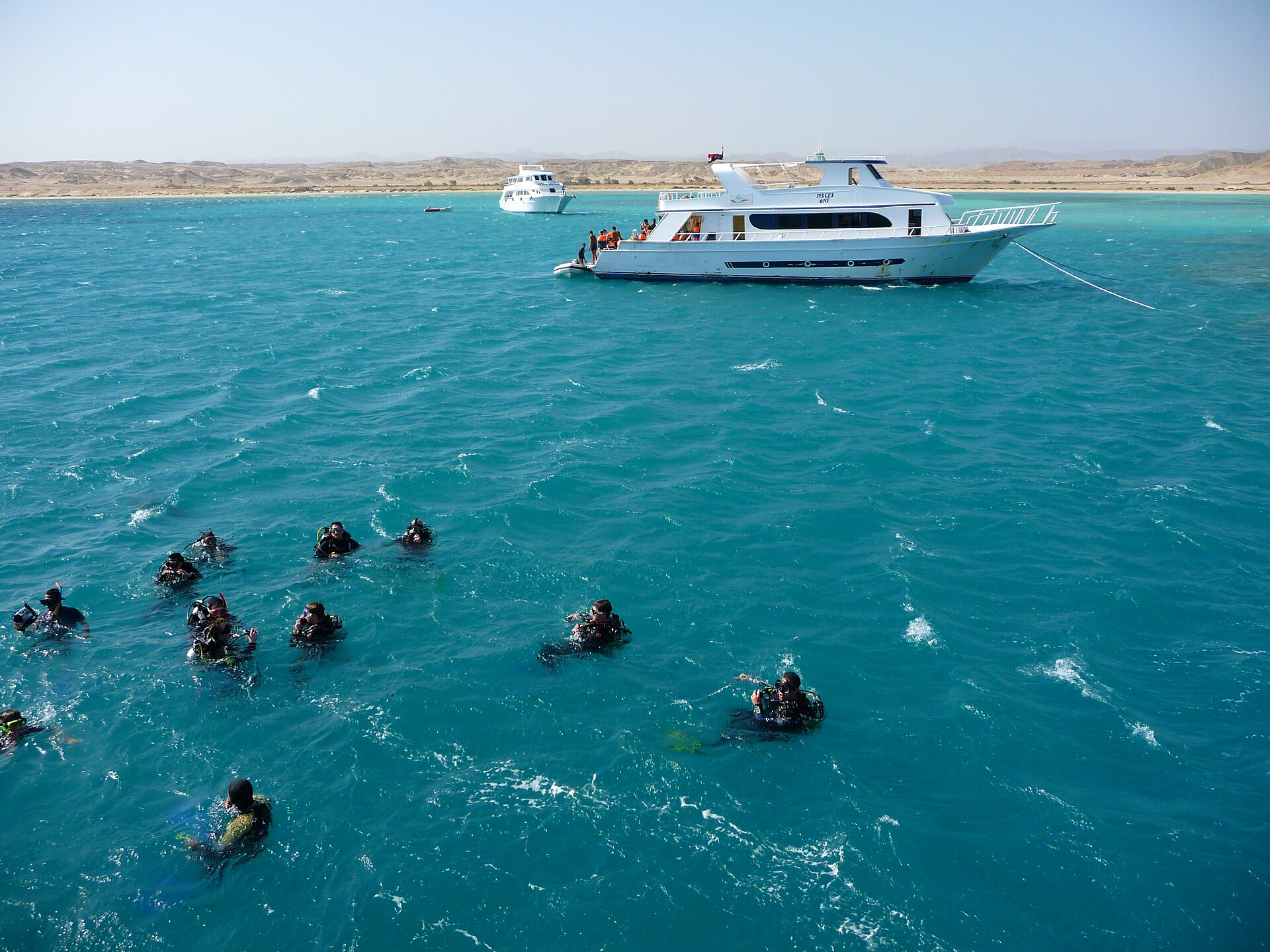
Diving in the Red Sea: rules, supervision, chambers
In Egypt, diving is regulated by the CDWS, the Egyptian Chamber of Diving and Water Sports: a health declaration before any activity, 40 m maximum on air, one guide per 12 divers on boats, intro dives to 12 m maximum, 20 logged dives for the Thistlegorm wreck. The main resorts have a decompression chamber; Nuweiba and Taba do not.
Checked on 14 October 2026
One authority along the whole coast
Egyptian diving has its own rules, the same from Taba to Marsa Alam. They are set by the CDWS (Chamber of Diving and Water Sports), created in 2007 under the Ministry of Tourism. Every dive centre and liveaboard must be a member and meet the international standards for recreational diving providers to obtain its licence. The CDWS audits its members, publishes their list and keeps a blacklist of closed or illegal operators.
For travellers, the practical consequence is this: before booking, check that the centre is on the members' list and not on the blacklist. Sabaro makes this check for every centre it offers, and each resort page covers its own sites and particularities: Sharm el-Sheikh, Dahab, Hurghada, El Gouna, Safaga, Marsa Alam, Nuweiba and Taba.
What the centre will ask for
A health declaration. Since May 2024, every centre has its customers sign the DAN (Divers Alert Network, an international diver assistance network) health declaration before any activity, including intro dives and snorkelling. Depending on your answers, a medical certificate may be required: read the questionnaire before you leave and, if needed, travel with that certificate.
Certification and logbook. The centre records your certification level and the date of your last dive.
Insurance that covers diving. Diving deeper than your policy's limit invalidates the cover, and an air or sea rescue can cost more than USD 4,000 an hour. Dive insurance, with medical assistance and repatriation, complements any travel insurance.
Depth and supervision
The CDWS applies the standards of the WRSTC (World Recreational Scuba Training Council, the body that sets common standards for training agencies). The maximum depth on air is 40 m, if the diver's training and experience allow it. On Nitrox, oxygen-enriched air, the limit is an oxygen partial pressure of 1.4 bar, with no more than 40 m on a single tank. Beyond that is technical diving, reserved for trained divers and centres certified for it.
| Activity | CDWS rule |
|---|---|
| Boat diving, day trips or liveaboards | 1 guide or instructor per 12 divers maximum |
| Intro dive at sea | 1 instructor per participant; skills at around 2 m, then 12 m maximum |
| Discover Scuba Diving-type experience (a programme of the PADI training agency) | 1 instructor per 2 participants, from the shore |
| Snorkelling | 12 participants maximum per guide |
| Solo diving | Only for divers with solo diving training |
Twelve is a ceiling: ask about the actual group size when booking.
Wrecks and reefs
The Thistlegorm. The most visited wreck in the Red Sea, a British cargo ship sunk in 1941 off Ras Mohammed, is being damaged by divers. In October 2025 the CDWS tightened its instructions: at least 20 logged dives and good buoyancy control are required. Touching the wreck, resting on it or kicking it with your fins is forbidden; these instructions apply to all Red Sea wrecks, including those of Abu Nuhas, off El Gouna, and the Salem Express, near Safaga.
Reefs. The CDWS has adopted the Green Fins code of conduct, a UN Environment Programme initiative. Do not touch corals or animals, do not feed fish, and keep your fins clear of the reef. Gloves are allowed against the cold, but the CDWS asks divers to do without them when the water does not require them; pointer sticks are banned and member centres do not sell coral. Taking or damaging coral is penalised, and a coral cut, however small, needs proper care, as it easily becomes infected.
Sharks. Attacks are rare, but there have been some in Egyptian waters, and some species are dangerous. Follow the instructions of dive centres and local authorities.
Liveaboards: choosing your boat
Liveaboards, where you spend several days on board, leave from Sharm el-Sheikh, Hurghada and Port Ghalib, near Marsa Alam, for offshore reefs, the Brothers or the Strait of Gubal. Several incidents, some fatal, have involved British divers on these boats, and safety standards vary widely. The UK Marine Accident Investigation Branch advises booking through a reputable vendor and insisting on a full safety briefing on board. Also check that the boat and its passengers are insured. Offshore trips often require an advanced certification and a minimum number of dives, set by each operator.
Decompression chambers
The CDWS publishes the list of hyperbaric medical centres that treat decompression illness. Sabaro recommends saving the number of the nearest one in your phone.
| Resort | Hyperbaric centres |
|---|---|
| Sharm el-Sheikh | Sharm Hyperbaric Medical Centre |
| Dahab | Dahab Hyperbaric Medical Centre |
| El Gouna | El Gouna Deco International |
| Hurghada | Hypermed; Naval Hyperbaric Medical Center |
| Safaga | Safaga Deco International |
| Marsa Alam | Marsa Alam Baromedical; Marsa Alam Deco International |
| Hamata, south of Marsa Alam | Hamata Deco International |
Nuweiba and Taba have no chamber: after an accident, a diver is evacuated to Eilat, in Israel, or to Dahab. On this coast, Sabaro recommends no-decompression dives and insurance that covers evacuation.
Read next
Frequently asked questions
Do I need a medical certificate to dive in Egypt?
The centre has you fill in the DAN health declaration before any activity. A medical certificate is only required if one of your answers calls for it; in that case, it is best to get it before you leave.
How deep can I dive?
40 m on air, if your training and experience allow it, according to the CDWS. Deeper dives require technical diving training and a centre certified for it.
How many dives do I need for the Thistlegorm?
At least 20 logged dives and good buoyancy control.
Can I try diving without a certification?
Yes: on an intro dive, one instructor per participant and 12 m maximum; on a Discover Scuba Diving experience, one instructor for two participants, from the shore.
Where are the decompression chambers?
In Sharm el-Sheikh, Dahab, El Gouna, Hurghada, Safaga, Marsa Alam and Hamata. There are none in Nuweiba or Taba.
Official sources
- CDWS : règles et réglementation (accessed 14 October 2026)
- CDWS : ratios d'encadrement (mai 2025) (accessed 14 October 2026)
- CDWS : manuel (octobre 2025) (accessed 14 October 2026)
- CDWS : consignes du SS Thistlegorm (octobre 2025) (accessed 14 October 2026)
- CDWS : code de conduite Green Fins (accessed 14 October 2026)
- CDWS : centres médicaux hyperbares (accessed 14 October 2026)
- France Diplomatie : Égypte, sécurité (accessed 14 October 2026)
- GOV.UK (FCDO) : Egypt, safety and security (accessed 14 October 2026)
A travel advisor replies by email. Free, no commitment.