Classic Tunisia in 8 days
8 days · First-time visitors to Tunisia, couples, friends and families with an interest in history · March to May, September to November
Eight days and seven nights covering the essentials of Tunisia: three nights in a palace in the Tunis medina with the Bardo, Carthage and Sidi Bou Said, two nights in Sousse for its medina, Kairouan and El Jem, then two nights by the sea in Mahdia before flying home from Monastir.
from 730 € per person
Price collected on 20 October 2026. Based on 2 adults, listed hotels and guided tours, breakfast included in Sousse and Mahdia; flights, transfers, car or driver between stops, site entry fees outside the guided tours and tourist tax (TND 12 per person per night in 4- and 5-star hotels) not included. Indicative price, taxes included, to be confirmed with your request.
Itinerary
- Days 1–4 Tunis, medina · 3 nights — Palais Bayram
- Days 4–6 Sousse, Corniche · 2 nights — Mövenpick Resort & Marine Spa Sousse
- Days 6–8 Mahdia · 2 nights — Iberostar Selection Royal El Mansour
Activities included in the indicative price
- Guided tour of the Bardo Museum and the medina (4 hours) · 93 € per person
Public price collected on: Civitatis — accessed 20 October 2026
- Guided trip to Carthage and Sidi Bou Saïd (6 hours) · 90 € per person
Public price collected on: Civitatis — accessed 20 October 2026
- Kairouan and El Jem day trip from Sousse, lunch and entry fees included (over 8 hours) · 85 € per person
Public price collected on: Musement — accessed 20 October 2026
How it works
In one week, this trip takes in five of Tunisia's UNESCO World Heritage Sites: the medina of Tunis, Carthage, the medina of Sousse, Kairouan and the amphitheatre of El Jem. It travels south from the capital to the Sahel, the central-eastern coast, in three stages, and ends with two quieter days by the sea in Mahdia.
You fly into Tunis-Carthage and out of Monastir. Tunis is 2h25 from Paris and 2 hours from Lyon by direct flighta few hours' flight from Europe's main cities, direct or with one stop and Monastir 2h35 from Paris and 2 hours from Lyon by direct flighta few hours' flight from Europe's main cities, direct or with one stop, and this open-jaw routing saves the drive back north at the end. Distances are short: about 160 km of motorway from Tunis to Sousse, 56 km from Sousse to Kairouan and 43 km from Mahdia to El Jem.
At a glance
| Day | Plan | Night |
|---|---|---|
| 1 | Arrive in Tunis, first walk in the medina | Palais Bayram |
| 2 | Bardo Museum and medina with a guide | Palais Bayram |
| 3 | Carthage and Sidi Bou Said with a guide | Palais Bayram |
| 4 | Drive to Sousse, medina and ribat | Mövenpick Sousse |
| 5 | Kairouan and El Jem day trip | Mövenpick Sousse |
| 6 | Mahdia, the Fatimid medina | Iberostar Royal El Mansour |
| 7 | Mahdia, beach and thalasso | Iberostar Royal El Mansour |
| 8 | Fly home from Monastir |
Days 1 to 3: Tunis, the Bardo and Carthage
Staying in the medina
Tunis-Carthage airport is only 8 km from the medina, about ten minutes by car. Your base is the Palais Bayram, an 18th-century palace with 16 rooms and suites in the oldest part of the medina, a few steps from the Zitouna Mosque and the Kasbah. It has a three-room domed hammam, a vaulted restaurant, a tea house above the garden and a collection of early 17th-century Iznik tiles. Rates start at about €150 a night, room only, for a stay in March 2027.
The Tunis medina, listed by UNESCO in 1979, holds some 700 monuments: palaces, mosques, mausoleums, madrasas and fountains. It was one of the great cities of the Islamic world under the Almohads and the Hafsids, from the 12th to the 16th century. Visitors can enter the courtyard of the Zitouna Mosque and look into the prayer hall, which is closed to non-Muslims.
The Bardo
On day two, a four-hour guided tour combines the Bardo Museum and the medina. The museum fills a 19th-century beylical palace that opened as a museum on 7 May 1888, and holds one of the world's largest collections of Roman mosaics, including the Triumph of Neptune in the entrance hall. It is closed on Mondays. From 1 January 2027, admission for non-residents will be TND 45, about €13.
Carthage and Sidi Bou Said
Day three is given to Carthage and Sidi Bou Said, with a guide for six hours. Founded in the 9th century BC, the Punic city was destroyed by Rome in 146 BC and rebuilt as a Roman town. A combined ticket covers the Antonine Baths, the theatre, the Roman villas park, the amphitheatre, the Magon quarter and the Palaeo-Christian Museum, which reopened in December 2025; it rises to TND 30, about €9, on 1 January 2027. The National Museum on Byrsa Hill has been closed since 2018.
In Sidi Bou Said, the Ennejma Ezzahra palace, built between 1911 and 1922 by Baron Rodolphe d'Erlanger, houses the Centre for Arab and Mediterranean Music: instruments, gardens and concerts. It is closed on Mondays and admission is TND 10.
Days 4 and 5: Sousse, Kairouan and El Jem
Sousse
The motorway takes you to Sousse in just over two hours. The Sousse medina, listed by UNESCO in 1988, was the port of the Aghlabids, the dynasty that ruled the region from 800 to 909. The ribat, a fortified monastery completed in 821, costs TND 10, and you can climb its watchtower. The Great Mosque of 851 looks like a fortress and has no minaret. The archaeological museum in the kasbah displays Roman mosaics and is closed on Mondays.
The Mövenpick Resort & Marine Spa Sousse sits on the Corniche, 2 km from the centre, with direct beach access, a spa with thalassotherapy, seawater pools and four restaurants. Rates start at about €120 a night with breakfast.
Kairouan and El Jem in a day
On day five, a day trip from Sousse covers Kairouan and El Jem, with lunch and admission included. Kairouan, founded in 670, is the leading holy city of the Maghreb. Its Great Mosque, the first to be founded in the Maghreb, became the model for mosques across the region and in al-Andalus; non-Muslims may enter the courtyard and look into the prayer hall. It closes at 2 pm local time, and at noon on Fridays, so Friday is best avoided. In the medina, the Bir Barrouta well is still turned by a camel, and workshops sell knotted carpets and makroudh, a semolina pastry filled with dates and honey.
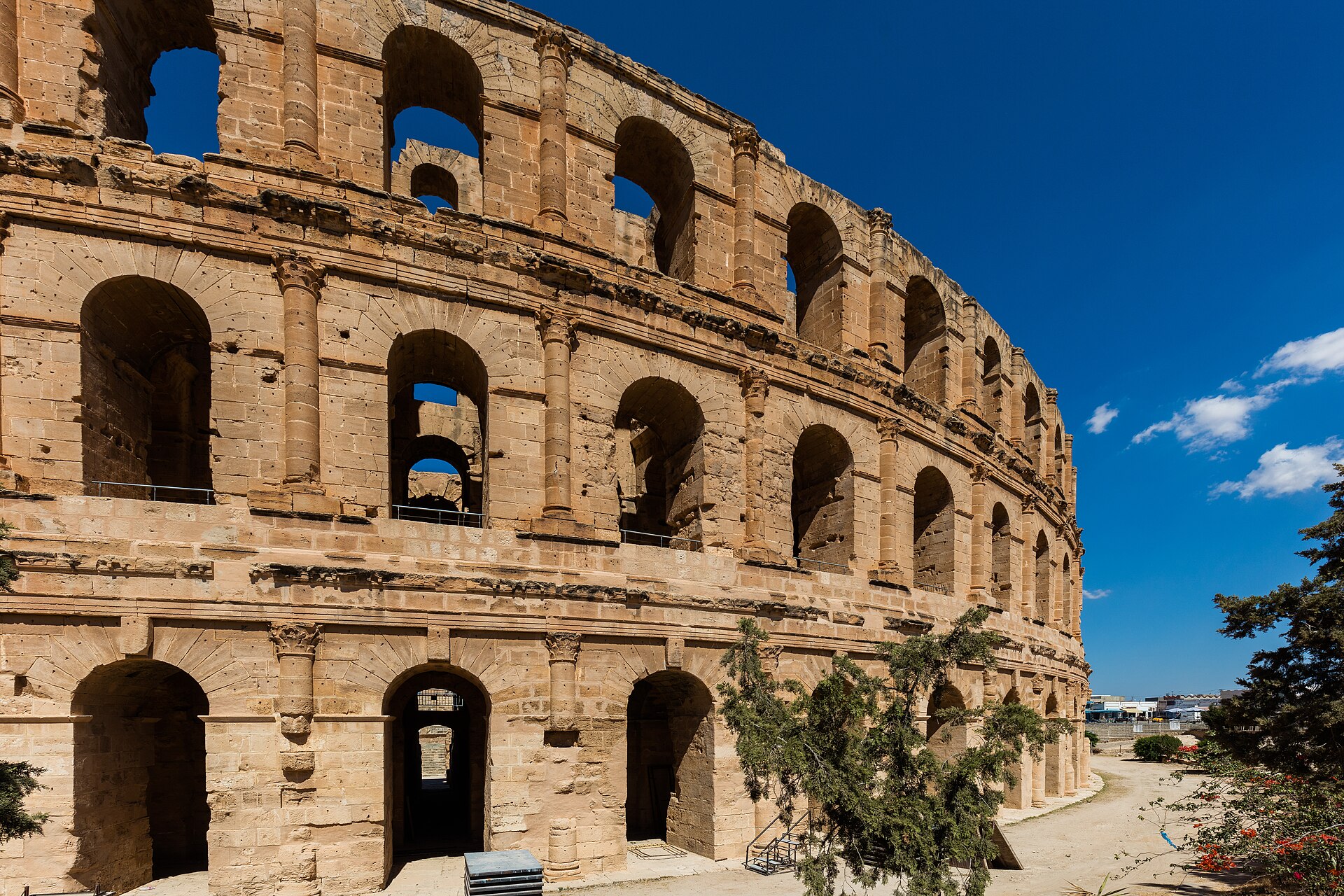
The El Jem amphitheatre, built between 238 and 250, measures 147.90 m by 122.20 m and stands 36 m high, among the largest in the Roman world; you can walk down into the passages beneath the arena. The ticket includes the nearby museum and its mosaics.
Days 6 and 7: Mahdia
Mahdia sits on a narrow peninsula. It was the capital founded by the Fatimids in the 10th century, and their legacy includes the Skifa el Kahla, a monumental gate now lined with wedding-dress shops, and the Great Mosque of 916, which has no minaret. Borj el Kebir, a late 16th-century fortress, costs TND 8; the Mahdia Museum, closed on Mondays, shows Roman mosaics, Byzantine gold coins and a local bridal costume. Weavers in the medina still make silk striped with gold and silver thread. The Mahdia and El Jem page covers the area in detail.
The Iberostar Selection Royal El Mansour faces the beach, a six-minute walk from the old town, with a thalassotherapy centre, a pool heated in winter and a kids' club. Rates start at about €110 a night with breakfast. Day seven is free for the beach, a treatment or a stroll along the seafront.
Day 8: departure
Monastir airport is 56 km from Mahdia, about an hour by road.
Good to know
- Getting around. The price does not include a car or driver between stops. The getting around Tunisia guide compares car hire, trains and private drivers.
- When to go. In Kairouan, average highs rise from 21.7 °C in March to 29.7 °C in May and top 38 °C in July; spring and autumn are better for sightseeing.
- Closing days. The Bardo, Ennejma Ezzahra and the museums of Sousse and Mahdia close on Mondays. During Ramadan, expected from 8 February to 9 March 2027, opening hours change: see Ramadan and public holidays 2027.
- Entry requirements. Tunisia has required a passport from all travellers since 1 January 2025; the visa and entry requirements guide covers the length of stay and the validity required. The rule for your country:
Entry requirements
| Nationality | Visa | Travel document | Source |
|---|---|---|---|
| French | No visa for stays of up to three months; beyond that, visa and residence card from the Ministry of the Interior; overstaying requires exit authorisation and a fine proportional to the overstay | Passport compulsory for all stays, valid for at least 3 months on the date of entry (rule in force since 1 January 2025). The ID card, formerly accepted on package tours, no longer is | France Diplomatie, Conseils aux voyageurs, Entrée / séjour (Site last updated 15 September 2026) |
| Details: French child travelling with one parent: no authorisation required on leaving Tunisia; family record book useful if surnames differ. Child who is also a Tunisian national: Tunisian passport and exit authorisation signed by the Tunisian parent before a Tunisian authority. French-Tunisian dual nationals: treated as Tunisian and asked for a Tunisian passport. Always carry ID or a copy of the passport photo page | |||
| Belgian | See the official page | Valid passport | Travel documents (Site last updated 17 January 2025) |
| Swiss | See the official page | The FDFA advises always carrying a photocopy of the passport or ID card, including the entry-stamp page — See the official page | DFAE (Département fédéral des affaires étrangères, Suisse), Conseils pour les voyages – Tunisie, « Adresses utiles » et « Criminalité » (Site last updated 3 November 2025) |
| British | Up to 90 days without a visa (except Crown Dependency passports, which may need a visa on arrival); get the passport stamped; overstay fine payable on departure; contact details, return or onward ticket and accommodation booking may be requested | Passport valid for the whole stay and in good condition (a damaged passport may cause problems on exit) | GOV.UK (FCDO), Tunisia, Entry requirements (Site last updated 24 July 2026) |
| Details: Always carry ID or a copy of the passport photo page. Driving: a 1968 international driving permit, obtained in the UK before you travel, in addition to your UK licence; a green card (international certificate of insurance) for the vehicle | |||
| German | No visa for tourist, private or business stays of up to 120 days; keep the 'non-resident visitor card' issued at some airports; beyond 120 days, TND 20 per five-day period, payable on departure | Passport or child passport valid for at least 6 months on entry; ID card not accepted; temporary passport accepted with a return ticket and sufficient funds. Without a package-tour booking, border police may ask for proof of funds | Auswärtiges Amt, Tunesien: Reise- und Sicherheitshinweise, « Einreise und Zoll » (Site last updated 6 October 2026) |
| Details: Child passport accepted. The parental authorisation formerly required for Tunisian or dual-national minors not accompanied by the Tunisian parent is officially no longer needed, but is sometimes still requested on exit. German-Tunisian dual nationals: treated as Tunisian and asked for a Tunisian passport. No vaccination required for travellers arriving from Germany. Driving: a German national licence is recognised for a tourist stay | |||
| Dutch | No visa for stays of up to 90 days with a Dutch passport; beyond that, visa from the Tunisian embassy in The Hague. On arrival, proof of a hotel booking is required, possibly also a return ticket and proof of sufficient funds; otherwise entry may be refused | Passport valid for the whole stay | Nederland Wereldwijd (ministère néerlandais des Affaires étrangères), Reisadvies Tunesië (Site last updated 17 September 2026) |
| Details: Each child needs their own passport; an adult travelling alone with one or more children under 18 should carry the documents required for travelling with a minor. Dutch driving licences are valid in Tunisia. Always carry your passport or a copy | |||
| Luxembourgish | Not checked by Sabaro: see mae.gouvernement.lu | ||
| Irish | Not checked by Sabaro: see ireland.ie (DFA) | ||
| Swedish | Not checked by Sabaro: see Regeringen (UD) | ||
| Danish | Not checked by Sabaro: see Udenrigsministeriet (um.dk) | ||
| Norwegian | Not checked by Sabaro: see Regjeringen | ||
| Polish | Not checked by Sabaro: see Odyseusz (MSZ) | ||
| Czech | Not checked by Sabaro: see MZV ČR | ||
| Austrian | Not checked by Sabaro: see BMEIA | ||
| Italian | Not checked by Sabaro: see Viaggiare Sicuri | ||
| Spanish | Not checked by Sabaro: see exteriores.gob.es | ||
| Portuguese | Not checked by Sabaro: see Portal das Comunidades | ||
| Finnish | Not checked by Sabaro: see Ulkoministeriö (um.fi) | ||
Rules change: always check the official website before you travel.
- Money. Dinars can only be obtained in Tunisia; keep your exchange receipts to change leftover dinars back. On 19 October 2026, €1 was worth TND 3.36. See the money in Tunisia guide.
- Safety. None of the stops lies in an area advised against by the European foreign ministries Sabaro follows. The country has been under a state of emergency since November 2015, and several ministries ask for heightened vigilance. The safety in Tunisia guide has the details; foreign ministries do not all give the same advice. Yours:
| Country | Official advice | Source |
|---|---|---|
| France | The country is under heightened vigilance and a state of emergency in force since 24 November 2015. Keep away from demonstrations and from places where security forces are posted, avoid night travel off the main roads, and fly or use the motorway to reach the south-west. A passport has been compulsory since 1 January 2025. Advised against (red): the far-south Saharan area near Libya and Algeria (military zone created in August 2013, entry by prior permit), the town of Ben Guerdane, and Mounts Orbata, Selloum, Semmama, Chaambi and Mghila. Advised against unless essential (orange): the desert south and east of the Bir Rjim Maatoug – Borj Bourguiba – Ben Guerdane line; the areas between Mounts Chaambi, Semmama and Mghila, south of Mount Selloum and around Mount Orbata; in Jendouba and Le Kef governorates, a 5 km strip along the Algerian border except roads to official crossings. Check with the authorities before visiting rural areas between Kasserine, Sbeitla, Sidi Bouzid and Gafsa off the Gafsa-Kasserine and Gafsa-Sidi Bouzid roads. Table de Jugurtha (Le Kef): on organised tours with a guide. Its map, dated 4 February 2026, also shows an orange strip along the whole Algerian border. | Ministère de l'Europe et des Affaires étrangères (France Diplomatie), Conseils aux voyageurs, Sécurité (Site last updated 15 September 2026) |
| Belgium | With due vigilance, travellers may visit Tunisia except the border areas with Algeria and Libya. Outside the coastal zone, use certified tour operators and agencies in close contact with the Tunisian security services. Heat (over 40 °C) and forest fires in summer. Strongly advised against: the Algerian border area west of the Jendouba – Le Kef – Kasserine – Feriana – Tameghza (Tamerza) axis, and the mountain areas of Kasserine and Le Kef governorates; the Libyan border area south of the Rjim Maatoug – Bir Ellouza – Bir Aouine – Borj Bourguiba – Remada – Ben Guerdane axis (military zone). Travel in the far south requires a permit from Tataouine governorate. | SPF Affaires étrangères, Commerce extérieur et Coopération au Développement (Belgique), Conseils aux voyageurs (Site last updated 2 October 2026) |
| Switzerland | Travel to Tunisia is considered generally safe. The political, social and economic situation is tense (demonstrations, strikes, possible curfews); the 2015 state of emergency remains in force and the risk of terrorist attacks persists nationwide. Reach your destination before nightfall. Advised against: the Algerian border area west of the Tabarka – Tozeur road, including the whole of Kasserine governorate (kidnapping risk in the Chaambi, Selloum and Mghila mountains); the Libyan border region. Tourist and non-urgent travel advised against south of the line Algerian border – Tozeur – Douz – Tataouine – Zarzis. The towns of Tabarka, Tozeur, Douz, Tataouine and Zarzis may be visited with the stated precautions; desert trips only in a group with a reliable local guide. | Département fédéral des affaires étrangères (DFAE, Suisse), Conseils pour les voyages (Site last updated 3 November 2025) |
| United Kingdom | Terrorists are likely to try to carry out attacks in Tunisia; higher risk around religious and tourist sites, festivals, government buildings and places where foreigners gather. State of emergency since 2015, frequent checkpoints. Demonstrations mostly at weekends and on national dates (14 January, 17 December). Possible power cuts in summer. Against all travel: Chaambi Mountains National Park; military operations zones of Mounts Salloum, Sammamma and Mghila; the militarised zone south of El Borma and Dhehiba; within 20 km of the Libyan border north of Dhehiba; Ben Guerdane and its surroundings. Against all but essential travel: north and west of Ghardimaou (Jendouba governorate), including El Feidja National Park; within 20 km of the Algerian border in El Kef and Jendouba governorates south of Jendouba town, including Chemtou; the whole of Kasserine governorate, including Sbeitla; within 10 km of the rest of the Algerian border south of Kasserine governorate; within 10 km of Mount Mghila; Mount Orbata; within 75 km of the Libyan border, including Remada and El Borma, excluding Zarzis, the C118 road and Medenine governorate north of it. Travelling against FCDO advice can invalidate travel insurance. | Foreign, Commonwealth & Development Office (FCDO, ministère britannique des affaires étrangères), Foreign travel advice (Site last updated 24 July 2026) |
| Germany | The security situation has broadly stabilised, but the terrorist risk remains high, including at busy tourist spots; stronger police presence in summer. State of emergency nationwide. Decree-Law 54 provides up to ten years in prison for spreading 'false information' online. Desert trips only in organised groups with a guide. Travel advised against: south and south-east of the line Algerian border – Tozeur/Nefta – Douz – Ksar Ghilane – Tataouine – Zarzis; the immediate Algerian border area, especially the mountains from Ain Draham to Kasserine governorate inclusive; Mounts Chaambi, Selloum and Mghila; individual, unorganised desert tours. Ben Guerdane and surroundings: particularly tense. A strip of about 20 km along the Libyan border and part of the southern Algerian border are military zones closed without a governorate permit. | Auswärtiges Amt (ministère fédéral des affaires étrangères, Allemagne), Reise- und Sicherheitshinweise (Site last updated 6 October 2026) |
| Luxembourg | Luxembourg's foreign ministry publishes no Tunisia-specific advice: it refers travellers to the travel advice of Belgium, France and Germany. | Ministère des Affaires étrangères et européennes, de la Défense, de la Coopération et du Commerce extérieur (Luxembourg), Avis de voyage (accessed 20 October 2026) |
| Ireland | High degree of caution and strong security awareness; state of emergency since 24 November 2015. Avoid unnecessary travel, especially at night outside urban areas, and demonstrations (frequent on Friday afternoons in city centres). Do not travel: Chaambi Mountain National Park; within 30 km of the borders with Algeria and Libya; Ben Guerdane and surroundings; the militarised zone of Tataouine governorate south of (but not including) El Borma. National Guard permission needed for some desert areas near the Algerian border. | Department of Foreign Affairs (DFA, ministère irlandais des affaires étrangères), Travel advice (Site last updated 16 July 2025) |
| Sweden | Since 30 March 2023, following an improved security situation, the Swedish ministry only advises against specific border and mountain areas. Against all travel: within 30 km of the Libyan border and Ben Guerdane; the militarised Chaambi, Samamma, Mghila, Selloum and Orbata mountains; the area south of El Borma and Dhehiba. Against non-essential travel: within 30 km of the Algerian border south of Jendouba town, except the Table de Jugurtha plateau; within 5 km of the Algerian border from Gafsa region southwards, except the town of Tamaghza (Tamerza). | Utrikesdepartementet (UD, ministère suédois des affaires étrangères), UD avråder (Site last updated 30 March 2023) |
| Denmark | The whole country except the orange and red zones: stay alert and follow the authorities, media and your travel agency. High terrorist risk; state of emergency, checks at tourist sites, photo ID compulsory. Do not go alone into the mountains or desert: use recognised agencies and guides. Red (very high risk): Mounts Chaambi, Salloum, Sammamma, Mghila and Orbata; the area south of a line passing south of El Borma and Remada and north of Ben Guerdane. Orange (non-essential travel advised against): the Algerian border area from south of Jendouba and Ghardimaou (P6 road) to El Borma, except Jendouba, Le Kef and Dahmani towns (yellow); Kasserine governorate except Kasserine town (yellow); the area south of a line from El Borma to south of Zarzis, including Remada but not Tataouine (yellow). | Udenrigsministeriet (ministère danois des affaires étrangères), Rejsevejledninger (Site last updated 18 May 2026) |
| Poland | State of emergency in force; photographing military and government sites or security forces is forbidden (arrest of at least 5 days possible). After the summer 2026 heatwave, electricity, running water and fuel supplies are back to normal and bottled water is gradually returning to shops. Level 3: region 1, the Sahara and desert areas near the Algerian and Libyan borders, excluding tourist routes; region 2, the central-western mountains (Mounts Orbata, Selloum, Semmama, Chaambi and Mghila). | Ministerstwo Spraw Zagranicznych (ministère polonais des affaires étrangères), service Odyseusz (Site last updated 3 September 2026) |
| Czechia | Increased caution during the stay, especially outside hotel resorts; avoid crowded places off the usual routes, isolated areas and going out at night; restrict photos to resorts and monuments, no public buildings or strangers. State of emergency since 24/11/2015. Warning against travel: areas near the Algerian and Libyan borders; mountains of Kasserine and Le Kef governorates; towns around Siliana and Kasserine; the desert south of the Bir Rjim Maatoug – Borj Bourguiba – Ben Guerdane line; the north-western mountains. The country sheet adds: high risk west of the Ain Draham – Jendouba – Le Kef – Kasserine – Sidi Bouzid – Gafsa – Tozeur line and south of the Tozeur – Kebili – Medenine – Zarzis line; south of Tataouine, military zone, governorate permit to request 4 to 6 weeks ahead outside organised tours. | Ministerstvo zahraničních věcí (ministère tchèque des affaires étrangères), Upozornění na cesty (Site last updated 10 April 2025) |
| Netherlands | Yellow for most of the country: specific security risks. Red, do not travel: the border area with Libya, largely a military zone, especially south of Ben Gardane; the desert areas south of the Al Borma – Remada – Ben Gardane line (criminals and terrorist groups, increased kidnapping risk); the Algerian border from west of the town of El Kef southwards, keeping at least 2 km from the border; the Chaambi massif and the Mghila, Semmama and Salloum mountains (armed clashes, explosives and landmines). Orange, essential travel only: the area between the south of the town of Tataouine and the Al Borma – Remada – Ben Gardane line; the town of Kasserine and its surroundings. Limited terrorist threat, state of emergency since 2015, road checks; outside the coastal area, travel with tour operators and agencies certified by the Tunisian Ministry of Tourism. Regular demonstrations, especially in Tunis. | Nederland Wereldwijd (ministère néerlandais des Affaires étrangères), Reisadvies Tunesië (Site last updated 17 September 2026) |
| Norway | Not checked by Sabaro: see Regjeringen | |
| Austria | Not checked by Sabaro: see BMEIA | |
| Italy | Not checked by Sabaro: see Viaggiare Sicuri | |
| Spain | Not checked by Sabaro: see exteriores.gob.es | |
| Portugal | Not checked by Sabaro: see Portal das Comunidades | |
| Finland | Not checked by Sabaro: see Ulkoministeriö (um.fi) | |
Hotel prices include taxes; the tourist tax of TND 12 per person per night in 4- and 5-star hotels is paid at the hotel.
Read next
Frequently asked questions
Can we stay in Kairouan instead of Sousse?
Yes. The Palais Harran, a seven-room guesthouse in a 13th-century house in the medina, lets you see the city early in the morning, when the Great Mosque opens. This itinerary keeps Sousse, where the day trips start and the hotel is on the beach.
Do we need a hire car?
Not necessarily: Tunis, Carthage, Kairouan and El Jem are all visited with a guide, and the Sahel metro links Sousse, Monastir and Mahdia. You still need to plan the transfer from Tunis to Sousse, by car with a driver or by train.
Is this trip suitable for children?
Yes, especially the El Jem amphitheatre and the beach. Both hotels in Sousse and Mahdia have a kids' club.
Can we add a few beach days?
Yes: stay longer in Mahdia, or continue with Djerba and its thalasso. The sea is above 22 °C from June to October.
A travel advisor replies by email. Free, no commitment.