The 2 August 2027 total eclipse in Tangier and northern Morocco, 6 days
6 days · Couples, astronomy enthusiasts, families · Saturday 31 July to Thursday 5 August 2027
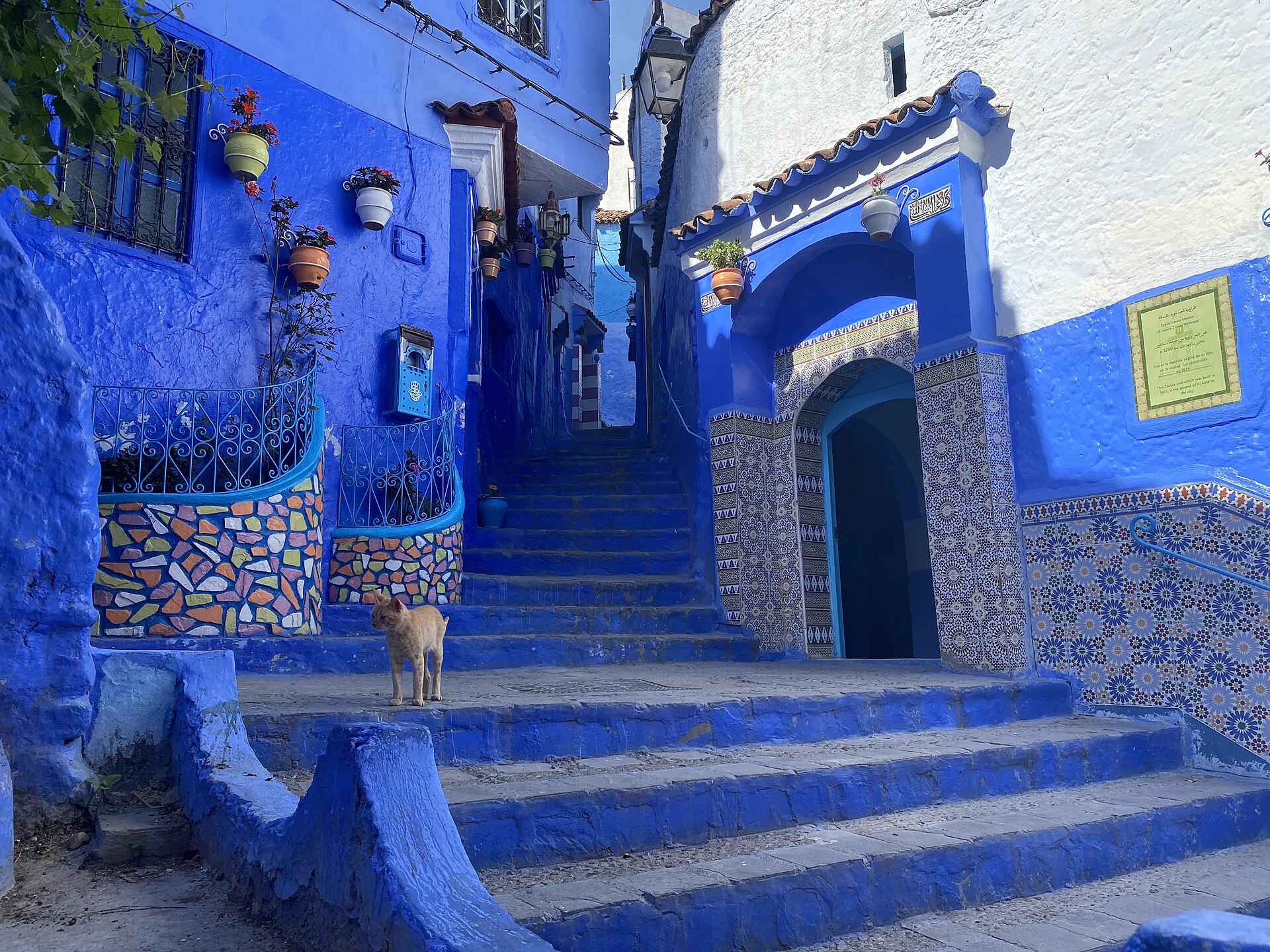
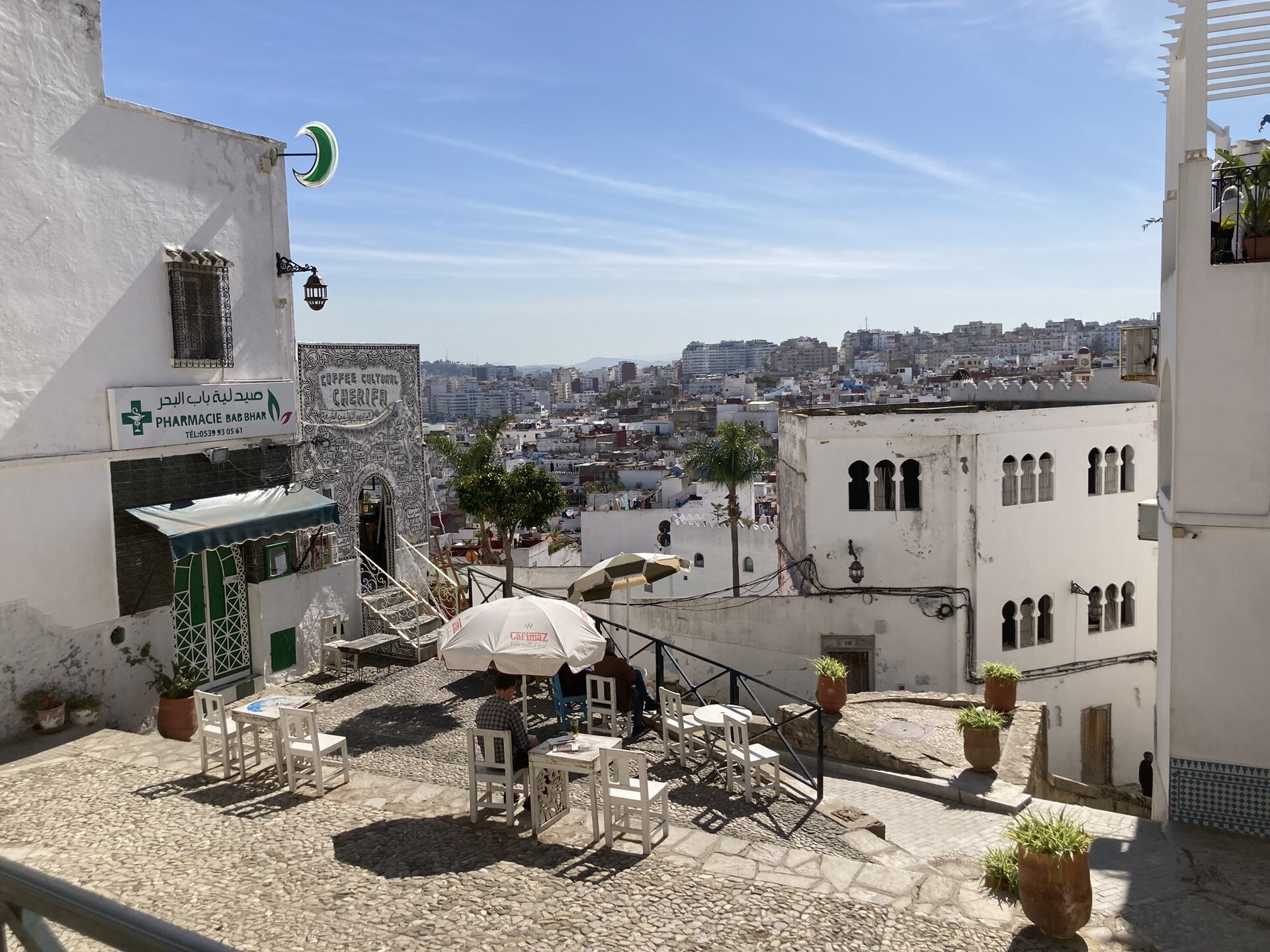
Six days in northern Morocco around the total solar eclipse of Monday 2 August 2027: three nights at the Fairmont Tazi Palace in Tangier, with nearly five minutes of totality from 08:45 local time, then two nights at Lina Ryad & Spa in Chefchaouen, via the Tetouan medina.
from 780 € per person
Price collected on 14 October 2026. Based on 2 adults, Saturday 31 July to Thursday 5 August 2027, listed hotels and activities; international flights, transfers and the Tangier – Chefchaouen drive not included. Indicative price, taxes included, to be confirmed with your request.
Itinerary
- Days 1–4 Tangier, with the eclipse on Monday 2 August · 3 nights — Fairmont Tazi Palace Tangier
- Days 4–6 Chefchaouen, via Tetouan · 2 nights — Lina Ryad & Spa
Activities included in the indicative price
- Cape Spartel, Caves of Hercules and Asilah (day trip) · 49 € per person
Public price collected on: Civitatis — accessed 14 October 2026
- Guided tour of Tangier (3 h) · 19 € per person
Public price collected on: Civitatis — accessed 14 October 2026
- Guided tour of Chefchaouen (2 h) · 20 € per person
Public price collected on: Civitatis — accessed 14 October 2026
The morning of 2 August
On Monday 2 August 2027, the Moon's shadow crosses the Strait of Gibraltar and northern Morocco before racing on towards Egypt. Tangier lies in the path of totality, and it happens in the morning.
Here is the sequence in Tangier, in local time. Morocco has been on GMT (Greenwich Mean Time) all year round since 20 September 2026: in August, it is 2 hours behind Paris2 hours behind Brussels2 hours behind Geneva2 hours behind Luxembourg1 hour behind London1 hour behind Dublin2 hours behind Frankfurt2 hours behind Vienna2 hours behind Amsterdam2 hours behind Rome2 hours behind Madrid1 hour behind Lisbon2 hours behind Warsaw2 hours behind Prague2 hours behind Stockholm2 hours behind Copenhagen2 hours behind Oslo3 hours behind Helsinki.
- 07:40: the Moon starts to cut into the Sun's disc. This is the partial phase, lasting a little over an hour.
- Around 08:45: totality begins. The sky turns to twilight, the temperature drops, the solar corona appears.
- Around 08:47: maximum eclipse. Totality lasts about 4 min 50 s.
- 10:00: the partial phase ends.
The Sun is then nearly 38° above the horizon, high in the sky. There is no need to hunt for a clear horizon: the hotel garden or a terrace will do, as long as no building hides the Sun. Some apps and calculation sites still treat Morocco as UTC+1 (Coordinated Universal Time plus one hour) and show times an hour too late: rely on the times above.
Protecting your eyes. According to NASA (the US space agency), you may look at the Sun unprotected only during totality, when the Moon covers it completely; before and after, you need glasses meeting ISO 12312-2, the international standard for direct solar viewing filters. Put them back on as soon as the first flash of sunlight reappears. Binoculars, cameras and telescopes need their own solar filter, fitted to the front of the optics: eclipse glasses behind a lens are not enough. Children should watch under adult supervision. Throw away any scratched or damaged pair.
Six days around the eclipse
Saturday 31 July: arrival. Tangier-Ibn Battouta airport is about twenty minutes from the Fairmont Tazi Palace, a 1926 palace in a 3.6-hectare park on Boubana hill. The outdoor pool, open from April to October, makes for a quiet first evening.
Sunday 1 August: Tangier. The 3-hour guided tour listed in this itinerary runs from the Grand Socco to the Mendoubia gardens, then through the medina to the kasbah, where the former sultan's palace houses a museum of Moroccan arts. In the afternoon, pick your viewing spot and get glasses and camera gear ready. Go to bed early.
Monday 2 August: the eclipse. Settle in around 07:30 local time, before first contact. Once the eclipse ends, at 10:00, the rest of the day is free. The day trip listed in this itinerary, to Cape Spartel, the Caves of Hercules and Asilah, can go here, or on Sunday if you prefer a quiet Monday.
Tuesday 3 August: Tetouan, then Chefchaouen. Tangier to Tetouan is about 1 h 20 by road. The Tetouan medina, inscribed on the World Heritage List of UNESCO (the United Nations Educational, Scientific and Cultural Organization) in 1997, is ringed by walls about 5 km long with seven gates; UNESCO describes it as one of the smallest medinas in Morocco, and the most complete. Next to it, the Ensanche, the Spanish protectorate town, is easy on foot. Then about 1 h 30 by road to Chefchaouen. Cars cannot reach Lina Ryad & Spa: let the house know so they can collect your bags at the edge of the medina.
Wednesday 4 August: Chefchaouen. In the morning, the 2-hour guided tour listed in this itinerary: Bab el Ain, Outa el Hammam square, the kasbah and its museum, Ras el Ma. In August, start early: the alleys are calmer before the day-trippers arrive. For a walk, the Akchour waterfalls and God's Bridge, a natural arch in Talassemtane National Park, are about 50 minutes away by road. Late in the day, the riad's spa, with its hammam and heated indoor pool, open from 12:00 to 21:00 local time.
Thursday 5 August: departure. Chefchaouen to Tangier airport, 112 km, a little over two hours by road.
For these drives, Sabaro recommends a car with driver. In the Rif, it is best to avoid secondary roads at night and not to stop there during the day; the Al Hoceima–Chefchaouen–Tetouan route poses fewer problems.
Foreign ministries do not all give the same advice. Your country's advice:
| Country | Official advice | Source |
|---|---|---|
| France | Heightened vigilance in Western Sahara and along the southern border with Algeria. In Western Sahara, any route leaving the paved coastal road requires prior approval from the Royal Gendarmerie or the Royal Armed Forces; do not drive the coastal road towards Mauritania at night, and travel along the Mauritanian border is strongly advised against. In the Rif, a hashish-producing and trafficking region, particular caution: at night, avoid secondary roads; by day, do not stop; the Al Hoceima-Chefchaouen-Tetouan road poses fewer problems. South-east of Guelmim province, some areas are still mined: report to the gendarmerie or the caid before taking an unpaved track by 4x4 or motorbike. Vigilance in places where crowds gather, extra vigilance in large cities such as Marrakesh, where bag snatching from motorbikes is reported; use official taxis where possible. Driving advised against for inexperienced drivers and at night; heavy and dangerous traffic on several national roads, including Casablanca-Marrakesh, and the Marrakesh-Agadir mountain motorway is very dangerous. | France Diplomatie, Conseils aux voyageurs, Maroc, sécurité (Site last updated 15 September 2026) |
| Netherlands | Yellow for most of the country: specific security risks. Red, do not travel: the border area between Morocco and Mauritania (regular violent incidents, landmines and unexploded ordnance). Orange, essential travel only: the border area with Algeria, a military zone; the border has been closed since 1994. In Western Sahara, landmines and unexploded ordnance: stay on the main coastal road between Laayoune and Dakhla. Risk of terrorist attacks; pickpocketing and theft throughout the country, especially in crowded and tourist areas; demonstrations possible in the larger cities. Forest fires possible during drought and heat. | Nederland Wereldwijd (ministère néerlandais des Affaires étrangères), Reisadvies Marokko (Site last updated 30 July 2026) |
| Belgium | Not checked by Sabaro: see diplomatie.belgium.be | |
| Switzerland | Not checked by Sabaro: see DFAE (eda.admin.ch) | |
| Luxembourg | Not checked by Sabaro: see mae.gouvernement.lu | |
| United Kingdom | Not checked by Sabaro: see GOV.UK (FCDO) | |
| Ireland | Not checked by Sabaro: see ireland.ie (DFA) | |
| Germany | Not checked by Sabaro: see Auswärtiges Amt | |
| Sweden | Not checked by Sabaro: see Regeringen (UD) | |
| Denmark | Not checked by Sabaro: see Udenrigsministeriet (um.dk) | |
| Norway | Not checked by Sabaro: see Regjeringen | |
| Poland | Not checked by Sabaro: see Odyseusz (MSZ) | |
| Czechia | Not checked by Sabaro: see MZV ČR | |
| Austria | Not checked by Sabaro: see BMEIA | |
| Italy | Not checked by Sabaro: see Viaggiare Sicuri | |
| Spain | Not checked by Sabaro: see exteriores.gob.es | |
| Portugal | Not checked by Sabaro: see Portal das Comunidades | |
| Finland | Not checked by Sabaro: see Ulkoministeriö (um.fi) | |
Why Tangier
The whole region of this trip lies within the path of totality, but its length varies from town to town:
- Tangier: about 4 min 50 s;
- Tetouan: about 4 min 55 s;
- Asilah: about 4 min 49 s;
- Chefchaouen: a little over 4 minutes;
- Tarifa, on the Spanish coast opposite: about 4 min 41 s.
Fez, further south, is outside the path and will only see a partial eclipse. Tangier and Tetouan have the longest totality in the region, within a second of each other; Tangier adds the widest choice of hotels, an airport and the Al Boraq high-speed train station. Sleeping on site the night before means no driving on eclipse morning.
August in the north
Early August is peak season in Morocco and Spain alike, and rooms within the path of totality will go early: Sabaro recommends booking now, and Chefchaouen has few places to stay. The coastal climate remains bearable: according to the 1991–2020 normals of the WMO (World Meteorological Organization) for the Tetouan station, the average maximum in July and August is 30 °C, and there is almost no rain from June to August.
For a beach day, Tamuda Bay, about thirty minutes from Tetouan, has 15 km of sand on the Mediterranean. It fits on Tuesday, between Tetouan and Chefchaouen, if you shorten your medina visit.
Variations
- Come from Spain. Ferries link Tarifa with Tangier Ville port in about an hour: you can combine Andalusia and northern Morocco.
- Extend to Fez. Chefchaouen to Fez is 194 km, about 3 h 24 by road; Fez deserves three days.
- The other eclipse. The same eclipse lasts about 6 min 20 s in Egypt, near Luxor, around 13:05 local time: you have to choose one country for 2 August, and Sabaro offers an itinerary for each.
Read next
Frequently asked questions
What time is the total eclipse in Tangier?
On Monday 2 August 2027, totality begins around 08:45 local time and lasts about 4 min 50 s, with maximum around 08:47. The partial phase runs from 07:40 to 10:00.
Can I look at the eclipse without protection?
Only during totality. Before and after, you need glasses meeting ISO 12312-2, and a solar filter on the front of any optics, according to NASA.
Do I need a special viewing spot?
No: the Sun is nearly 38° above the horizon. A terrace, a garden or a wide street will do, as long as no building blocks it.
Is this trip suitable for children?
Yes, with child-size eclipse glasses and adult supervision. Drives are short, and the Fairmont Tazi Palace has connecting rooms and a kids' club in summer.
Is the total eclipse visible from Chefchaouen?
Yes, the town is within the path, but totality there lasts a little over 4 minutes. This trip plans to watch it in Tangier, where it lasts nearly five minutes.
A travel advisor replies by email. Free, no commitment.