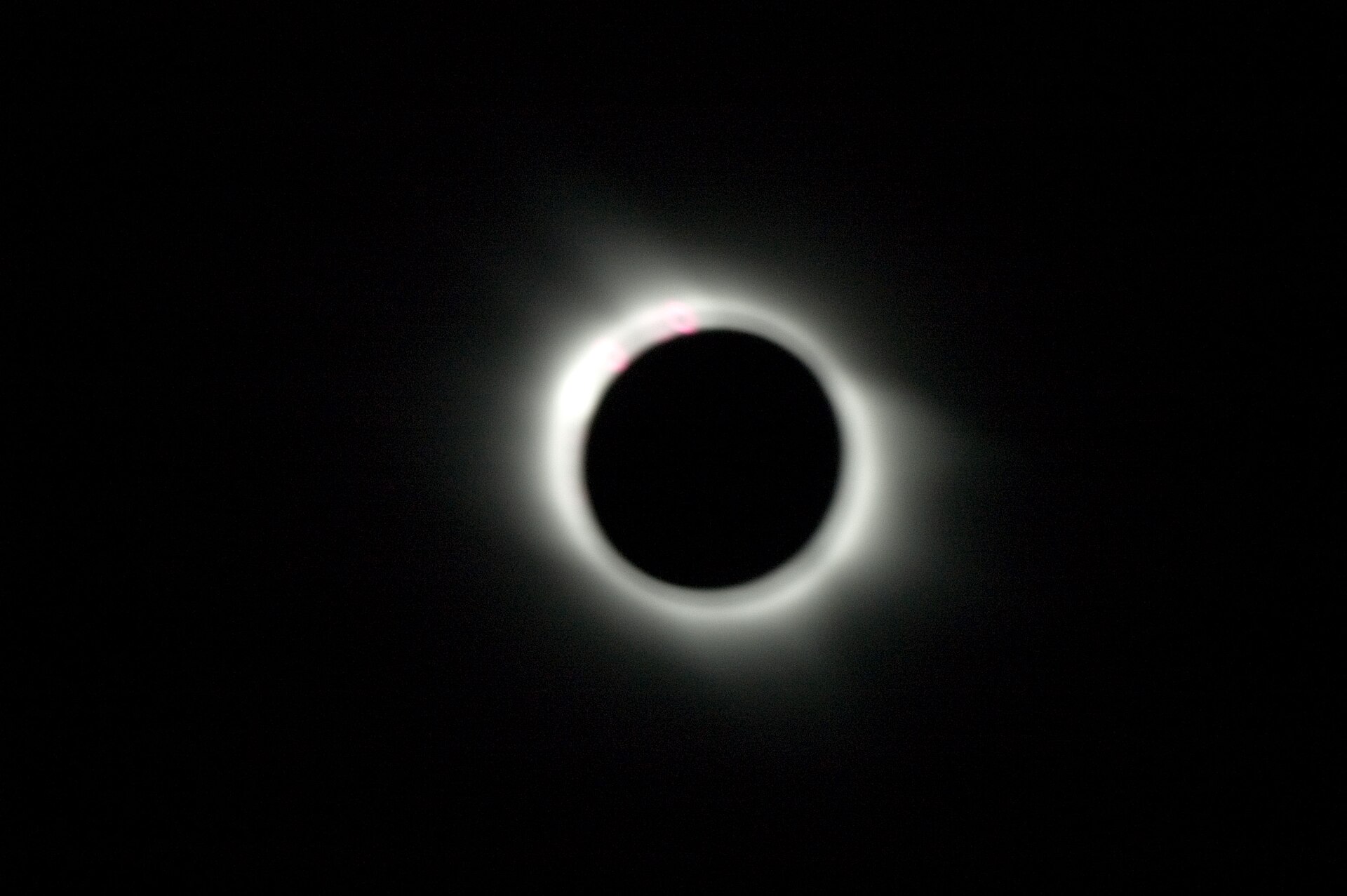
Watching the 2 August 2027 eclipse: where, when and safely
The total eclipse of 2 August 2027 crosses northern Morocco and Egypt. In Luxor, totality lasts about 6 min 20 s, peaking at about 13:05 local time; in Tangier, about 4 min 50 s, peaking at about 8:47 local time.
Checked on 14 October 2026
The eclipse at a glance
A total solar eclipse occurs on 2 August 2027. According to NASA (the US space agency), totality lasts up to 6 min 23 s. Greatest eclipse is at 10:06:34 UT (Universal Time) near Luxor, i.e. 13:06 local time. The path of totality is 257.7 km wide.
Across the Earth, according to EclipseWise, the calculation site of Fred Espenak, a former NASA astrophysicist:
| Phase | Universal Time |
|---|---|
| Partial eclipse begins | 07:30 |
| Moon's shadow touches the Earth, totality begins | 08:23 |
| Shadow near the Strait of Gibraltar | about 08:46 |
| Shadow enters Egypt | about 09:42 |
| Shadow over Luxor | about 10:05 |
| Shadow leaves the Earth, totality ends | 11:50 |
| Partial eclipse ends | 12:43 |
Luxor and Tangier: times
| Luxor (Egypt) | Tangier (Morocco) | |
|---|---|---|
| Partial eclipse, local time | 11:40 to 14:26 | 7:40 to 10:00 |
| Maximum, local time | 13:05 | 8:47 |
| Totality | about 6 min 20 s | about 4 min 50 s |
| Sun altitude | 81.8° | 37.9° |
In Luxor, totality runs from about 13:02 to 13:08 local time.
Time zones on 2 August 2027. Egypt is on summer time (UTC+3): 1 hour ahead of Paris1 hour ahead of Brussels1 hour ahead of Geneva1 hour ahead of Luxembourg2 hours ahead of London2 hours ahead of Dublin1 hour ahead of Frankfurt1 hour ahead of Vienna1 hour ahead of Amsterdam1 hour ahead of Rome1 hour ahead of Madrid2 hours ahead of Lisbon1 hour ahead of Warsaw1 hour ahead of Prague1 hour ahead of Stockholm1 hour ahead of Copenhagen1 hour ahead of Oslothe same time as Helsinki. Morocco has been on GMT all year since 20 September 2026 (decree no. 2.26.530, Official Bulletin no. 7521 of 29 June 2026): 2 hours behind Paris2 hours behind Brussels2 hours behind Geneva2 hours behind Luxembourg1 hour behind London1 hour behind Dublin2 hours behind Frankfurt2 hours behind Vienna2 hours behind Amsterdam2 hours behind Rome2 hours behind Madrid1 hour behind Lisbon2 hours behind Warsaw2 hours behind Prague2 hours behind Stockholm2 hours behind Copenhagen2 hours behind Oslo3 hours behind Helsinki. Some calculation sites still count Morocco as UTC+1 and show 9:47 at maximum in Tangier; the correct local time is 8:47.
Where totality is longest
According to EclipseWise, the longest totality, 6 min 23.24 s, occurs at 10:00:21 UT (13:00 local time) in the desert west of the Nile (26°48.8' N, 31°08.0' E). At the point of greatest eclipse, south-east of Luxor (25°30.2' N, 33°11.0' E), totality lasts 6 min 22.64 s.
On the day
- In Luxor, the Sun is almost overhead, 81.8° above the horizon: you watch with your head tilted back, and a lounger or a mat on the ground makes the six minutes more comfortable. The partial phase lasts almost three hours, at the height of an August midday: shade, water and a hat for the wait.
- In Tangier, the eclipse happens early in the morning, with the Sun at 37.9° towards the east: pick a viewpoint open on that side, a terrace or the seafront, scouted the day before.
- Everywhere, settle in before the partial phase begins, and set up your camera and filter in advance: totality goes by quickly.
Protecting your eyes
NASA guidance:
- Outside totality, look at the Sun only through eclipse glasses or a handheld viewer meeting ISO 12312-2 (the international standard for direct solar viewing filters).
- Sunglasses are not safe, however dark.
- Remove your glasses only during totality, and put them back as soon as the Sun reappears.
- A camera, binoculars or telescope need a solar filter fitted to the front of the optics; eclipse glasses are not enough behind these instruments.
- During the partial phases: sunscreen, a hat and covering clothes.
Read next
Frequently asked questions
At what time is the total eclipse visible in Luxor and Tangier?
In Luxor, maximum is at about 13:05 local time, with totality of about 6 min 20 s. In Tangier, at about 8:47 local time, with about 4 min 50 s. On the day, Egypt is 1 hour ahead of Paris1 hour ahead of Brussels1 hour ahead of Geneva1 hour ahead of Luxembourg2 hours ahead of London2 hours ahead of Dublin1 hour ahead of Frankfurt1 hour ahead of Vienna1 hour ahead of Amsterdam1 hour ahead of Rome1 hour ahead of Madrid2 hours ahead of Lisbon1 hour ahead of Warsaw1 hour ahead of Prague1 hour ahead of Stockholm1 hour ahead of Copenhagen1 hour ahead of Oslothe same time as Helsinki and Morocco 2 hours behind Paris2 hours behind Brussels2 hours behind Geneva2 hours behind Luxembourg1 hour behind London1 hour behind Dublin2 hours behind Frankfurt2 hours behind Vienna2 hours behind Amsterdam2 hours behind Rome2 hours behind Madrid1 hour behind Lisbon2 hours behind Warsaw2 hours behind Prague2 hours behind Stockholm2 hours behind Copenhagen2 hours behind Oslo3 hours behind Helsinki.
Are special glasses needed during totality?
ISO 12312-2 glasses are essential during the partial phases. You can remove them only during totality, when the Sun's disc is fully covered, and put them back as soon as the Sun reappears.
Where is totality longest?
In the Egyptian desert west of the Nile (26°48.8' N, 31°08.0' E): 6 min 23 s. Luxor, near the centre line, is within a few seconds of it.
What time will it be in Morocco on eclipse day?
GMT, 2 hours behind Paris2 hours behind Brussels2 hours behind Geneva2 hours behind Luxembourg1 hour behind London1 hour behind Dublin2 hours behind Frankfurt2 hours behind Vienna2 hours behind Amsterdam2 hours behind Rome2 hours behind Madrid1 hour behind Lisbon2 hours behind Warsaw2 hours behind Prague2 hours behind Stockholm2 hours behind Copenhagen2 hours behind Oslo3 hours behind Helsinki. Some calculation sites still show Morocco's former time (UTC+1): take one hour off their local times.
Official sources
- NASA Goddard Space Flight Center : Solar Eclipse Search Engine, 2027 Aug 02 (accessed 14 October 2026)
- EclipseWise : Total Solar Eclipse of 2027 Aug 02 (accessed 14 October 2026)
- eclipse-solaire.fr : éclipse du 2 août 2027 à Louxor (accessed 14 October 2026)
- eclipse-solaire.fr : éclipse du 2 août 2027 à Tanger (accessed 14 October 2026)
- Classic Holidays : solar eclipse 2027 Egypt times (accessed 14 October 2026)
- Finances News Hebdo : le Maroc repasse définitivement à l'heure GMT (18 septembre 2026) (accessed 14 October 2026)
- Moonblink : Total Solar Eclipse 2027 August 02 (accessed 14 October 2026)
- NASA Science : Eclipse Safety (accessed 14 October 2026)
A travel advisor replies by email. Free, no commitment.