Tan-Tan Moussem
Tan-Tan
The Tan-Tan Moussem, a gathering of the nomadic tribes of southern Morocco on UNESCO's intangible cultural heritage list, held its 19th edition from 30 October to 3 November 2026, with tribal tents, camel races, tbourida and Hassani poetry.
Dates
Last edition: 30 October 2026 – 3 November 2026. The dates of the next edition have not been announced yet.
Source: Le Matin — accessed 11 October 2026
The nomads' gathering
Tan-Tan is a town in southern Morocco, at the gateway to the Sahara, between the desert and the Atlantic. The Oued Noun region was long a meeting place between oasis dwellers and nomads. The moussem grew out of this: originally a festival around the shrine of Sheikh Mohamed Laghdaf, patron saint of the gathering, and a great market where nomads sold their wool and bought grain, dates and manufactured goods.
Today the moussem brings together some thirty tribes, each under its own tent. When UNESCO (the United Nations Educational, Scientific and Cultural Organization) inscribed it, 34 were counted in the region, with ties reaching as far as the Sahel. UNESCO proclaimed it a Masterpiece of the Oral and Intangible Heritage of Humanity in 2005, then inscribed it in 2008 on the Representative List of the Intangible Cultural Heritage. First held in 1963, the moussem was interrupted from 1979 to 2004 for security reasons. Urbanisation and settlement threaten the passing on of nomadic knowledge: the moussem also serves to keep it alive.
What you see there
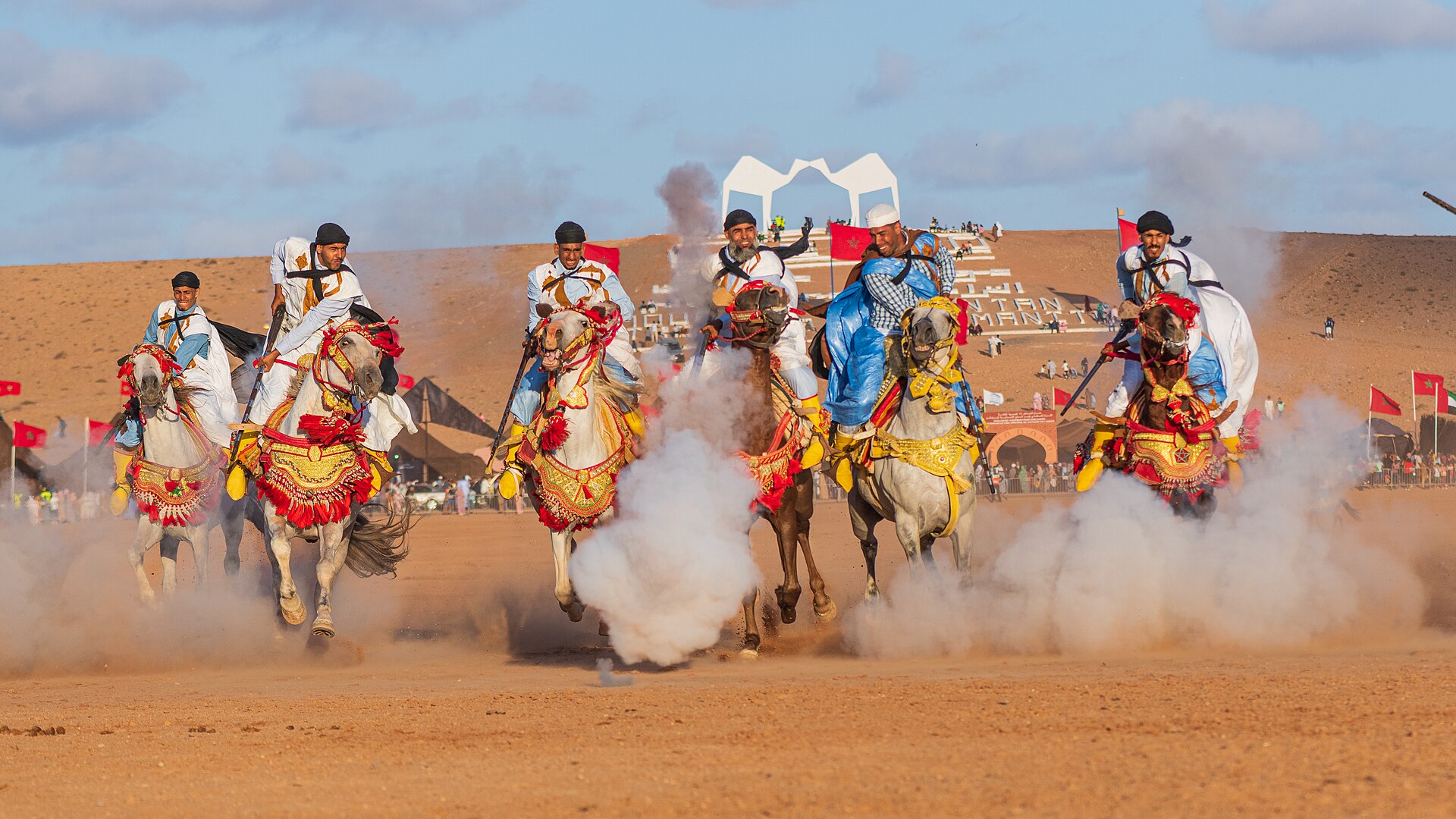
Themed tents show the daily life of the nomads: the khaima, the Sahrawi tent, the tea ceremony, women's crafts, herding. Around them, the 2026 programme included:
- camel races and parades of méharistes, riders on dromedaries;
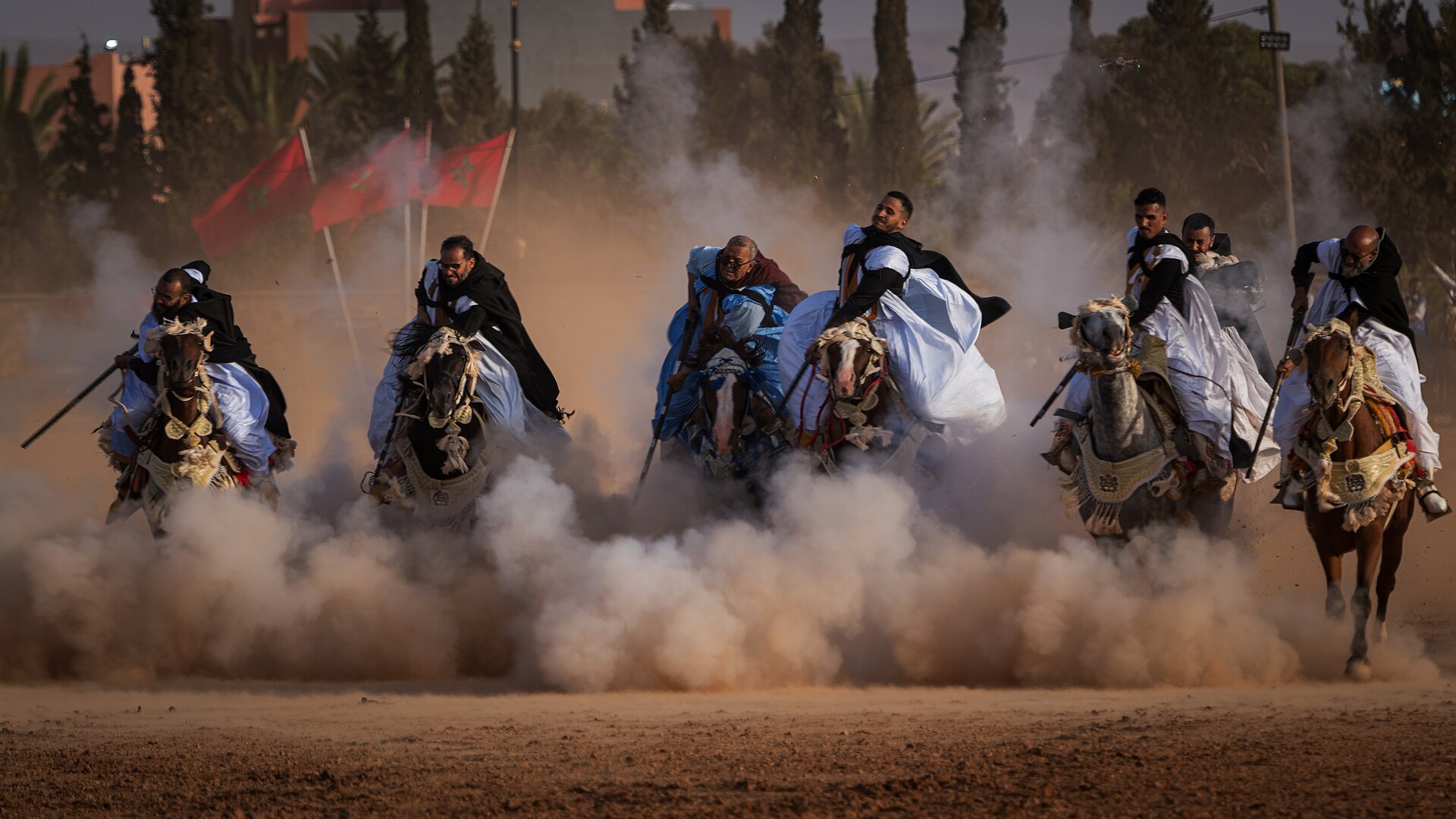
- tbourida, a charge of horsemen who fire a single volley of powder together;
- traditional games and tribal gatherings;
- concerts in Tan-Tan and in El Ouatia, on the coast, with Moroccan and international artists;
- Hassani poetry, in Hassaniya, the spoken Arabic of the Sahrawi peoples, which closes the moussem.
The 2026 edition was organised by the Almouggar Foundation, under the high patronage of King Mohammed VI, with the United Arab Emirates as partner country.
Highlights of the 2026 edition
On Friday 30 October, the moussem opened with the traditional religious ceremony at the zawiya (brotherhood and shrine) of Sheikh Mohammed Laghdaf Ma El Ainin. Saturday 31 October was Unity Day, a public holiday created in 2025 and celebrated for the first time in 2026: official guests and delegations paraded before tableaux of Sahrawi heritage, with a grand parade of several hundred participants. On Tuesday 3 November, an evening of poetry closed the five days.
Getting there and planning
Tan-Tan is on the N1 national road, which runs along the southern Atlantic coast, south of Guelmim. International flights land in Agadir; Tan-Tan has an airport served by domestic flights. The Sabaro selection does not yet include a hotel in Tan-Tan: Sabaro recommends combining the moussem with the coast of Sidi Ifni and Mirleft, further north, or with Agadir, with a driver for the journeys.
On safety, some areas south-east of Guelmim province are still mined: before taking an unpaved track by 4x4 or motorbike, you must report to the gendarmerie or the caid, the local authority. Foreign ministries do not all give the same advice. Your country's advice:
| Country | Official advice | Source |
|---|---|---|
| France | Heightened vigilance in Western Sahara and along the southern border with Algeria. In Western Sahara, any route leaving the paved coastal road requires prior approval from the Royal Gendarmerie or the Royal Armed Forces; do not drive the coastal road towards Mauritania at night, and travel along the Mauritanian border is strongly advised against. In the Rif, a hashish-producing and trafficking region, particular caution: at night, avoid secondary roads; by day, do not stop; the Al Hoceima-Chefchaouen-Tetouan road poses fewer problems. South-east of Guelmim province, some areas are still mined: report to the gendarmerie or the caid before taking an unpaved track by 4x4 or motorbike. Vigilance in places where crowds gather, extra vigilance in large cities such as Marrakesh, where bag snatching from motorbikes is reported; use official taxis where possible. Driving advised against for inexperienced drivers and at night; heavy and dangerous traffic on several national roads, including Casablanca-Marrakesh, and the Marrakesh-Agadir mountain motorway is very dangerous. | France Diplomatie, Conseils aux voyageurs, Maroc, sécurité (Site last updated 15 September 2026) |
| Netherlands | Yellow for most of the country: specific security risks. Red, do not travel: the border area between Morocco and Mauritania (regular violent incidents, landmines and unexploded ordnance). Orange, essential travel only: the border area with Algeria, a military zone; the border has been closed since 1994. In Western Sahara, landmines and unexploded ordnance: stay on the main coastal road between Laayoune and Dakhla. Risk of terrorist attacks; pickpocketing and theft throughout the country, especially in crowded and tourist areas; demonstrations possible in the larger cities. Forest fires possible during drought and heat. | Nederland Wereldwijd (ministère néerlandais des Affaires étrangères), Reisadvies Marokko (Site last updated 30 July 2026) |
| Belgium | Not checked by Sabaro: see diplomatie.belgium.be | |
| Switzerland | Not checked by Sabaro: see DFAE (eda.admin.ch) | |
| Luxembourg | Not checked by Sabaro: see mae.gouvernement.lu | |
| United Kingdom | Not checked by Sabaro: see GOV.UK (FCDO) | |
| Ireland | Not checked by Sabaro: see ireland.ie (DFA) | |
| Germany | Not checked by Sabaro: see Auswärtiges Amt | |
| Sweden | Not checked by Sabaro: see Regeringen (UD) | |
| Denmark | Not checked by Sabaro: see Udenrigsministeriet (um.dk) | |
| Norway | Not checked by Sabaro: see Regjeringen | |
| Poland | Not checked by Sabaro: see Odyseusz (MSZ) | |
| Czechia | Not checked by Sabaro: see MZV ČR | |
| Austria | Not checked by Sabaro: see BMEIA | |
| Italy | Not checked by Sabaro: see Viaggiare Sicuri | |
| Spain | Not checked by Sabaro: see exteriores.gob.es | |
| Portugal | Not checked by Sabaro: see Portal das Comunidades | |
| Finland | Not checked by Sabaro: see Ulkoministeriö (um.fi) | |
Frequently asked questions
When was the 2026 Tan-Tan Moussem?
From Friday 30 October to Tuesday 3 November 2026, for the 19th edition. Saturday 31 October, Unity Day, was the main official day.
Why is the Tan-Tan Moussem listed by UNESCO?
Because it gathers the nomadic tribes of southern Morocco every year and keeps their knowledge alive: the tent, Hassani poetry, herding, crafts. Proclaimed a Masterpiece of the Oral and Intangible Heritage in 2005, it has been on the Representative List of the Intangible Cultural Heritage of Humanity since 2008.
What can you see at the Tan-Tan Moussem?
The tribal tents, camel races, tbourida, parades of camel riders, evening concerts and, to close, the evening of Hassani poetry.
Where to stay for the Tan-Tan Moussem?
The Sabaro selection does not yet include a hotel in Tan-Tan. Sabaro recommends combining the moussem with the coast of Sidi Ifni and Mirleft, or with Agadir, where international flights arrive.